
Log in or create a free Rosenverse account to watch this video.
Log in Create free account100s of community videos are available to free members. Conference talks are generally available to Gold members.
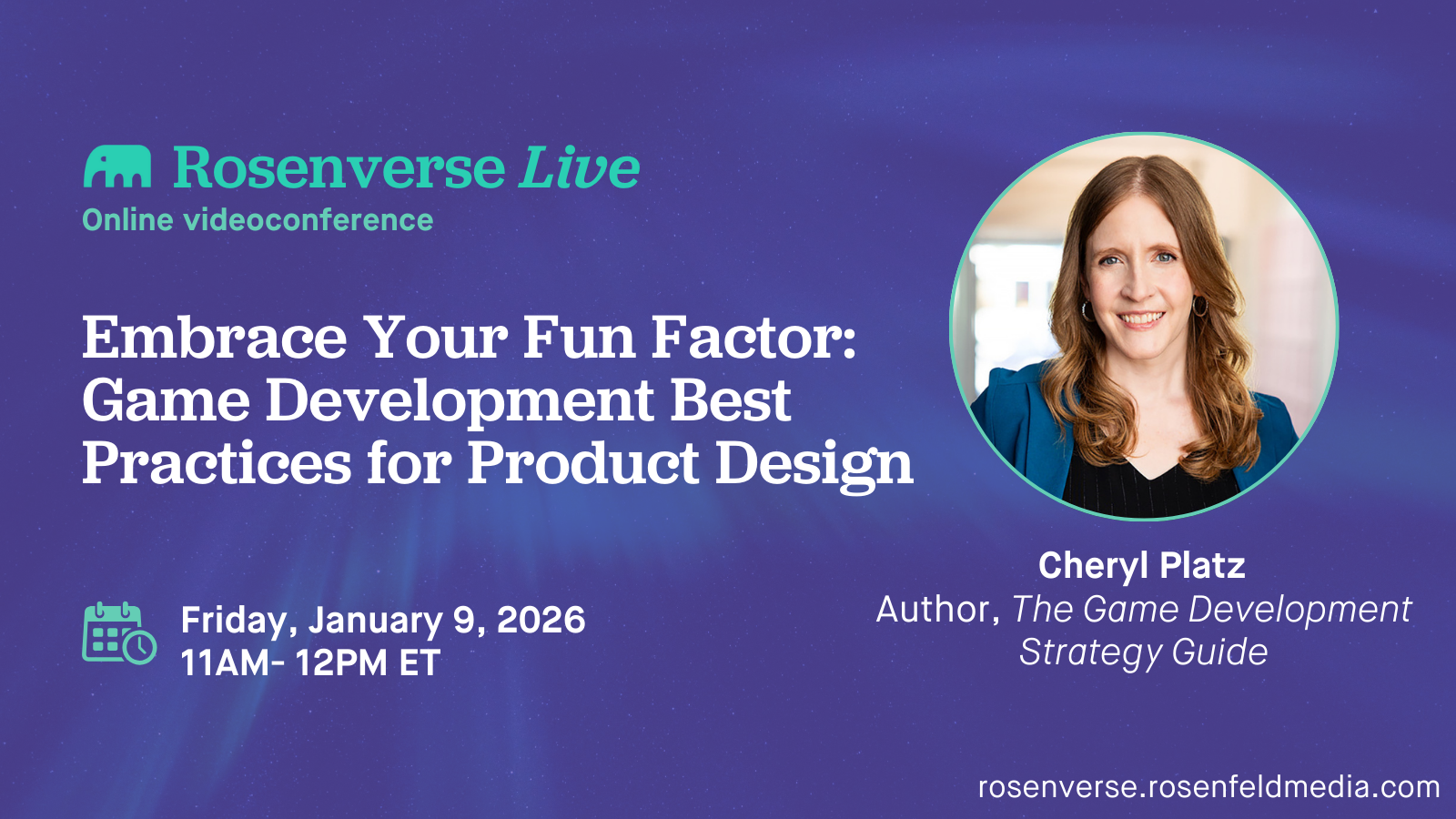
Embrace Your Fun Factor: Game Development Best Practices for Product Design
This video is featured in the UX Watch Party playlist.

Summary
In this session, author Cheryl Platz shares her insights as a missing link between the two worlds. She’s worked as design lead for Microsoft’s Azure platform, but she’s also served as UX Director for Riot Games and Scopely’s MARVEL Strike Force in addition to her continuing role as adjunct faculty of video games for Carnegie Mellon University’s Masters of Entertainment Industry Management program.
You'll learn about some of the most universally applicable insights from her new Rosenfeld book The Game Development Strategy Guide: Crafting Modern Video Games That Thrive, including the Motivators of Play – a tool for understanding player and customer behavior backed by cognitive psychology and industry research that reveals how expectations have changed deeply in the past decade. You’ll also be introduced to useful concepts around monetization, emergent behavior, and designing for positive large-scale interactions. Isn’t it time to level up your product design skills with a new skill tree?
Key Insights
-
•
71% of people self-identify as gamers, making game design principles widely relevant.
-
•
Classic motivators of play include mastery, competition, immersion, meditation, and comfort.
-
•
Modern motivators like self-expression, companionship, and education have risen due to technological and social changes.
-
•
Competitiveness as a motivator has diminished, replaced increasingly by a desire for companionship and collaboration.
-
•
Misapplied gamification, such as meaningless badges or incentivizing harmful behaviors, can demotivate users.
-
•
Game loops help understand and optimize user engagement by linking sequential player actions with feedback.
-
•
Pro-social design focuses on fostering positive social interactions and community safety, a key challenge at scale.
-
•
Ethical monetization varies; pay-to-express models (cosmetics) are less harmful than pay-to-win (pay-for-power) schemes.
-
•
Duolingo exemplifies both strengths (mastery challenges) and pitfalls (manipulative nudges, declining immersion) in gamified products.
-
•
Understanding and designing for motivators can transform traditionally 'non-fun' domains like banking, healthcare, and enterprise software.
Notable Quotes
"If 71% of people self-identify as gamers, why aren’t you learning from the video game industry?"
"Is gamification just last decade’s fad or have the principles become so ubiquitous we stopped calling it that?"
"With great power comes great responsibility; we shouldn’t abandon using motivation techniques, or others will use them poorly."
"Competitiveness doesn’t motivate play as much as it used to; companionship and collaboration are more motivating now."
"Mastery is a core human motivator; people want to understand and feel competent in what they do."
"Pro-social gaming is about designing for positive social interactions that contribute to thriving communities."
"Not all monetization is equal; pay-to-express models are less threatening to social dynamics than pay-for-power schemes."
"Duolingo’s AI push damaged immersion by breaking narrative cohesion and lowering course quality."
"The Echo Look failed because it missed key motivators like self-expression and companionship by focusing too much on AI."
"Designing for human motivation makes experiences more likely to thrive long term."
Or choose a question:















More Videos

"Are you creative? Such a loaded question, isn't it?"
Dr. Karl JeffriesThe Science of Creativity for DesignOps
January 8, 2024

"Investment is attention: If the business funds you, it means they believe in what you do."
Amy MarquezINVEST: Discussion
June 15, 2018

"The core of it is really putting yourself in that other person’s shoes—it’s basic but essential empathy."
Steve Portigal Chris Chapo Kelly Goto Christian RohrerDiscussion
May 13, 2015

"One designer's security in a dedicated model may be another designer's stagnation."
Alicia MootyDesign Staffing Models
September 30, 2021

"I am not throwing away your UX."
Ana Maria Montero Barrantes Aditi Dhar Michelle Kaplan Nate Osborne Matt LaurenceThe Authentic UX Talent Show
January 8, 2024

"We can’t complain about not having a seat at the table if we don’t offer one of our own."
Lada Gorlenko Sharbani Dhar Sébastien Malo Rob Mitzel Ivana Ng Michal Anne RogondinoTheme 1: Discussion
January 8, 2024

"I didn’t want to be part of that as a founder, hacking attention just to fulfill engagement metrics."
Sofia QuinteroThe Product Philosophy Behind EnjoyHQ
March 10, 2021

"If you think innovation can happen without buy-in from the CEO, I would love to see that; I have not seen it work."
Laura KleinUnique challenges of innovation in enterprises
April 23, 2020

"Combining the what we see in data with the why we get from user research is where true insights live."
Andrew MichaelBuilding a Product Insights Team
March 10, 2022













