Log in or create a free Rosenverse account to watch this video.
Log in Create free account100s of community videos are available to free members. Conference talks are generally available to Gold members.
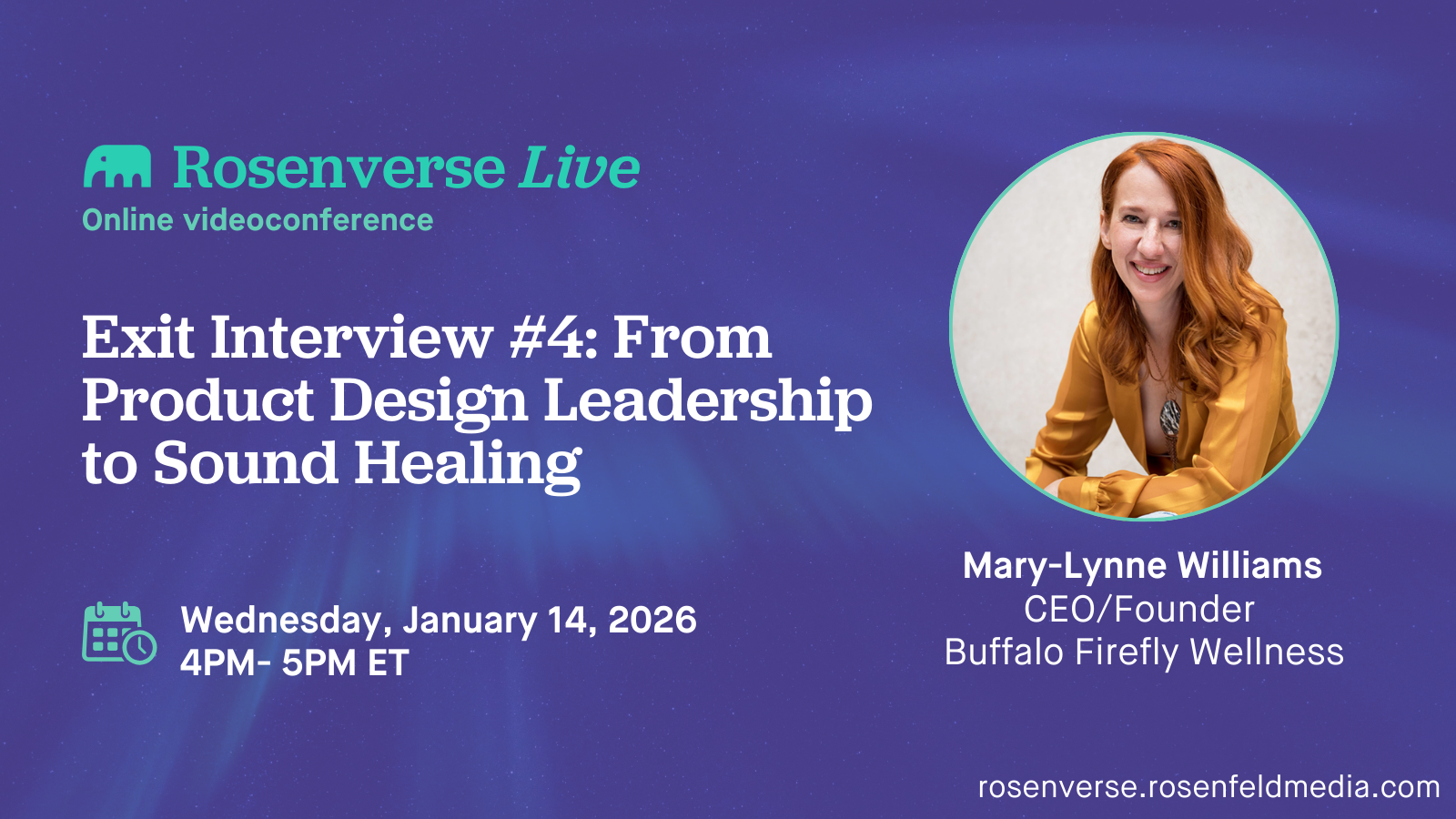
Exit Interview #4: From Product Design Leadership to Sound Healing
This video is featured in the Learning playlist and 1 more.

Summary
Her story is not about leaving ambition behind, but about redefining success—trusting discernment, and choosing work that feels sustainable not just intellectually, but physically, emotionally, and spiritually as well.
Key Insights
-
•
Prolonged stress and undiagnosed illness were key factors prompting Mary Lynn's departure from UX leadership.
-
•
A retreat for women design leaders exposed Mary Lynn to energy healing, which catalyzed her career pivot.
-
•
Experience in leadership roles enriched Mary Lynn’s communication skills, aiding her transition to wellness coaching.
-
•
'Data-driven' design practices increasingly prioritize company goals over authentic user needs, diminishing job satisfaction.
-
•
Women leaders in tech often face pressure to conform to masculine behavioral norms, leading to a lack of mentorship and support.
-
•
Starting a wellness business required significant personal financial investment and lifestyle adaptation, including relocating to a smaller city.
-
•
Stepping away from UX design can heighten awareness of the impact of constant interface changes on users, especially older adults.
-
•
Imperfect, authentic content is gaining value in the age of AI-generated, overly polished digital experiences.
-
•
Career transitions can feel isolating as previous social networks shift, but new communities form in aligned interest areas.
-
•
Trusting intuition and taking oneself seriously are crucial pieces of advice for anyone considering leaving UX or tech for a new venture.
Notable Quotes
"What is it they say about death? It's not a door closing, it's a door opening."
"I couldn't be as good at this job if I hadn’t been in those leadership roles."
"I walked into the building and it just felt surreal. It didn’t feel right in my body to be there anymore."
"I wanted to be in a place where I was making people feel better, not worse."
"There was an expectation for you to behave like a man, but when you do, you're criticized for being aggressive."
"Decisions based on clicks can be detrimental to the user because they favor company goals, not user needs."
"The universe will absolutely provide if it’s the right thing for you."
"I put most of my retirement savings into making this happen because I didn’t think I was going to survive otherwise."
"The sloppier you are, the more real you’re looking in the age of AI content."
"Meditation isn’t about stopping thinking, it’s about becoming aware of thinking."
Or choose a question:
















More Videos

"Hiring designers in non-design functions spreads headcount across sponsors so if one area faces cuts, the whole team doesn’t suffer."
Silke Bochat5 Antifragile Strategies for a DesignOps 2.0
September 23, 2024

"Draw your ideas, draw your ideas — it unlocked a skill I never thought I had and made my ideas have more traction."
Mujtaba HameedFrameworks for Excellence: Using Visual Thinking and Communication to Elevate Your Research
March 26, 2024

"Networking isn't just knowing people, it's about staying in warm connection with people over time."
Louis RosenfeldCoffee with Lou
January 11, 2024

"Managing resistance is mental; customers might resist because they've learned workarounds with legacy systems."
Malini RaoLessons Learned from a 4-year Product Re-platforming Journey
June 9, 2021

"Don't just flip the switch and say go talk to customers; you have to set guardrails and train people."
Janelle EstesUX Research Trends
January 28, 2021

"If you’re recruiting for research projects, look critically at your job descriptions for embedded barriers to diverse candidates."
Joi FreemanA New Vantage Point: Building a Pipeline for Multifaceted Research(ers)
March 30, 2020

"Middle management likes things the way they are and are very risk averse, which can be a big obstacle."
Catherine CourageThe Enterprise UX Journey: Lessons From the Voyage & The Opportunity Ahead
May 13, 2015

"Design ops really is the story of design’s role within the business at MailChimp."
Jacqui FreyFlow and Superfluidity for Design Orgs
November 7, 2018

"Sometimes you just have to plant a flag and say this is what we can do, even if the math and boundaries are complicated."
Victor Lombardi Ted Booth HK Dunston Andrew OtwellBridging Design and Climate Science
February 14, 2024