
Log in or create a free Rosenverse account to watch this video.
Log in Create free account100s of community videos are available to free members. Conference talks are generally available to Gold members.
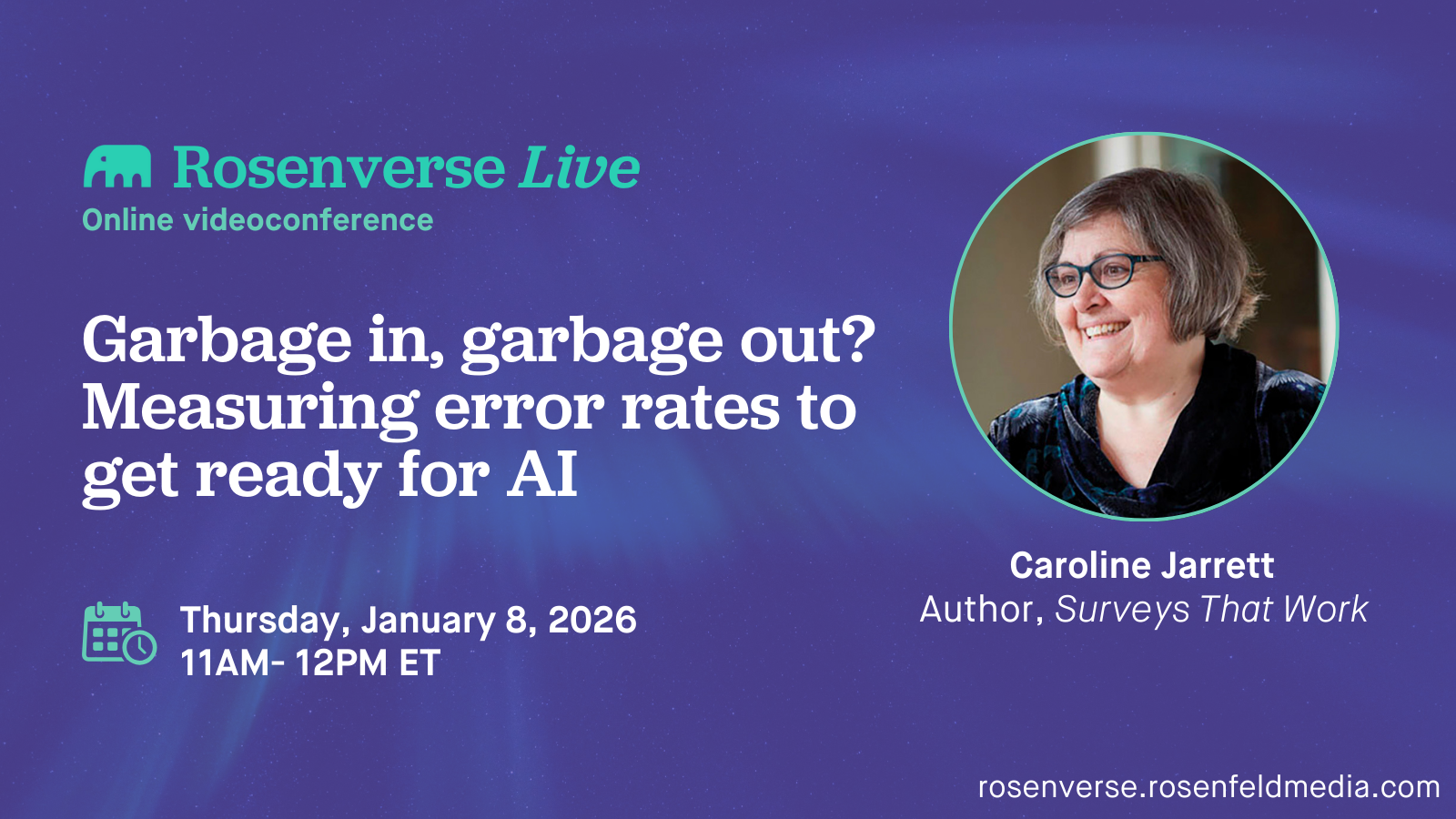
Garbage in, garbage out? Measuring error rates to get ready for AI

Summary
We’re all aware of a big push to implement AI everywhere, including in the services that many of us are working on. It seems only fair to try to give the AI some good quality input in the hope of getting decent output from it. Or, being more pessimistic: we probably expect to get some level of errors from the AI, but what do we know about the error rates in what we’re putting into the AI? In this session, we will compare our ideas on identifying errors and measuring error rates, including thinking about errors in six ways: 1) Problems along the way 2) Wrong result 3) Unnecessary action 4) Delayed-impact problem 5) Non-uptake or over-uptake 6) Technology problem We’ll wrap up with “tips and next steps”: an opportunity to consider what we now need to find out or do differently.
Key Insights
-
•
Errors in data collection and user input are foundational issues that compromise AI and service outcomes.
-
•
Users often 'fudge' answers due to ambiguous questions, privacy concerns, or to achieve a desired outcome.
-
•
Non-uptake, where users abandon a form or process, is a major source of error but is rarely published or measured.
-
•
Mistakes can be categorized as problems along the way, wrong results, unnecessary actions, and delayed impact issues.
-
•
Multiple accounts creation often occurs due to users forgetting existing accounts, leading to data duplicates and service inefficiencies.
-
•
Measuring error rates is complex; different metrics (per person, per attempt, completion vs. start) yield different perspectives.
-
•
Elections provide a useful model for measuring data quality, using turnout, participation, and eligibility rates.
-
•
Data quality deteriorates over time due to changes like moving, name changes, loss of documents, or organizational restructuring.
-
•
AI initiatives can provide a compelling rationale and funding opportunity for improving longstanding data quality problems.
-
•
Frameworks like the UK Government Data Quality Framework help organizations systematically assess and address data issues.
Notable Quotes
"If we get garbage in, we get garbage out — this is true for AI as much as for surveys or forms."
"People can make all sorts of inventive mistakes on their forms that AI struggles to interpret."
"Sometimes a form forces you into a wrong answer by giving inappropriate options."
"I’ve seen people fudge their date of birth so their child can attend a summer camp they aren’t technically eligible for."
"A major error in many services is users creating multiple accounts because they can’t find or reuse existing ones."
"An error might not be immediate; data can be fine when collected but deteriorate over time and cause problems later."
"Completion rates (conversion rates) and dropout rates are simple metrics but often not tracked or shared."
"Organizations rarely know their error rates, which limits their ability to improve user experience or data accuracy."
"Linking data quality efforts to AI initiatives can help secure attention and budget for necessary improvements."
"Data quality involves accuracy, completeness, uniqueness, timeliness, and representativeness—not just error reduction."
Or choose a question:















More Videos

"We are the fix — everything online is made by people, so we can change it together."
Lisa WelchmanCleaning Up Our Mess: Digital Governance for Designers
June 14, 2018

"Delivering a clear request along with your project’s goal helps get buy-in and clarifies what collaborators need to provide."
Cara Maritz Rachel NyThe Art of Extrapolation
March 29, 2023

"Simplicity can be a differentiator, as shown by Tally, which gained traction as a free, easy form builder."
Aleksandra Korczynska Caroline Jarrett Justyna ParmeeSurvey Tools
March 12, 2026

"Having questions about team happiness broken into person, team and product helps clear up confusion in large organizations."
Tess DixonC'mon Get Happy
September 29, 2021

"We design with our biases and subjectivities, so we must work with diverse stakeholders to avoid tunnel vision."
Paul Pangaro, PhDSystems Disciplines: Table Stakes for 21st Century Organizations
June 6, 2023

"Optimizing something for ease of use does not mean best for the user or humanity."
Sheryl CababaLiving in the Clouds: Adopting a Systems Thinking Mindset
June 6, 2023

"Stop trying to make your weaknesses a strength, just minimize weaknesses and maximize your strengths."
Greg PetroffDesign is the Differentiator: Bringing New Design Innovations to a Very Antiquated and Very Large Industry
June 9, 2021

"For every 10 men promoted from entry to middle management, only 7.2 women are promoted—showing the broken rung problem."
Joi FreemanA New Vantage Point: Building a Pipeline for Multifaceted Research(ers)
March 30, 2020

"Operations is a verb. You’ve always been operating — the role just invites you to do it better."
Kate Towsey Jake BurghardtResearchOps AMA with Kate Towsey & Jake Burghardt
October 16, 2025
Latest Books All books














Dig deeper with the Rosenbot
How can product teams ensure they prioritize meaningful user outcomes over rapid AI-powered development speed?
Why do employees often struggle with AI adoption mandates from leadership in the workplace?
How do constant reorganizations in tech companies impact employee motivation and career decisions?