
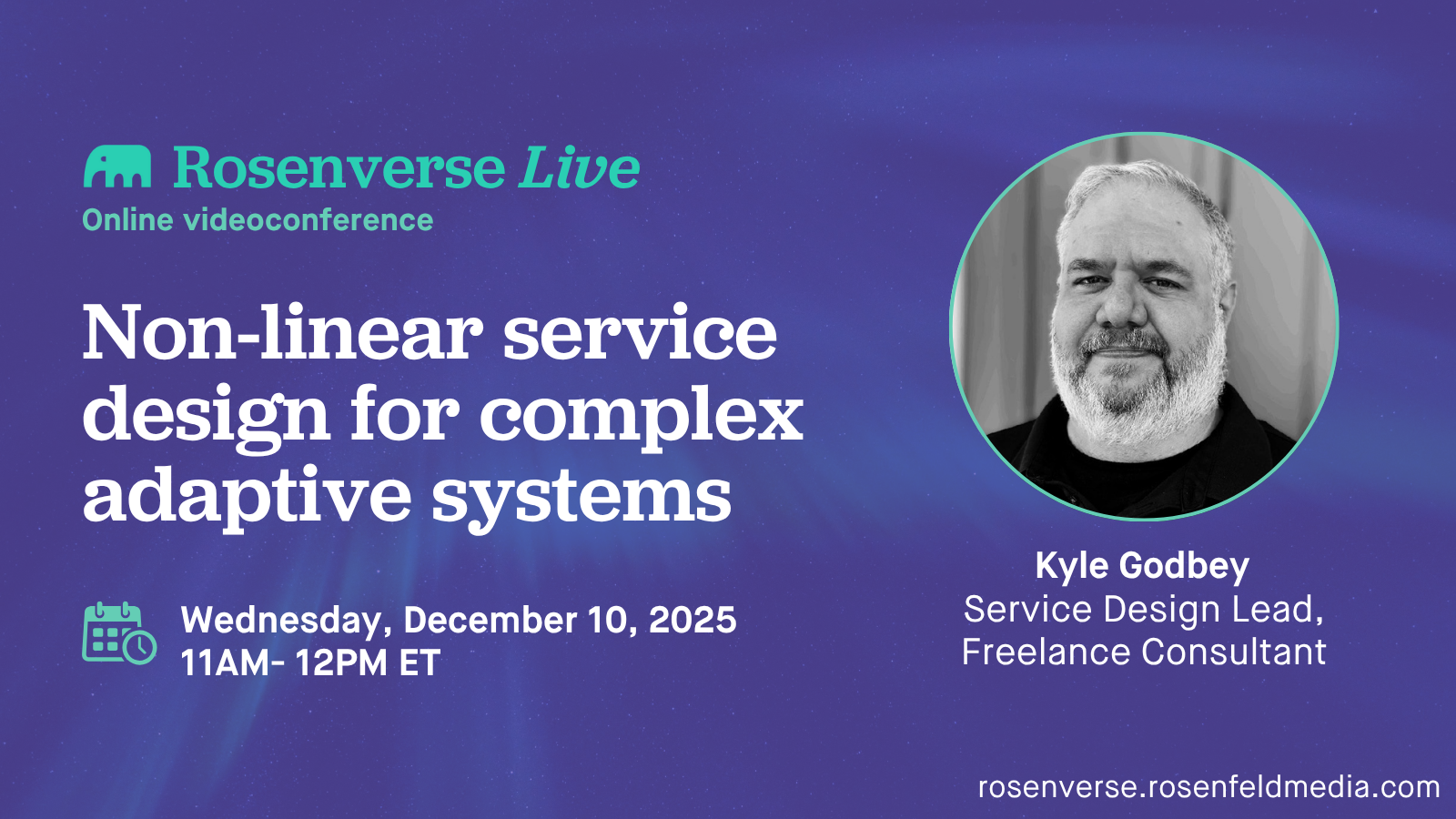
Log in or create a free Rosenverse account to watch this video.
Log in Create free account100s of community videos are available to free members. Conference talks are generally available to Gold members.
Non-linear service design for complex adaptive systems
This video is featured in the Systemic Design playlist and 1 more.

Summary
In this session, Kyle Godbey uses the Cynefin framework to show how the methods we rely on work beautifully for known, constrained, and measurable spaces—like airport security—but can fail us in more fluid, unpredictable, self-organizing spaces—like an airport atrium. If humans are complex, then human-centered design needs to better reflect that complexity. Kyle will share a set of new tools designed to complement traditional service design methods—tools that help teams work in and make sense of complex, ambiguous contexts, and find opportunities for innovation right where uncertainty lives.
Key Insights
-
•
Human systems are inherently complex adaptive systems where messiness and unpredictability are features, not bugs.
-
•
Traditional service design tools that rely on linear, ordered sequences struggle to represent complex, unconstrained human interactions.
-
•
The Cynefin framework helps differentiate domains of order (clear, complicated) from disorder (complex, chaotic), guiding appropriate design methods.
-
•
Emergence means whole-system properties cannot be reduced to the properties of individual parts, making prediction impossible but creativity possible.
-
•
Participatory sense-making involves creating spaces where people collectively discover and reframe their roles and agency, enabling systemic change.
-
•
Service designers are shifting from deliverers of solutions to facilitators, spacemakers, and guides in complexity navigation.
-
•
No single tool or process fits all complexity challenges; success requires mixing, adapting, and iterating tools contextually.
-
•
Storytelling methods like warm data and participatory narrative inquiry reveal multiple perspectives and affordances not captured by traditional metrics.
-
•
Understanding energy and constraints in systems helps identify where to intervene, amplify, or monitor relationships effectively.
-
•
Cultural context matters; complexity approaches are more readily embraced in places like Australia and Europe versus the US, requiring tailored communication.
Notable Quotes
"Complex adaptive system is the domain of humans. Humans are messy and we’re complex."
"When we’re released from constraints and enter into the airport atrium, we become free range humans self-organizing unpredictably."
"The right answer is, it depends. And for the sake of our tools we’re forced to make edits not knowing what nuance we lose."
"Chaos is brief. Humans are bad at existing without constraints. We impose or imagine them because we like constraints like gravity."
"Emergence is properties of a whole system not expressed in properties of parts. Water is liquid but hydrogen and oxygen atoms are not."
"It’s not about solving or fixing complexity. We’re making sense of it so we can operate in it."
"Service design fundamentals carry over nicely: pragmatism, evidence, building assets, and iterative relationships."
"No one size fits all solution in complexity. We have to work in context and be resourceful and repurpose tools."
"The role of the service designer shifts from design savior to facilitator, spacemaker, and guide."
"Navigating complexity is like sailing in open ocean. A GPS won’t help if you don’t know how to read wind and water."
Or choose a question:
















More Videos

"Think of a creative professional as an ideas athlete or a creativity Olympian."
Dr. Karl JeffriesThe Science of Creativity for DesignOps
January 8, 2024

"Making your chief legal officer your best friend as a designer makes a lot of sense."
Amy MarquezINVEST: Discussion
June 15, 2018

"The core of it is really putting yourself in that other person’s shoes—it’s basic but essential empathy."
Steve Portigal Chris Chapo Kelly Goto Christian RohrerDiscussion
May 13, 2015

"Agency style staffing allows designers to bring learnings across multiple projects and grow through new challenges."
Alicia MootyDesign Staffing Models
September 30, 2021

"For the right audience, if applied correctly, humor and music can move people in many ways."
Ana Maria Montero Barrantes Aditi Dhar Michelle Kaplan Nate Osborne Matt LaurenceThe Authentic UX Talent Show
January 8, 2024

"Stakeholders start demanding better digital experiences at work because they expect the same quality they have at home."
Lada Gorlenko Sharbani Dhar Sébastien Malo Rob Mitzel Ivana Ng Michal Anne RogondinoTheme 1: Discussion
January 8, 2024

"Most organizations don’t have one research tool, but a mix, so openness and integration are essential."
Sofia QuinteroThe Product Philosophy Behind EnjoyHQ
March 10, 2021

"Large companies demand certainty, but certainty is the opposite of innovation."
Laura KleinUnique challenges of innovation in enterprises
April 23, 2020

"You’ve got to take control of the backlog and position your team as value-driven, not just servicing individual teams."
Andrew MichaelBuilding a Product Insights Team
March 10, 2022
Latest Books All books














Dig deeper with the Rosenbot
What are the challenges of demand charges in residential solar rate plans and how can they be managed automatically?
What are some signs or 'weak signals' that designers can follow when seeking new career directions?
What skills do researchers unknowingly develop when collaborating with stakeholders?