Log in or create a free Rosenverse account to watch this video.
Log in Create free account100s of community videos are available to free members. Conference talks are generally available to Gold members.
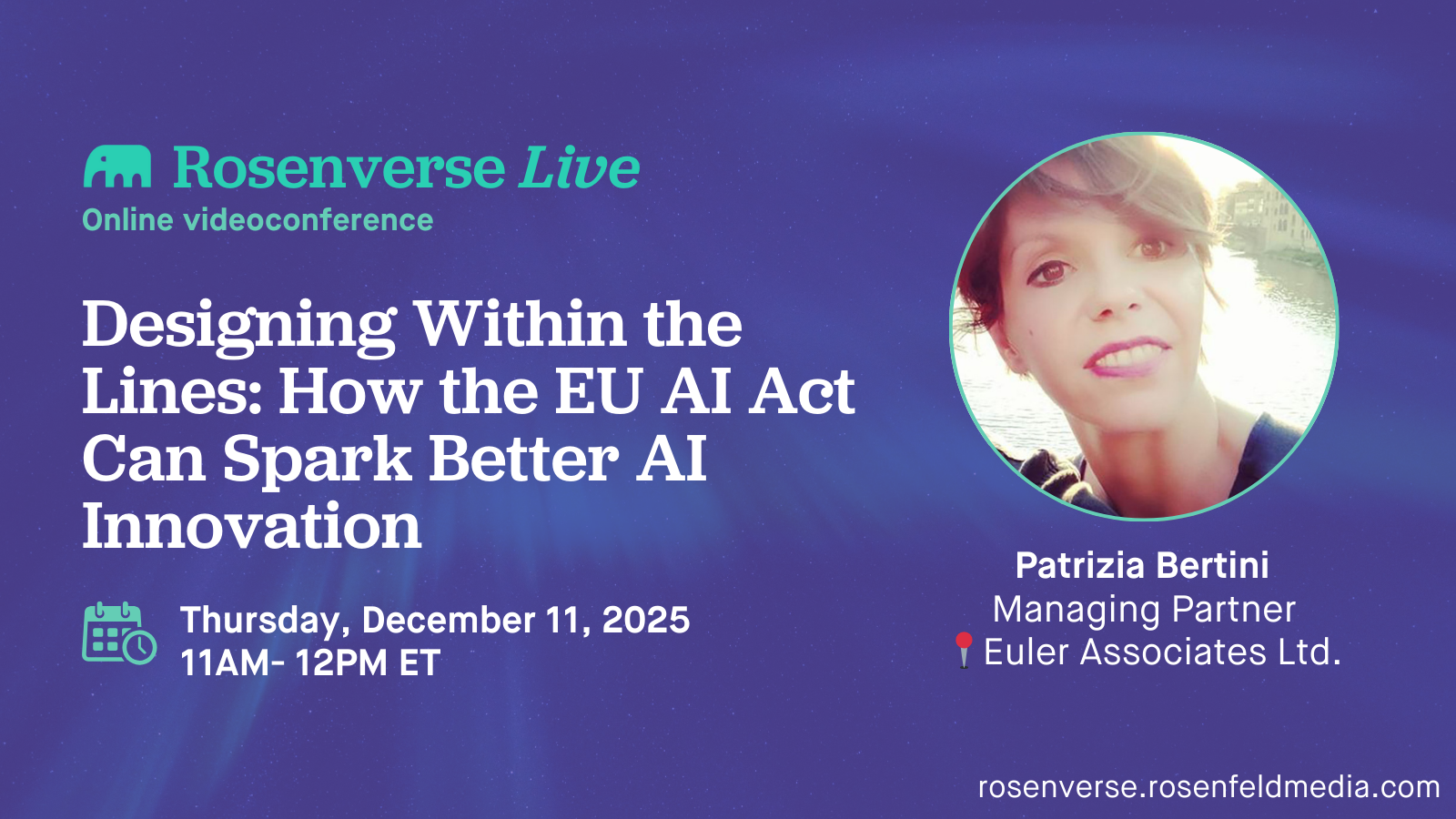
Designing Within the Lines: How the EU AI Act Can Spark Better AI Innovation

Summary
Are you building or using AI in your products? Do you have customers in the EU, or plan to? If so, the EU AI Act isn’t just another piece of legislation. It’s a blueprint for the future of digital product design, a signal of where responsible, human-centered technology is headed. As the world’s first comprehensive AI law, the Act sets new expectations for trust, transparency, and accountability. And it doesn’t matter whether your team is in San Francisco, Singapore, or Sydney: if you build or use AI, this shift affects you. Let’s stop treating AI like a race, and start seeing it as a design challenge: how to build products that people trust, adopt, and keep using. From chatbots to recommendation engines, every AI-powered experience will soon need to meet standards for safety, explainability, and fairness. But this isn’t only about compliance. It’s about turning responsibility into a competitive edge, building systems that last, and products that lead. In this session, we’ll unpack what the EU AI Act means for design, product, and operations leaders, in plain language, no legal jargon required. You’ll walk away understanding: - How AI systems are classified and why “high risk” might apply to your product even if you’re not in the EU - Why transparency, documentation, and human oversight are becoming core design principles - How acting early can strengthen user trust, reduce risk, and set your team apart - How design and product roles are evolving and why that shift is an opportunity, not a threat This isn’t about avoiding fines. It’s about leading with integrity, designing technology people believe in, and using regulation as a launchpad for innovation. Whether you’re a designer, product manager, or operations leader, this session will help you understand what’s changing, take action now, and turn the EU AI Act into your next innovation catalyst.
Key Insights
-
•
The EU AI Act introduces penalties up to 35 million euros or 7% of global turnover for non-compliance, affecting any company serving European customers.
-
•
AI is agency with impact, not just a tool; it can make decisions dramatically affecting human lives.
-
•
Transparency and accountability are core to the AI Act, requiring detailed documentation and auditable logs of all AI decisions, preserved for up to 10 years.
-
•
High-risk AI systems, such as those used in healthcare or hiring, require bias testing, human oversight, and clear escalation paths.
-
•
Many current AI systems cannot be retrofitted to comply, making early compliance and documentation essential.
-
•
Chatbots are generally low or limited risk but become high risk if their decisions significantly impact humans, such as insurance claims denial.
-
•
Synthetic content generated or altered by AI must be persistently labeled as such to maintain transparency for users and auditors.
-
•
Human oversight must prevail in AI interactions; humans retain accountability and must be able to override AI decisions.
-
•
Designers need to create flows that embed human control, transparency, and accountability, moving beyond traditional user flows to 'agent flows' managing AI interactions.
-
•
Organizations should map their AI systems, classify risk levels, assign responsibility, and prioritize compliance as part of their product strategies.
Notable Quotes
"The AI Act can spark better innovation with AI rather than constraining it."
"Speed is not everything we need velocity—speed plus direction is key."
"AI is not a tool. AI has agency. AI makes decisions that impact people's lives."
"Machines cannot be accountable; responsibility is always human."
"If you are building or deploying AI that impacts people, you need to document everything."
"Transparency requires all decisions to be clear and understandable to non-technical users."
"Humans need to override and dominate AI because machines have no context or experience."
"Most AI systems today cannot be retrofitted easily to comply with regulation."
"Everything touched by AI becomes synthetic and needs persistent labeling."
"Real innovation is not being first; it's about doing it right and sustainably."
Or choose a question:
















More Videos

"It’s important to create a clear value proposition that ties your work to the larger organizational mission."
Jackie AjouxLeveling-Up: A Single-Player’s Guide to the DesignOps Team-of-One
January 8, 2024

"Everyone contributes to conflict; it’s not about right or wrong, but what each person is trying to protect."
Laura WeissTurn Down the Heat: 3 Ways to Handle Conflict in the Moment
November 20, 2024

"It’s not about speed or efficiency only—it’s about respect for the research participants."
Marjorie Stainback Molly Fargotstein Stephanie MarshWhat Research Ops Professionals Have Learned from COVID-19
July 16, 2020

"Being trauma-informed means caring for yourself, forgiving your mistakes, and moving forward with humility."
Matt Bernius Sarah Fathallah Hera Hussain Jessica Zéroual-KaraTrauma-informed Research: A Panel Discussion
October 7, 2021

"People coming from agencies sometimes need help dropping bad habits like working at 2am or stressful environments."
Allison SandersOperating with Purpose
January 8, 2024

"We work with over 1,200 people to develop diverse perspectives in our content."
Louis RosenfeldYou’ve got Gold! A Rosenverse demo with Lou Rosenfeld
June 9, 2026

"Consistency is key. I'm on a 73-week streak right now, and that's pretty badass."
Reginé GilbertAsking the Right Questions: Life, Hope and Moving Forward During the Pandemic
June 10, 2022

"We are co-creating with the product organization to make sure everything fits seamlessly rather than being separate."
Elizabeth Sklar Jessica ShengCo-creating research enablement with your tech org: a case study
March 10, 2026

"The linguistic shift from we have AI to we’re redesigning how we work signals maturity."
Bethany BrownRewiring operations with service design and AI
November 20, 2025