
Log in or create a free Rosenverse account to watch this video.
Log in Create free account100s of community videos are available to free members. Conference talks are generally available to Gold members.
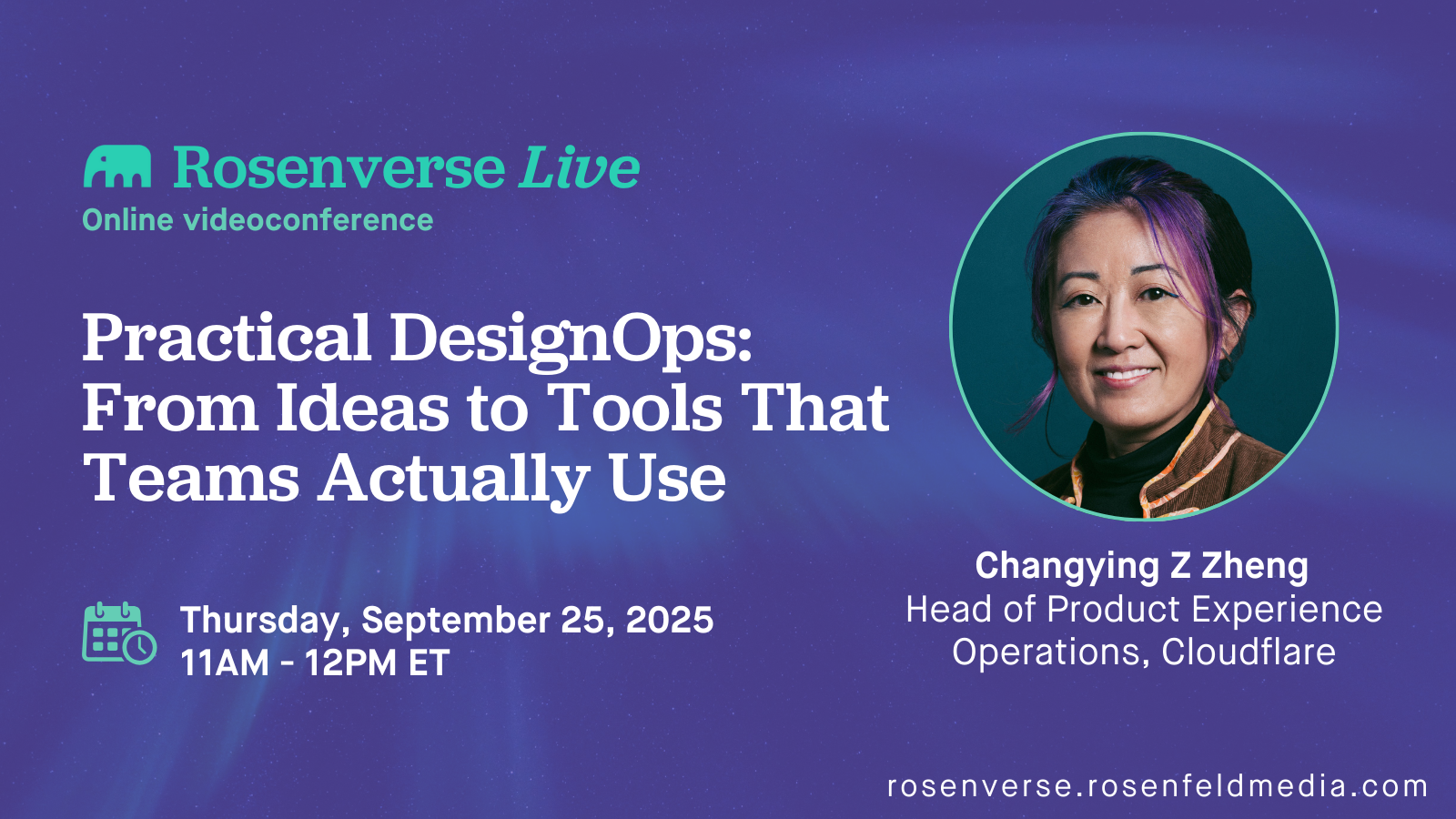
Practical DesignOps: From Ideas to Tools That Teams Actually Use

Summary
In this one-hour community session, Z will:
- Share the journey of building these resources, including how AI collaboration played a role from ideation to delivery
- Highlight examples of tools currently being used by teams in DesignOps, ResearchOps, and Product Design
- Invite the community to shape the next phase of this work by sharing their most pressing needs and challenges
This is a conversation for the DesignOps community and with the community. We hope to co-create the resources that will move us forward.
Who should attend:
DesignOps, ResearchOps, and Product Design professionals looking for actionable tools, as well as anyone interested in contributing practical insights to strengthen our shared practice.
Key Insights
-
•
Design operations can be effectively supported through practical templates, playbooks, and frameworks rather than only theoretical discussions.
-
•
AI tools like ChatGPT, Google Gemini, and vibe coding can accelerate creation of operational content and automation, but require human oversight to avoid issues like hallucinations.
-
•
Operations roles are evolving and sometimes move between different organizational teams (e.g., design ops shifting between design and product experience teams).
-
•
A RACI model helps clarify authority and responsibility, especially in distributed design teams embedded across different parts of an enterprise.
-
•
Building career ladders for design disciplines improves clarity on growth paths and skills development within teams.
-
•
Invisible operations work is critical; when things break, it highlights operations’ vital contributions that often go unnoticed.
-
•
Peace time for operations teams should be used proactively for activities like documentation cleanup, training, and process improvement.
-
•
Integrating research operations and democratizing research empowers designers to conduct more user research independently.
-
•
Design operations often influence without formal authority, requiring strong collaboration with leaders across design, content, research, and product.
-
•
The future role of design and product operations professionals includes leveraging AI responsibly while focusing on creativity and curiosity to ask novel questions.
Notable Quotes
"Design operation is essentially service design to the design team."
"Operations work best when practical tools are put in peoples' hands, not just theory."
"When operations do their job well, people don’t even know it exists until something breaks."
"For distributed embedded designers, a RACI model helps outline who’s responsible and what authority they have."
"Our approach to career development is thinking about two dimensions: what you’re good at and enjoy, and what you’re good at but don’t enjoy."
"AI helped me produce nearly 80 posts in a year; without AI, that pace would be impossible."
"Different AI systems have different strengths; Claude is great for creative writing, ChatGPT is concise and to the point, Gemini is deeper for research."
"Use AI responsibly; never input sensitive info without governance, or it could lead to dangerous outcomes."
"The future belongs to designers who ask questions worth answering, not just answering questions already asked."
"Operations often move around organizationally, from design to product operations and back, reflecting evolving team needs."
Or choose a question:















More Videos

"Tech workers in the UK are five times more depressed than the UK average, with stress killing creativity."
Dr. Karl JeffriesThe Science of Creativity for DesignOps
January 8, 2024

"Making your chief legal officer your best friend as a designer makes a lot of sense."
Amy MarquezINVEST: Discussion
June 15, 2018

"The weakest insight method might win simply because of the relationship to the power structure."
Steve Portigal Chris Chapo Kelly Goto Christian RohrerDiscussion
May 13, 2015

"One designer's security in a dedicated model may be another designer's stagnation."
Alicia MootyDesign Staffing Models
September 30, 2021

"With enough creativity and imagination, you can make anything interesting."
Ana Maria Montero Barrantes Aditi Dhar Michelle Kaplan Nate Osborne Matt LaurenceThe Authentic UX Talent Show
January 8, 2024

"We never compromise on the business goals, but how we achieve them can be flexible and pragmatic."
Lada Gorlenko Sharbani Dhar Sébastien Malo Rob Mitzel Ivana Ng Michal Anne RogondinoTheme 1: Discussion
January 8, 2024

"Research isn’t linear; it’s messy and modular, so your tools have to reflect that fluidity."
Sofia QuinteroThe Product Philosophy Behind EnjoyHQ
March 10, 2021

"Large companies demand certainty, but certainty is the opposite of innovation."
Laura KleinUnique challenges of innovation in enterprises
April 23, 2020

"Embedded squads build domain expertise but risk losing knowledge if someone leaves, while centralized teams help reduce duplicated effort."
Andrew MichaelBuilding a Product Insights Team
March 10, 2022













