Log in or create a free Rosenverse account to watch this video.
Log in Create free account100s of community videos are available to free members. Conference talks are generally available to Gold members.
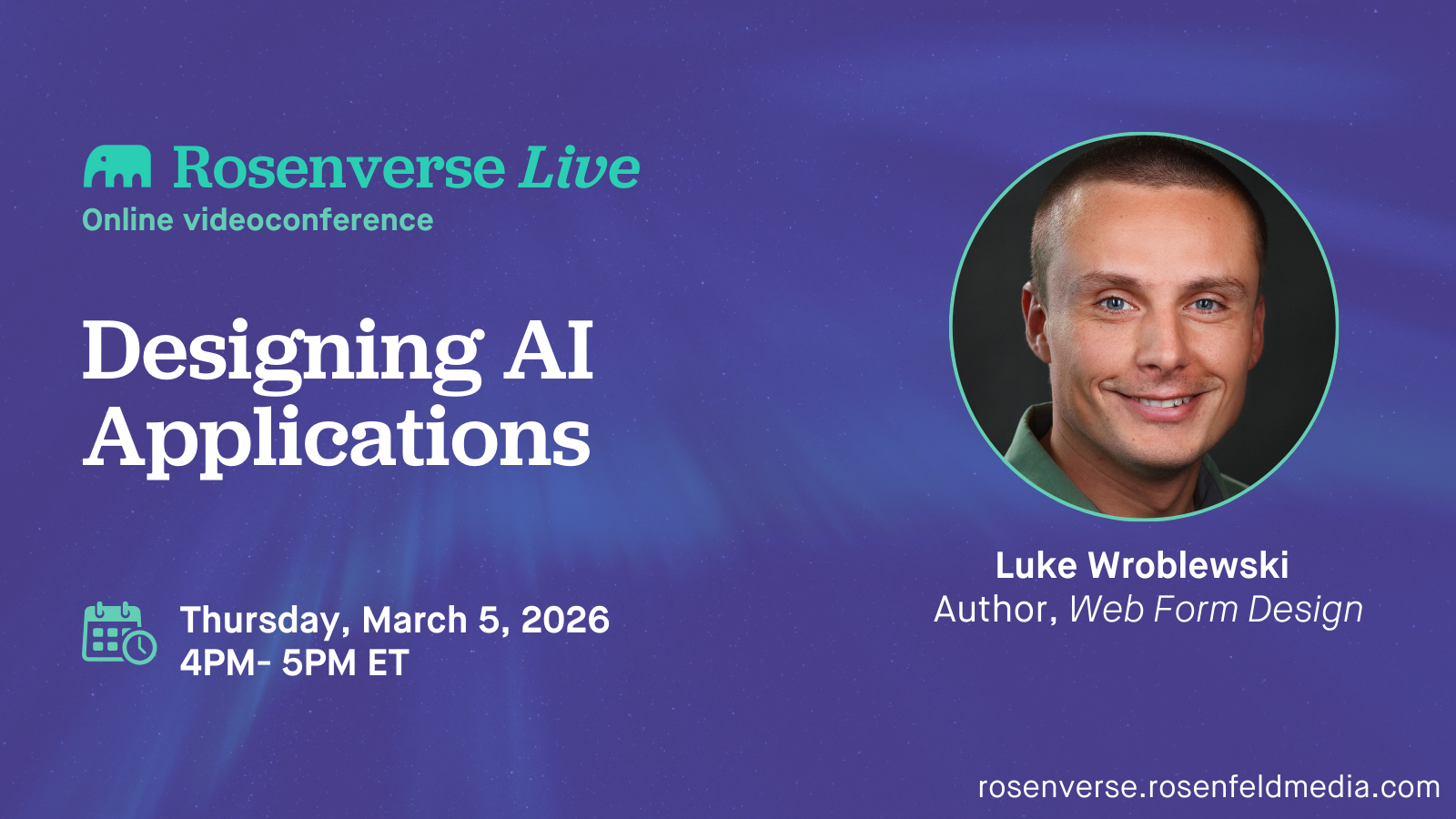
Designing AI Applications
This video is featured in the UX Watch Party playlist.

Summary
The way we build applications has changed dramatically with every major platform shift: mainframe to PC, web to mobile, and now AI. Luke Wroblewksi, author of Web Form Design and Mobile First, will chart the evolution of AI product design from behind-the-scenes AI models and chat interfaces to agent management and beyond. He'll show how designing AI applications isn't about where to add chat—it's about using AI to solve UX challenges in onboarding, search, customization, task management, and more.
Key Insights
-
•
Every major technology wave transforms applications fundamentally—from mainframes to AI-powered conversation and agentic systems.
-
•
Early AI adoption was mostly behind-the-scenes, enhancing existing UIs without changing user interaction paradigms.
-
•
The explosion of chat-based AI like ChatGPT introduced direct user-AI interaction but also the challenge of the 'empty text box' with unclear capabilities.
-
•
Suggested questions and answers significantly improve user onboarding by guiding users on what they can do and how.
-
•
Including citations in AI responses builds trust and helps users verify information sources.
-
•
Agentic AI systems that autonomously select and use tools create complex interaction flows, raising new UI design challenges for transparency versus simplicity.
-
•
There are two main user mindsets toward AI autonomy: those who want to see the system’s thinking and those who just want results.
-
•
Separating AI process steps from results in interfaces (e.g., ChatDB) helps manage mental load and make outputs more comprehensible.
-
•
Context awareness—understanding and controlling what AI pays attention to—is essential for effective AI interactions.
-
•
Software developers lead AI agent adoption, influencing the trajectory and sophistication of AI products across industries.
Notable Quotes
"In the AI era, applications are conversations. AI models understand intent and execute complex tasks without programming for every scenario."
"When there’s a major technology shift, almost everything about an application changes, including how users experience it."
"Google Translate completely reinvented itself by replacing many translation systems with a single neural network capable of zero-shot translations."
"Suggested questions give you a sense of what the heck can I do here, which is really important in empty text box AI interfaces."
"Showing citations in AI responses helps people develop trust and understand where answers come from."
"Agentic systems don’t just respond; they decide which tools to use, analyze results, think between tool calls, and can do multiple things simultaneously."
"People fall into two groups: some want to see what the system is thinking and why, others just want to see the final output."
"Separating process from results in the UI lets you see what the AI is thinking while giving more prominence and clarity to the results."
"Context management lets you tell the system what to look at, whether it’s files, folders, or highlighting specific image regions."
"The evolution in AI UIs is ongoing and rapid, and we’re still figuring out what the final form of AI-native applications looks like."
Or choose a question:















More Videos

"AI cannot replace user research, usability testing, or domain expert validation."
Snehal PendharkarConducting pre-research with AI agent personas: Pressure-testing concepts for expert workflows
June 10, 2026

"It was not the remote tools that were the challenge, but getting people to focus."
Niko LaitinenAdaptable Org Design for Resilient Times
June 10, 2021

"It’d be nice if we had someone to blame, but none of these are true."
Steve PortigalWar Stories LIVE! Steve Portigal
March 30, 2020

"Fear of losing your livelihood drives people to work longer hours and avoid asking for support."
Alla WeinbergPeople Are Sick of Change: Psychological Safety is the Cure
July 20, 2023

"Black women are diverse; no two Black women are alike, which presents opportunities to innovate inclusive technology."
Yolanda RankinBlack Feminist Epistemology as a Critical Framework for Equitable Design
March 11, 2021

"Recruitment is so difficult, especially in B2B where you need to speak to customers using similar products."
Erin May Roberta Dombrowski Laura Oxenfeld Brooke HintonDistributed, Democratized, Decentralized: Finding a Research Model to Support Your Org
March 10, 2022

"Self-care is as much about preparing before you enter the field as it is about debriefing afterwards."
Rachael Dietkus, LCSW Uday Gajendar Dr. Dawn Emerick Dawn E. Shedrick, LCSWLeading through the long tail of trauma
July 7, 2022

"Focus on the destination, not the vehicle, because AI tools will change every single day."
Erika FlowersAI-Readiness: Preparing NASA for a Data-Driven, Agile Future
June 10, 2025

"If going from no design system to a system, you should see an increase in product development efficiency by at least 25%."
Craig VillamorDesign Systems for Ethical Design
January 26, 2023