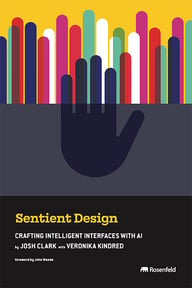
Sentient Design: Crafting Intelligent Interfaces with AI
This video is featured in the AI Conference playlist.


Summary
Learn how AI can elevate design (and designers!) instead of replacing them by grinding out efficiencies. Instead of treating AI as a tool, Sentient Design invites you to use AI as a design material, woven into the interface itself. What entirely new kinds of experiences can we create? What dramatic new value can they deliver?
Intelligent interfaces are the new frontier of experience design. This session delivers a map of the territory, as well as the framework and perspective to deliver these experiences in your own practice.
Key Insights
-
•
AI allows creation of adaptive interfaces that embody user intent and context, not just static outputs or text chat.
-
•
Sentient Design defines four interaction postures: tools, chat, copilots, and agents, each representing different AI-user collaboration levels.
-
•
The intelligent canvas pattern blends AI-generated visualizations and collaborative UI elements tailored on demand.
-
•
AI is fluent in intent and manner but less reliable on facts; designers must structure data sources and constrain outputs.
-
•
Design with AI is about delegation, not abdication; designers set goals and rules, AI executes within those boundaries.
-
•
Gen Z designers bring natural fluency with dynamic, adaptive, multimodal interfaces that older designers might find disruptive.
-
•
Dynamic interfaces can increase cognitive load for some users; starting with familiar, stable landing pages helps navigation.
-
•
Multimodal AI interfaces (voice, touch, gesture, visual) expand accessibility and unlock new user experiences and business models.
-
•
AI-driven interfaces shift the point of control, requiring new design frameworks to keep users grounded and avoid surprises.
-
•
Intelligent interfaces enable experiences previously impossible, making design more about orchestrating behavior than drawing fixed paths.
Notable Quotes
"We can make things that weren’t possible before just a few months ago; not just capabilities but the user experience itself."
"This interface could field any request, no matter how it was formatted, and adapt its entire form in its response."
"The intelligence is woven into the interface itself, creating presence and personality without pretending to be human."
"AI is a strange design material that introduces new problems and challenges, requiring fresh perspectives and revisiting assumptions."
"Designers really become the creative director who give the system its brief; it’s delegation, not abdication."
"If we don’t design the best way to use this powerful technology, the technology will decide for us, and the future shouldn’t be self-driving."
"We have these new behavioral systems that work across modalities and channels, not just voice or screen but combinations."
"Dynamic AI-generated interfaces can increase cognitive load for users unfamiliar with rapid change; predictability matters."
"The system suggesting what’s right rather than imposing it lets users adjust, making AI a collaborator, not a dictator."
"Intelligent interfaces enable us to create value with experiences we couldn’t previously imagine, elevating design instead of replacing it."
Or choose a question:















More Videos

"We think about research as the magnetic field that attracts every part of the business into alignment around the customer."
Sofia QuinteroThe Product Philosophy Behind EnjoyHQ
March 10, 2021

"Sometimes, avoiding the conversation feels easier but can have bigger costs than facing it."
Joshua GravesWe Need To Talk: Navigating Conversations with Your Boss (Part 1 of 3)
April 14, 2025

"How might we scale fast without losing our culture, our clarity and stay human?"
Ebru NamaldiDesigning the Designer’s Journey: Scaling Teams, Culture, and Growth Through DesignOps
September 11, 2025

"Either way, the Rosenbot will save you a lot of time in getting your people or you up to speed on all things UX and product design."
Louis RosenfeldHow to use the Rosenbot
March 16, 2026

"A lot of design frameworks funnel thinking narrowly, which feels like baked-in limitations of human-centered design."
Sheryl CababaIntegrating Systems Thinking Into Your Practice as a Designer
October 1, 2025

"Large discovery should focus on tier-3 unexplored markets, ones that require multiple years and large capital but may disrupt long-term."
Mike OrenWhy Pharmaceutical's Research Model Should Replace Design Thinking
March 28, 2023

"Community-centered design flips the traditional script to give design power to those most impacted by policies and services."
Ashley Cortez Devika Menon Nidhi Singh Rathore Danita J. Reese Mari NakanoShifting Toward Community-Led Innovation in Local Government
December 8, 2021

"Trust is built not just in big moments but in little marbles filling a jar over time."
Etienne FangThe Power of Care: From Human-Centered Research to Humanity-Centered Leadership
March 10, 2021

"We have to slow down to speed up — understanding the why before chasing the outcome."
Sara Asche Anderson Jamie KaspszakNot Your Ordinary Re-Brand: Design's Path to Driving Customer Obsession at Best Buy
January 8, 2024