Log in or create a free Rosenverse account to watch this video.
Log in Create free account100s of community videos are available to free members. Conference talks are generally available to Gold members.
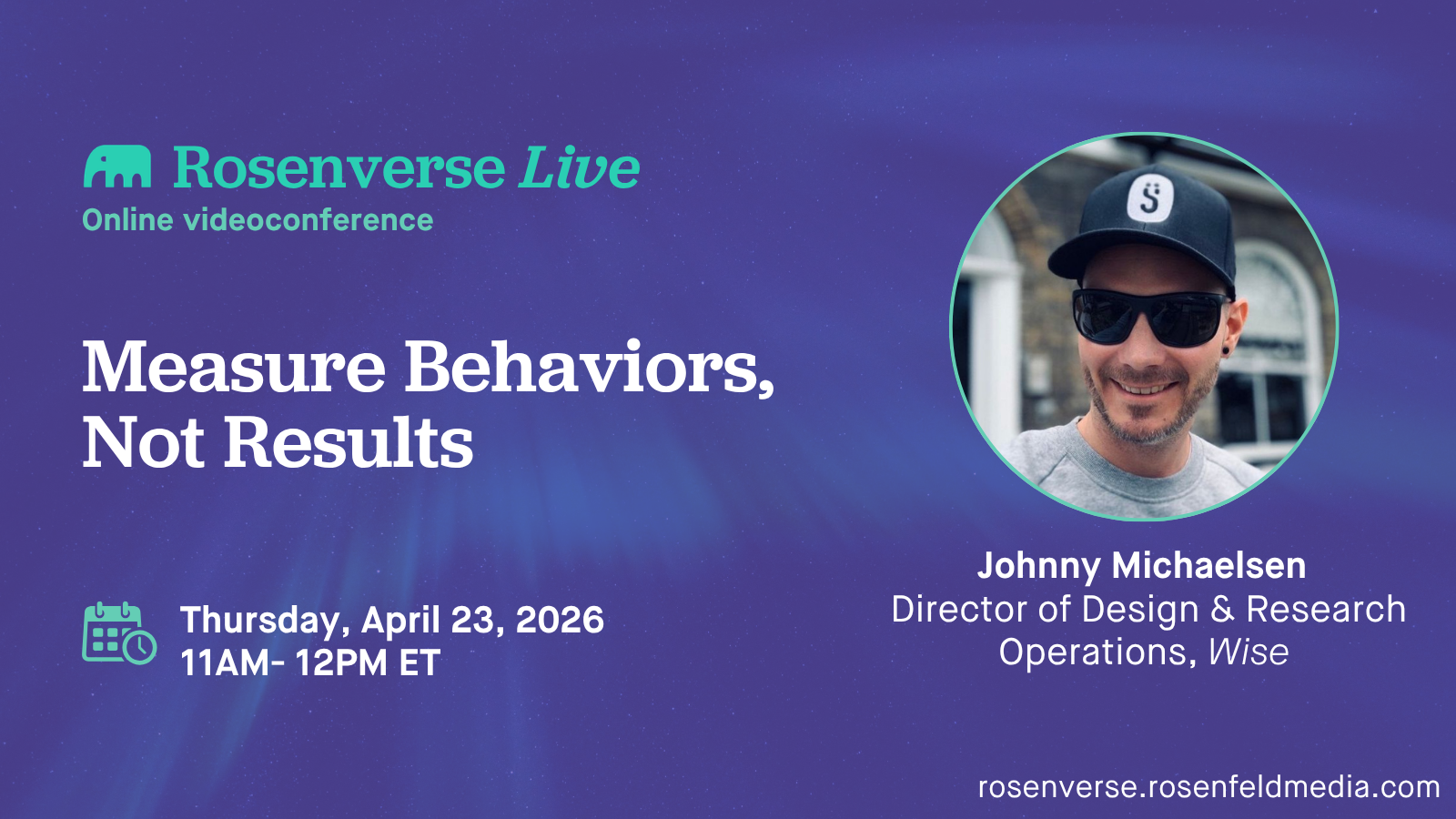
Measure Behaviors, Not Results
This video is featured in the UX metrics & analytics playlist and 1 more.

Summary
I believe positive feedback from stakeholders always outweighs vanity metrics. In this talk, I’ll share the core behaviors the Design & Research Operations team at Wise uses as the foundation for how our team operates. These behaviors focus on how we show up for the people we serve, for each other and importantly, for ourselves. They ultimately determine our focus and help us build trust while we deliver a positive change for the Design & Research environment across Wise.
Finally, you’ll hear what we learned from a three-month experiment where we aimed to measure ourselves against these behaviors, rather than just measuring the results of our efforts. Join us as we dive into team psychology and explore why the right behaviors might actually matter more than metrics from final outcomes.
Key Insights
-
•
Measuring behaviors rather than just results can provide deeper insight into team health and trust.
-
•
Three core behaviors—delivering value now, being observant and of service, and creating visibility with clarity—form a balanced foundation for design ops.
-
•
Clear problem framing and sponsor alignment are essential for prioritization and impact in operations work.
-
•
Building trust hinges on relationship-building and understanding people’s real needs beneath their complaints or requests.
-
•
Autonomy in teams comes from aligning on strategic objectives rather than micromanaging tasks.
-
•
AI tools can dramatically speed up delivering value and impact reporting but require disciplined focus to avoid chaos.
-
•
Self-rating in work behaviors may be limited by psychological biases, but the behaviors themselves still guide improvement.
-
•
Storytelling and influence are crucial skills to gain sponsorship and support for operational initiatives.
-
•
Personal growth and energy management at work improve effectiveness and resilience, especially in complex environments.
-
•
Visibility systems for workload should be lightweight and non-distracting to maximize productivity and clarity.
Notable Quotes
"Without execution, we have no impact."
"Effort doesn’t mean progress, hard work doesn’t guarantee a harvest."
"We spend a lot of time measuring every little aspect, but how can we trust that our results show the value of our effort?"
"Maybe we can measure our behaviors, not just our results."
"The value of what we do is only really valuable if it’s recognized by others."
"Be observant means to observe what’s being said, not just what people say."
"Building relationships is essential to being of service and having impact."
"You have to be 80% impactful and 20% helpful — that’s the balance we try to maintain."
"The behaviors act as a gauge, not a scorecard, to see who is struggling and who is thriving."
"You can do everything right and still get poor results, but it’s no excuse not to do the right thing."
Or choose a question:
















More Videos

"I think the world we’re in is definitely not antagonistic to research, there’s a huge opportunity right now."
Renee BouwensLanding Product Impact: Aligning Research as a Foundational Driver for Delivering the World’s Best Products
December 15, 2023

"Async communications helped us reduce emails and meetings, improving overall efficiency."
Amy EvansHow to Create Change
September 25, 2024

"Job titles are a lagging indicator—it will take a while before the industry renames roles in line with actual work changes."
James LangHopeful Futures for UX Research
January 30, 2026

"You wanna do rapid research when the feedback or the findings is gonna be focused and impactful."
Feleesha SterlingBuilding a Rapid Research Program
May 18, 2023

"What if it’s all a hoax and we just invented a better world for no reason? That’s a good place to be."
Louis Rosenfeld Matt Jones Olga Khroustaleva Michael Leggett Karol MunozDo you want to work on climate? (Climate UX Discussion Series)
November 15, 2023

"Serendipity happens when you explore across different journeys, personas, and contexts in the knowledge repository."
Tony TurnerCapturing Deep Insights
September 30, 2021

"Design in government is growing at all levels around the world, but the public sector really only began using this approach in earnest about 10 to 15 years ago."
Stephanie WadeBuilding and Sustaining Design in Government
December 8, 2021

"Slowing down on messy data is worth it because you could miss something incredibly important that changes the trajectory of the product."
Maria RosalaAI-Assisted Qualitative Analysis: What to Automate and What to Own
June 5, 2026

"The tasks left for humans after automation will be strategic, multifaceted, creative, and complex."
Janaki KumarInnovate with Purpose
June 14, 2018