Log in or create a free Rosenverse account to watch this video.
Log in Create free account100s of community videos are available to free members. Conference talks are generally available to Gold members.
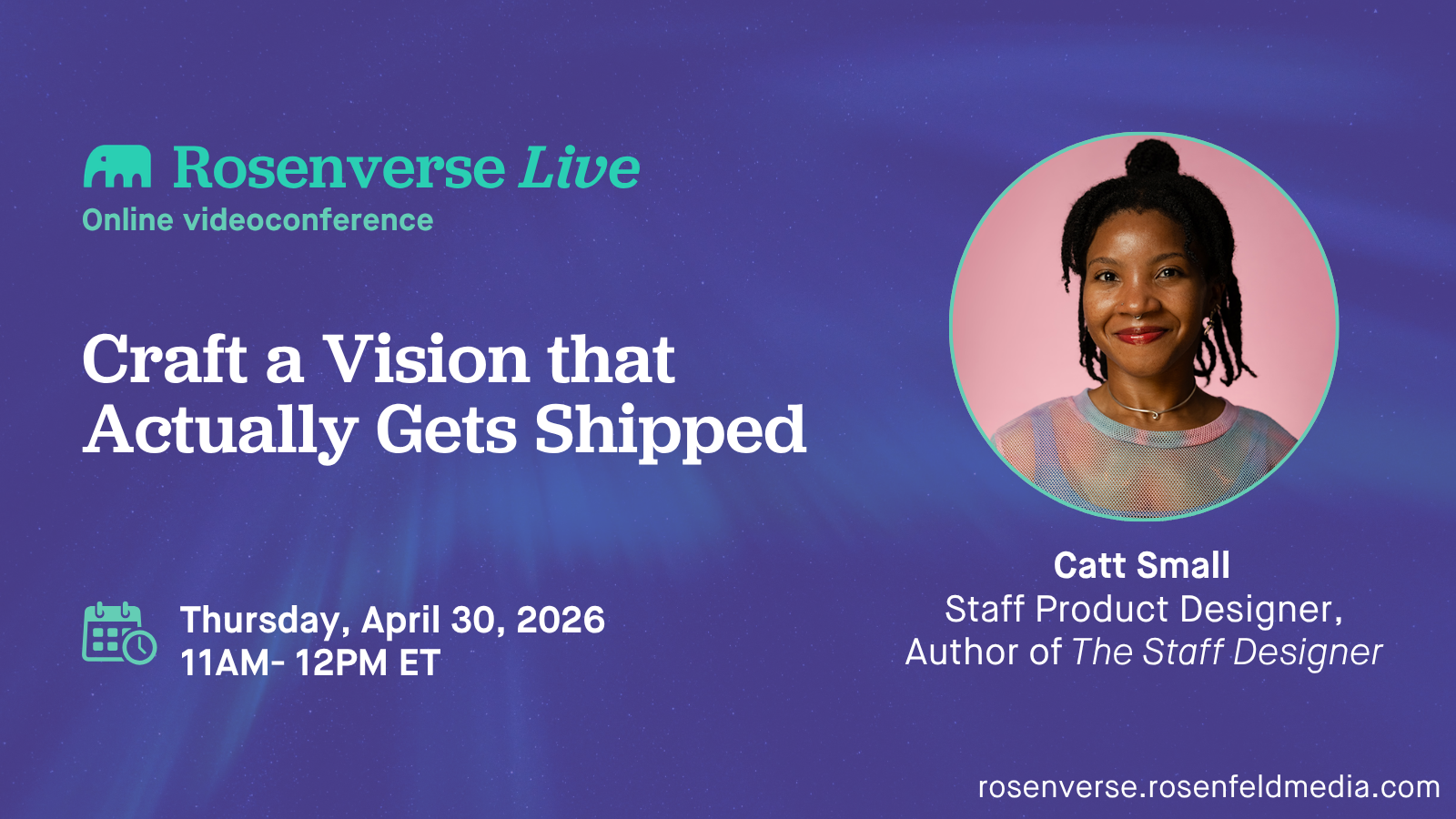
Craft a Vision that Actually Gets Shipped
This video is featured in the UX Watch Party playlist and 1 more.

Summary
In this talk, Catt Small shares a practical process for crafting a product vision that drives real decisions. You’ll learn how to identify the right moment for vision work, anchor future-state thinking in user and business realities, efficiently validate directional concepts, and translate long-term direction into roadmap-ready milestones. Let’s create vision artifacts that increase confidence, align teams, and shape strategy!
Key Insights
-
•
A product vision is a strategic illustration of the desired customer experience that guides team alignment and motivates progress.
-
•
Visions often fail when high-fidelity visuals mask weak or incomplete ideas without a clear core thesis.
-
•
Early and active involvement of product managers is critical to create visions grounded in real business strategy and attain cross-team buy-in.
-
•
Visions with timelines too far in the future (5-10 years) disconnect teams and fail to inform immediate roadmaps; 1-2 years is usually optimal.
-
•
A vision must include a documented work-back plan that outlines actionable steps to integrate the vision into the product roadmap and delivery.
-
•
Starting the vision work in text form, focusing on the narrative and goals before any visual design, leads to stronger foundational ideas.
-
•
AI tools speed up prototyping but don’t replace the need for a purposeful and strategic vision to guide what is built.
-
•
Internal visions (for teams and leadership) differ from external ones aimed at customers and require different presentation styles and content.
-
•
Validation with user research and assessing what customers are willing to pay for ensures the vision aligns with real market opportunities.
-
•
Sharing draft outlines and involving peers throughout the vision process prevents surprises and builds organizational advocacy and momentum.
Notable Quotes
"Visions capture held knowledge that a team has maybe not been able to yet take action on."
"You can spend a lot of time building a really cool concept that no one will care about because it’s not possible, it’s not feasible, it’s not grounded."
"If the ideas aren’t fully baked or there’s no real core thesis, then you’ve kind of missed the point."
"Move thoughtfully and purposefully is better than move fast and break things, especially in large companies with millions of users."
"If you can’t see how this artifact is going to be a reference that is constantly pointed to, maybe you shouldn’t make it."
"The vision really does say This is where we could be in the future and that emotional component is really important."
"Early involvement of product helps you frame the problem better and co-create a solution that others will buy into."
"If there’s no plan or no handoff after the vision, then the vision feels like an artifact that has no legs."
"Creating different formats of the vision for different stakeholders improves resonance and adoption."
"Visioning can be an antidote to a top-down reactive organization by proposing stable, aligned direction upfront."
Or choose a question:















More Videos

"Prioritization is one of those fractal topics that can go from the micro to the macro level."
Harry Max Jim MeyerPrioritization for Leaders (2nd of 3 seminars)
June 27, 2024

"Design is an excellent way to navigate chaos, turning ambiguity into direction through alternatives."
Aras BilgenWho does the math: A designer’s journey in building an AI-based tutoring app
June 10, 2025

"You don’t want to give too many options like rating from one to ten because consistency gets lost between different LLM calls."
Peter Van DijckBuilding impactful AI products for design and product leaders, Part 2: Evals are your moat
July 23, 2025

"For OKRs to work, incentives have to focus on learning, customer centricity, and evidence-based decision making, not just delivery."
Jeff GothelfWho does what by how much?
November 20, 2025

"You have to avoid speaking when the screen reader is speaking, which takes some training to get used to."
Samuel Proulx Laur BaekInclusive Research: Debunking Myths and Getting Started
March 12, 2025

"Many governments need to buy design services to augment their internal capacities."
Ariel KennanTheme 2 Intro
December 9, 2021

"Magnification can cover the entire screen two to ten times, and users pan around to see different areas."
Sam ProulxSUS: A System Unusable for Twenty Percent of the Population
June 9, 2021

"Stakeholder mapping helps you see who needs what and align your tactics accordingly."
Joshua GravesWe Need To Talk: Managing Ludicrous Requests at Work (Part 3 of 3)
May 12, 2025

"Taking stakeholders on the journey by involving them in interviews really changed how they saw the product and business strategy."
Dr Chloe SharpUsing Evidence and Collaboration for Setting and Defending Priorities
November 29, 2023