Log in or create a free Rosenverse account to watch this video.
Log in Create free account100s of community videos are available to free members. Conference talks are generally available to Gold members.
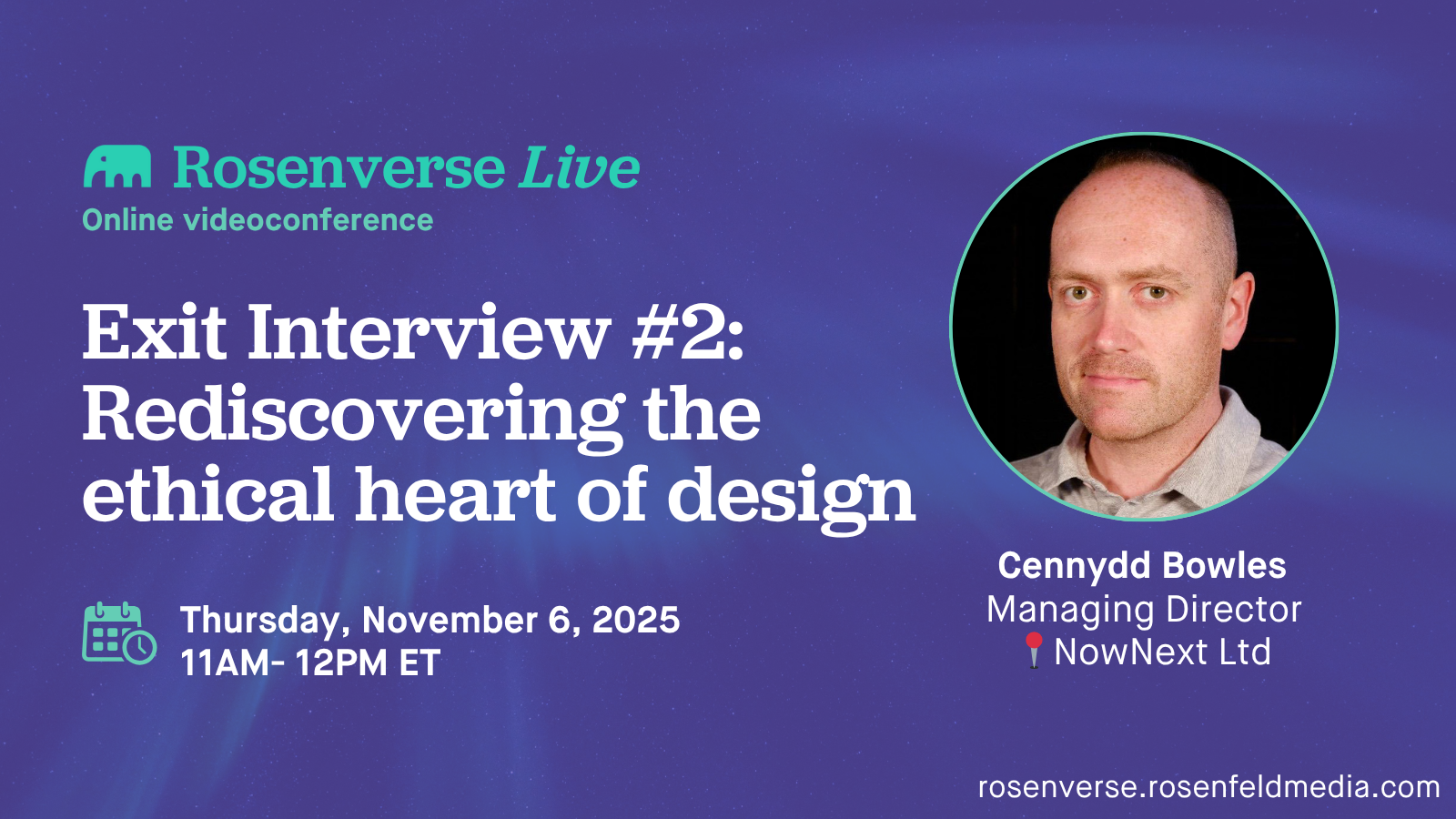
Exit Interview #2: Rediscovering the ethical heart of design
This video is featured in the My first playlist playlist and 1 more.

Summary
After two decades in Product Design, I’m stepping away — not out of burnout, but disillusionment. The craft that once sought to elevate human experience now too often serves the false gods of metrics and efficiency, while the industry eagerly embraces approaches that lead to its own commoditization. I’ll share why I’m stepping away from the tech industry, what I’ve learned about doing design responsibly in a system obsessed with mechanical efficiency, and how my next chapter—studying deception and morality in AI—might still bring us back to what design was meant to be.
Key Insights
-
•
Kenneth transitioned from senior UX design roles into technology ethics and philosophy due to ethical disillusionment and industry collapse.
-
•
Philosophy demands a shift from empirical, data-driven thinking to rigorous, logical reasoning devoid of experimental data.
-
•
There is a growing awareness of the moral impact of technology, but a retreat from ethical responsibility is currently observable in the tech industry.
-
•
Designers inevitably engage in ethics through decisions affecting others, whether consciously or not.
-
•
The ethics of deception in design is complex; some deception like placebo buttons is socially acceptable, but dark patterns are morally problematic.
-
•
AI as a designer raises novel ethical questions since AI lacks intention and cannot understand deception in human terms.
-
•
Support for transitioning from industry design work to academic philosophy is limited and often requires personal resilience and external financial backing.
-
•
Academia is a difficult career path with limited job security and funding, especially in humanities and philosophy, making it a commitment driven by intrinsic motivation.
-
•
Kenneth views his role as translating complex ethical philosophy into approachable guidance for tech practitioners.
-
•
Despite leaving design practice, Kenneth retains affection for the discipline but is critical of the industry's current direction and values.
Notable Quotes
"Ethics tends to emerge at the level of mastery of a community."
"I'm basically a philosopher because 50% of people don't know what an ethicist is."
"Design permeates everything as a lens through which you see the world; philosophy is just a different shaped lens."
"You can't just measure ethics like a scientific question; you have to reason differently."
"Philosophy is hardass; it's rigid, robust, and demanding, not fluffy or subjective."
"Designers use deception all the time, but the moral dividing line between acceptable and harmful deception is fuzzy."
"There is no value in outsourcing the thinking of philosophy to AI; doing the thinking yourself is the point."
"The tech industry is retreating from responsibility and ethics despite increasing awareness of moral impact."
"Support structures for switching from design to academia are sparse; you mostly have to figure it out yourself."
"I love the things—technology, design—but I really dislike the industry."
Or choose a question:














More Videos

"When you step away as a conflict manager, the conflict often just reignites because the root issues aren’t addressed."
Sylvie Abookire Susan Abookire Caitlyn NalderA Civic Designer's Guide to Mindful Conflict Navigation
November 17, 2022

"The checklist starts with: have you checked if this is an actual problem, and how are users currently solving it?"
Prayag Narula Abhinav KrishnaDialing for Research: How to Reach the Unreachable
March 10, 2022

"It’s about empowering a maker culture where the collective ‘we’ accomplishes something far beyond what any individual imagined."
Uday GajendarThe Wicked Craft of Enterprise UX
May 13, 2015

"You know you’ve succeeded as a coach when you put yourself out of a job by giving away the role."
Alissa BriggsHow to Coach Enterprise Experimentation
May 14, 2015

"Accessibility isn’t just a checklist; it changes moment to moment for any individual."
Asia HoePartnering with Product: A Journey from Junior to Senior Design
November 29, 2023

"In our desire to see the big table, we often forget that sometimes it’s more important not to seek validation at the table but to offer it to someone else."
Kit Unger Lada GorlenkoTheme 3 Intro
June 10, 2022

"We didn’t want to develop yet another model but rather a customizable approach to support diverse clients with innovation portfolio management."
Milan Guenther Benjamin KumpfThe $212 billion ‘so what?’: unlocking impact in development cooperation
November 20, 2025
"Doing no harm is a core tenet of user experience research, whether or not you are trained in IRB processes."
Broad Strokes: Connecting Design, Research, and AI to the World Around Us
June 7, 2023

"You don’t want to game anybody here. This is persuasion by evidence, not by trickery."
Daniel J. RosenbergDesigning with and for Artificial Intelligence
August 11, 2022