Log in or create a free Rosenverse account to watch this video.
Log in Create free account100s of community videos are available to free members. Conference talks are generally available to Gold members.
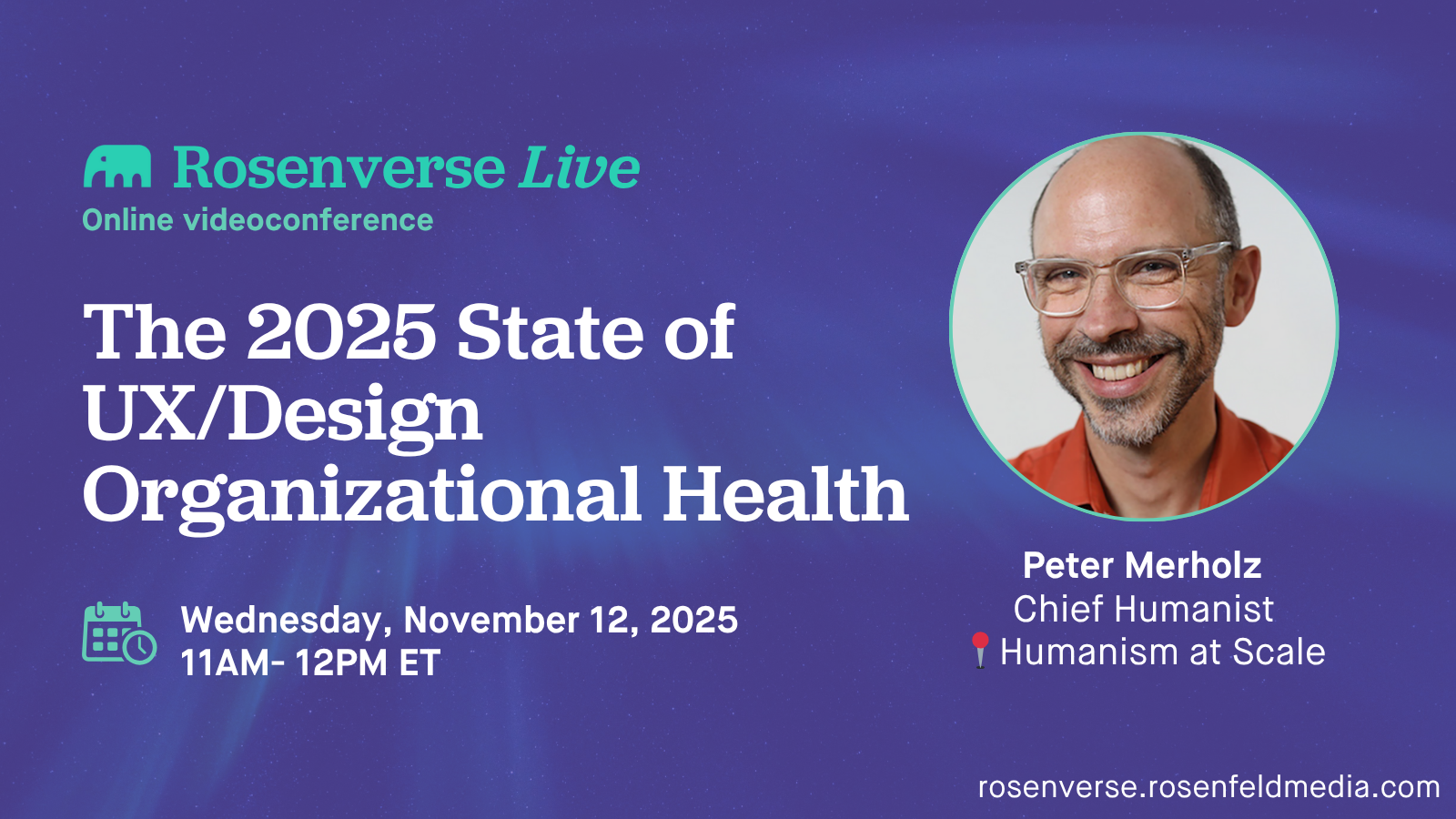
The 2025 State of UX/Design Organizational Health

Summary
This past summer, 763 responded to a series of questions Peter Merholz posted, meant to reveal just how healthy their UX/Design organizations are. The top finding: Individual designers are fulfilled, but their organizations aren't giving them or their teams the support they need to do their best work. Additionally intriguing: there seems to be a sweet spot for org size, certain departments house UX/Design better than others, and the company type that most supports health has been on the decline for 20 years. Join Peter Merholz as we dig into the research, unpack the paradox, and chart a course toward healthier, more effective design teams. If you care about UX organizations not just surviving, but truly thriving, join us for this discussion.
Key Insights
-
•
Designers feel confident and proud about the quality of work they themselves produce despite organizational constraints.
-
•
Most companies lack clear career pathing and career development support for UX and design professionals.
-
•
Insufficient staffing and lack of time to focus on work strongly correlate with high burnout rates among designers.
-
•
Many design teams do not have explicit, robust standards of design quality comparable to engineering or product management standards.
-
•
Reporting lines deeply affect team health: design teams reporting directly to CEOs or digital departments report better organizational health than those under engineering or marketing.
-
•
Professional services and consulting environments yield the happiest and healthiest design teams despite typically lower pay.
-
•
Design organizations sized roughly between 30 and 150 members strike a balance between growth opportunity and avoiding bureaucratic overhead.
-
•
The traditional roles in UX and design are blurring or becoming obsolete, complicating career architectures and growth paths.
-
•
Designers often bring an idealistic mindset that clashes with corporate bureaucracy and pragmatic cultures, which may underpin some dissatisfaction.
-
•
There is a renewed interest in the experience architect role, now often evolving within service design practices, which are distinct yet related to UX design teams.
Notable Quotes
"No s**t designers burnout more than any other function."
"I feel good about the work I do, but my company doesn't ship good work."
"Most organizations don't care that design has an explicit standard of quality."
"Design teams reporting through engineering tend to have the worst quality scores."
"The farther away you are from the CEO or GM, the less happy and healthy your organization tends to be."
"Smaller design orgs rate high on some health indicators but often have no growth path; very large orgs get bogged down by bureaucracy."
"Design as a function is empathetic and human-centered, corporations are calculating and bureaucratic; integrating these value systems takes effort."
"Career growth is mostly about skills development, responsibility, and influence rather than just compensation or titles."
"Many designers don't understand corporate realities and thus have an idealistic view that clashes with organizational constraints."
"Design roles are blurring or dead; super senior individual contributor roles are emerging as a new career path."
Or choose a question:
















More Videos

"When infrastructure breaks down, it is human infrastructure — communities and organizers — that saves the day."
Tricia WangSpatial Collapse: Designing for Emergent Culture
January 8, 2024

"If you want to receive value, you have to create value first; expecting it before contributing is a mistake."
Mark TempletonCreating a Legacy: the ultimate experience
June 9, 2017

"Success here isn’t shipping products, it’s delivering great science and publishing."
Mark BoultonOps without Designers
November 7, 2018

"Budgets are allocated by project, not by specialism, so investment matches the scale of the question, not the methodology."
Catherine BlizzardUsing Integrated Insight to Drive Growth
March 10, 2022

"Far too often security fails because we forget people are involved."
Jeff SussnaWhat DesignOps Can Learn From DevOps
November 6, 2017

"If you don't understand what your audience values, you won’t prove value."
Dianne QueReal Talk: Proving Value through a Scrappy Playbook
October 23, 2019

"If you’re a team of one, focus on getting one stakeholder at a time to sponsor your work."
Jon White Erin MayUnsticking Research for Better Information Flow
March 11, 2026

"You don’t get anyone to do anything."
Matt LeMayYou Don’t “Get” Anyone to Do Anything
December 6, 2022

"I kind of think of it one as like fields of influence — staff influences the team or pillar, principal influences organization-wide."
Catt Small Micah Bennett Brian Carr Jessica HarlleeWhat's Next for ICs: Exploring Staff and Principal Designer Roles
February 22, 2024