Log in or create a free Rosenverse account to watch this video.
Log in Create free account100s of community videos are available to free members. Conference talks are generally available to Gold members.
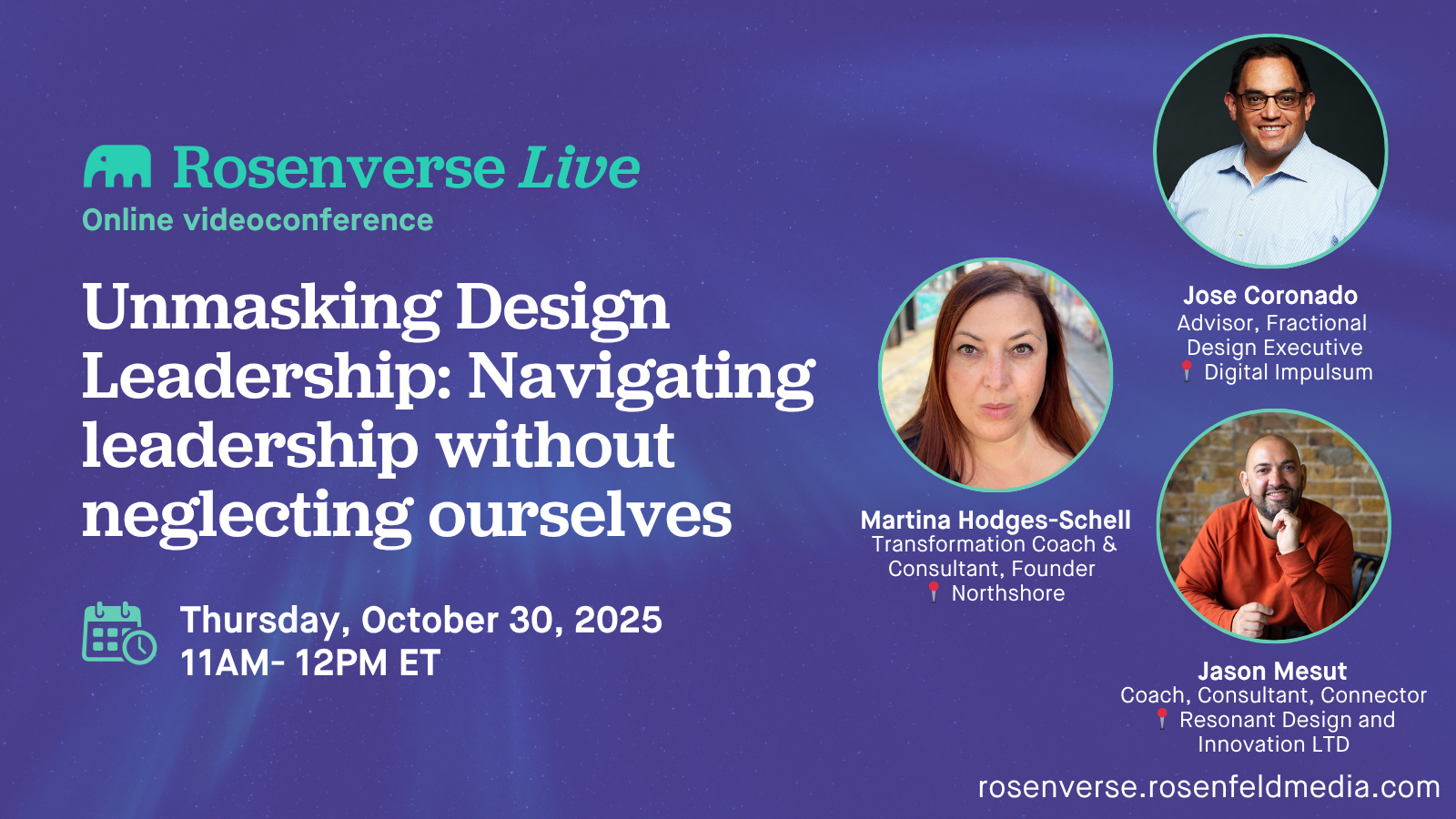
Unmasking Design Leadership: Navigating leadership without neglecting ourselves
This video is featured in the UX Watch Party playlist.



Summary
Many of us wrestle with being the right kind of leader — for our teams, our organizations, and for ourselves. Over the years, Martina, Jose, and Jason have explored the many faces and shapes of design leadership: the archetypes, the attitudes, and the patterns of behavior that shape teams — for better or worse.
Join us for an interactive Rosenverse session where we’ll unpack what positive design leadership looks like in practice. You’ll get a chance to reflect on your own leadership style (and maybe recognize a few familiar archetypes), share stories with peers, and explore how to find a balance between leading others and staying true to yourself.
Come ready to listen, laugh, and maybe even unmask a few of your own leadership habits along the way.
Key Insights
-
•
Six negative leadership archetypes define damaging patterns that many design leaders unintentionally exhibit.
-
•
The Directive Disruptor archetype damages culture by ignoring context and imposing a rigid approach.
-
•
Protective Parent leaders overly shield their team but disempower individual growth.
-
•
Solo Solver leaders prioritize personal relationships over team advocacy, undermining team culture.
-
•
Academic Purists adhere rigidly to tested methods, stifling flexibility and innovation in teams.
-
•
Omni Oppressors attempt to control everything, causing micromanagement and low autonomy.
-
•
Mask Manipulators use emotional manipulation disguised as care, eroding trust and safety.
-
•
Leadership Functions tool helps leaders map where they spend time, what they enjoy, and their confidence across eight dimensions.
-
•
Leadership Dichotomies frames leadership style as spectrums rather than fixed categories, promoting self-awareness and adaptability.
-
•
Reflection and dialogue about leadership styles can surface mismatched expectations and open opportunities for growth and team empowerment.
Notable Quotes
"When we first thought about this topic, we quickly realized we needed to point the finger at ourselves because we've exhibited some of these behaviors."
"Directive Disruptors plow through organizations without listening, causing alienation and low morale."
"Protective Parent leaders hold the umbrella for the team but limit their growth by taking on too much themselves."
"Solo Solver leaders don’t advocate for their team and delegate culture building to others."
"Academic Purists believe one size fits all, ignoring context and stifling innovation."
"Omni Oppressors try to do everything, resulting in micromanagement and harming organizational culture."
"Mask Manipulators appear caring but use guilt and emotional pressure, killing trust and psychological safety."
"The Leadership Functions chart helps reflect on where you spend time, what you enjoy, and where you feel confident."
"Leadership Dichotomies are not opposites but spectrums where leaders find their dominant position and comfort range."
"Many leaders don’t have time to pause and reflect, but that reflection is critical for understanding the full picture of their leadership."
Or choose a question:















More Videos

"With selfie pay, you take a picture, blink to prove it’s you alive, and authenticate in-app seamlessly and securely."
Karen PascoeDeveloping Experience Teams and Talent in the Enterprise
June 8, 2016

"Most of institutional knowledge is tacit, meaning it’s understood or implied without being stated."
Maria TaylorKnowledge is Power: Managing the Lifeblood of the Design Org
October 3, 2023

"Even with all our automation, we always need a human to judge the output."
Claire DhooscheCoordinating chaos: Preventing workflow fragmentation when everyone accelerates with AI
June 9, 2026

"Half the battle is having good questions and the right language to ask those questions."
Louis RosenfeldGenAI for UXers: A Rosenbot Demo and Discussion
June 11, 2025

"You have to keep AI at arm’s length so you can critique it and not blindly trust it - Christopher."
Bria Alexander Brittany Hobbs Christopher NoesselDay 1 Panel: Up to the Minute: The latest in AI’s impact on UX
June 10, 2025

"Maybe I too had joined another tech company that really wasn’t walking the walk when it came to diversity."
Libby MaurerTreating Diversity & Inclusion in Hiring as a Design Problem
December 5, 2019
"The relationship with AI is like having a gopher or minion — don’t give it the final decision."
Louis Rosenfeld Billy Carlson Jon Fukuda Maria TaylorHow AI will Change DesignOps Tooling
October 3, 2023

"AI decision-making on behalf of billions of people isn’t just scary; it’s terrifying and dangerous, so ethics must be embedded."
Mitchell BernsteinOrganizing Chaos: How IBM is Defining Design Systems with Sketch for an Ever-Changing AI Landscape
September 29, 2021

"The marketplace is going to decide if it’s close enough in cost-benefit tradeoff."
Daniel J. RosenbergDesigning with and for Artificial Intelligence
August 11, 2022