
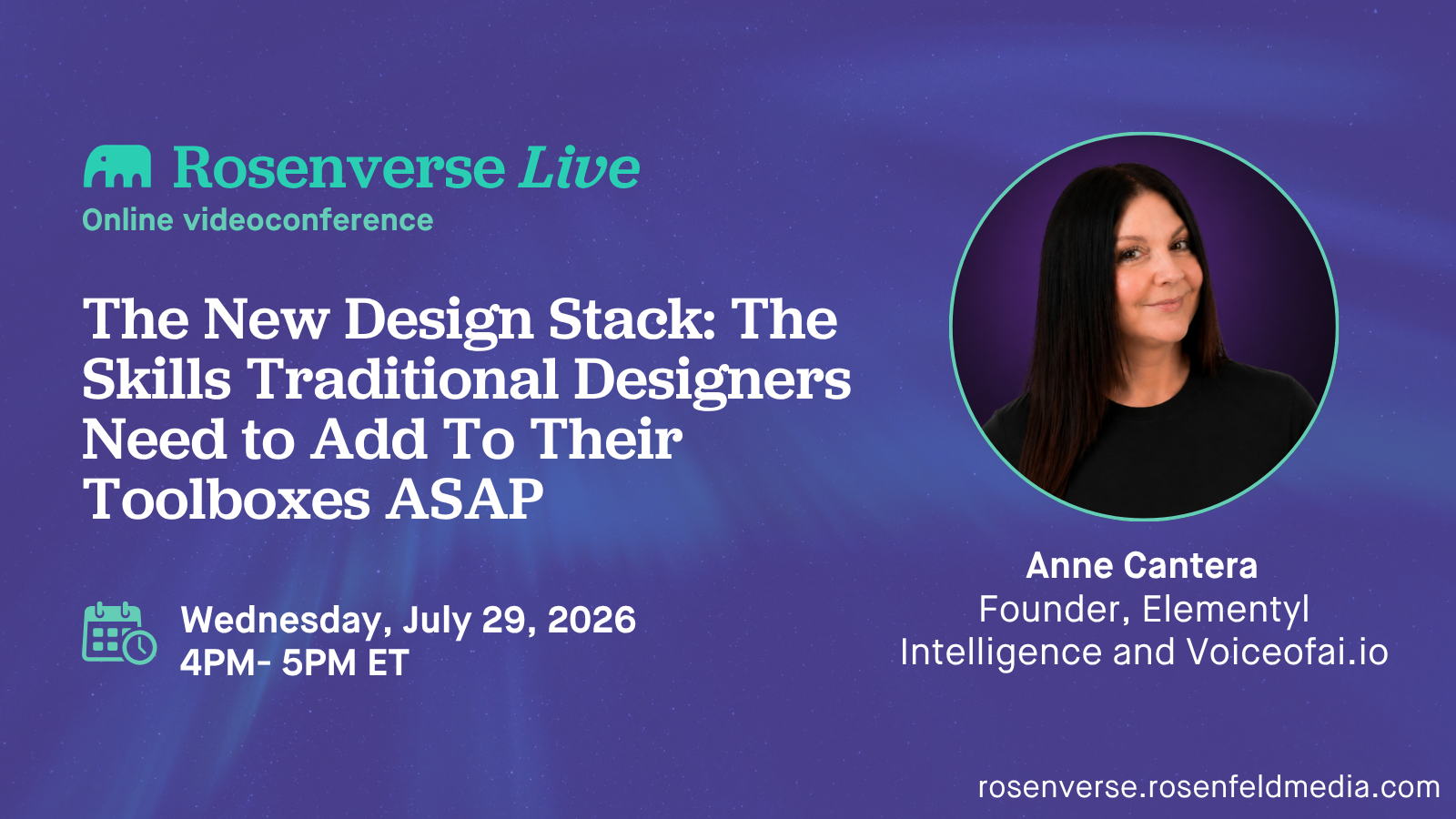
Log in or create a free Rosenverse account to watch this video.
Log in Create free account100s of community videos are available to free members. Conference talks are generally available to Gold members.
The New Design Stack: The Skills Traditional Designers Need to Add To Their Toolboxes ASAP
This video is featured in the UX Watch Party playlist and 1 more.

Summary
Key Insights
-
•
Design is not dead; foundational skills like research, storytelling, and judgment are more important than ever but applied to larger, adaptive surfaces.
-
•
AI interfaces transcend traditional screens and become multimodal—voice, chat, UI, agents, and human handoffs must be designed together.
-
•
Repair and recovery after AI misunderstandings are critical conversations designers live in, requiring explicit language behavior design beyond just input and output.
-
•
Modality routing is a leadership problem as much as a technical one, deciding the best mode—voice, chat, UI, human—in each moment.
-
•
Agents represent a new design material: systems that act by connecting to tools and workflows, requiring design of autonomy, boundaries, permissions, and escalation.
-
•
Journey continuity architecture is vital to maintain context and trust across multiple channels and handoffs, an underaddressed aspect of AI product design.
-
•
Evaluation design in AI products demands new success criteria beyond task completion, focusing also on appropriateness, trust, recovery, and usefulness.
-
•
Governance must be integral from the start, managing model behavior standards, monitoring real-world performance, and assigning accountability—'the human on the hook'.
-
•
Spec-driven design is essential for successful AI products; vague prompting wastes tokens and degrades outcomes.
-
•
AI is best used as a tool to extract, structure, and pressure-test human thinking rather than to replace it, fostering deeper understanding and better artifacts.
Notable Quotes
"Design is not dead; the things we know how to do still really matter."
"A lot of AI products are not failing because of the models. They're failing because nobody designed the experience around it."
"The interface no longer is always a screen. The flow is no longer always linear. The system is no longer always passive."
"The work is designing what the system should mean, how it should behave, when it should act, when it should stop, and how it should care for the person on the other side."
"When the system misunderstands, the experience needs a way to recover without starting over and preserving trust."
"The experience may move across voice and chat or UI or systems and humans, and the context has to survive all that movement."
"The best designers will be the ones who can make intent explicit, choose the right mode, design the handoff, evaluate behavior, and keep the human experience coherent."
"Spec first, generate second. This is not fast. The better the spec, the better the generation, and the better the designer, the better the spec."
"Stop asking AI to magically guess what you mean. Make it interview you, capture your intent, preserve your language, and show you your gaps."
"Governance should have been slide one: these systems keep behaving in the world after release."
Or choose a question:
















More Videos

"It was the first time I’ve actually seen this work all put together like this."
John Mortimer Milan Guenther Lucy Ellis Patrick QuattlebaumPanel Discussion
December 3, 2024

"My mom told me some people don’t like black people, and because of that, I wouldn’t be successful in that school."
B. Pagels-MinorBreaking the Tension: The Power of Enabling Your Employees to Show Up Authentically
June 10, 2022

"Journey maps and service design blueprints focus on flows within parts of a system; ecosystem maps focus on relationships across the system."
Jennifer FraserWhat would Emmy Noether Do? Math, Models and Mulling in UX Research
March 29, 2023

"We want you to leave feeling like all those missed Slack messages and emails are worth it."
Bria AlexanderTheme Two Intro
October 3, 2023

"If seeing a diverse participant pool is important to you, it's your responsibility to make sure your recruiters use it as a priority."
Megan CamposWhat Did I Miss? The Hidden Costs of Deprioritizing Diversity in User Research
March 12, 2021

"We didn't actually overspend our budget. The allocations simply fell short of our expenditure."
Kristin Sundermeyer Tygre MorehartDesign Ops Metrics
September 30, 2021

"Collaboration among technologists, ethicists, and healthcare professionals is key."
Vincent BrathwaiteOpener: Past, Present, and Future—Closing the Racial Divide in Design Teams
October 22, 2020

"Open yourself up to the ways of being, knowing, doing, working, living, and breathing of others."
Victor UdoewaTheme One Intro
March 27, 2023
"I want a story that moves and quakes me, palpitates my heart and shakes me."
Victor UdoewaResearch in the Pluriverse
March 29, 2023
Latest Books All books










Dig deeper with the Rosenbot
How can naming vulnerabilities in a team setting improve communication and accountability?
What are the core question groups Tomer identified from interviewing product managers and investors?
What roles can information architects and service designers play in the emerging field of AI context engineering?