Log in or create a free Rosenverse account to watch this video.
Log in Create free account100s of community videos are available to free members. Conference talks are generally available to Gold members.
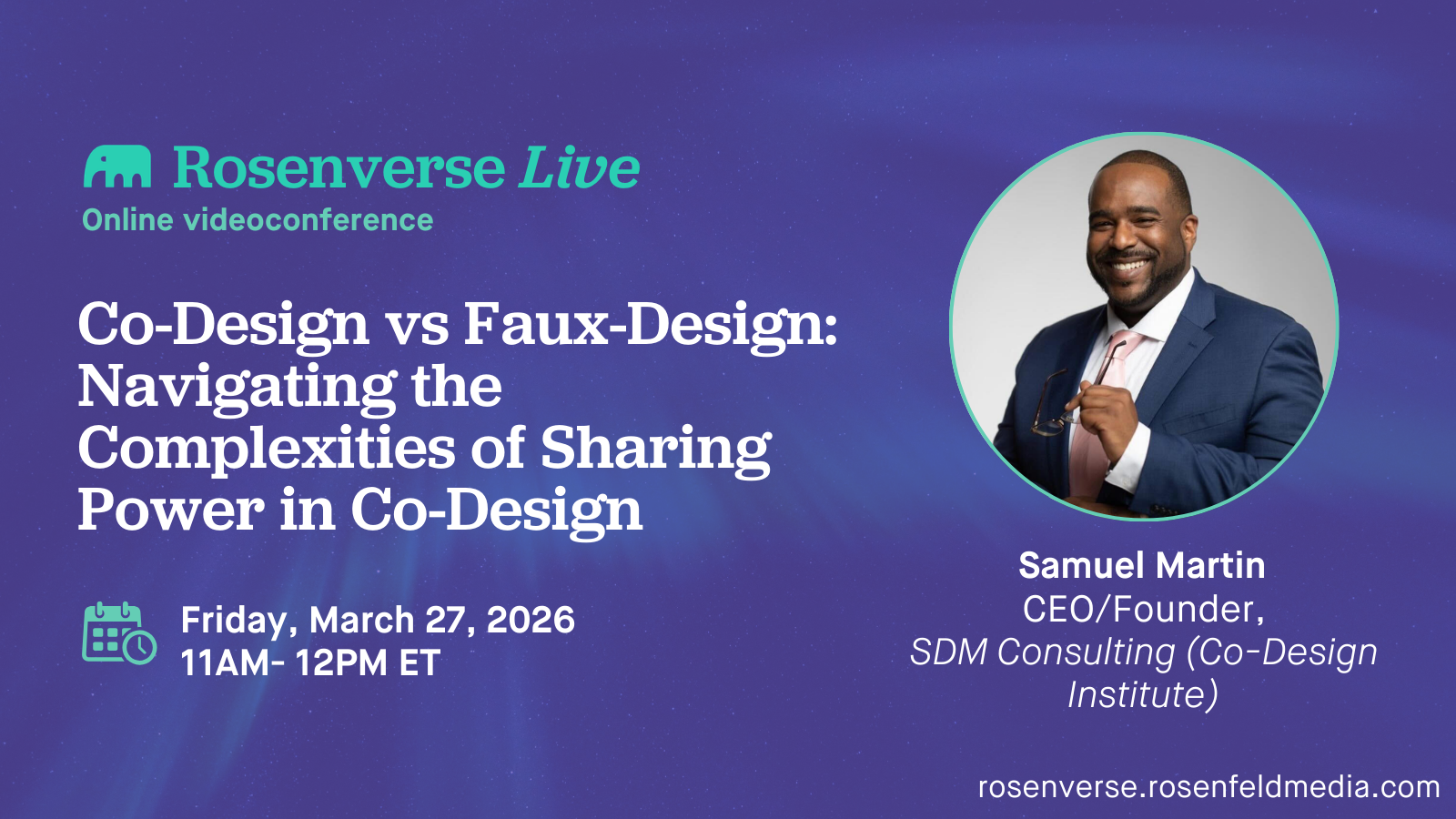
Co-Design vs Faux-Design: Navigating the Complexities of Sharing Power in Co-Design
This video is featured in the UX Watch Party playlist.

Summary
This session invites professionals, advocates, system designers, and lived experts alike to grapple with uncomfortable questions about who holds power and at what cost. It will equip participants with practical tools to recognize tokenism, navigate conflict, and build processes where lived experts drive true change.
Key Insights
-
•
Co-design is an approach that builds with, not for, communities by sharing power across the entire engagement.
-
•
Authentic lived experience must be directly relevant; proxies or near experiences risk diluting design intention.
-
•
Healing and trust-building are foundational to effective co-design, particularly given historical traumas in marginalized communities.
-
•
Power sharing requires explicit acknowledgment of power imbalances and establishing structures that allow community decision-making authority.
-
•
Participatory engagement should accommodate diverse communication and participation styles, including art, conversation, and digital formats.
-
•
Surveys tend to be less effective for trust-building and deep engagement compared to qualitative, relational methods like focus groups and one-on-ones.
-
•
Compensation for lived experts must be meaningful and equitable, recognizing their expertise as equally valuable as academic or professional input.
-
•
Removing participation barriers (e.g., childcare, internet access, food insecurity) is essential to equitable co-design processes.
-
•
A continuum of engagement—from ignoring to co-creating—helps organizations assess and evolve their community involvement strategies.
-
•
Innovations from lived experts are often practical and empathetic to systemic constraints, debunking myths about unrealistic demands.
Notable Quotes
"Together we can bridge the gap by incorporating lived expertise and knowledge through access and opportunity."
"If someone doesn’t have that direct lived experience, it’s not just enough to go to the closest thing you can find."
"We have a responsibility to help heal communities and build trust so we can do design with intention."
"Power is more than authority; it involves influence, privilege, and communication styles that shape dynamics."
"The same reason they hire us is the very reason why they fire us, because when things get real, it sometimes gets hard."
"You should never be engaging lived experts without compensating them for their time."
"When you’re doing a survey, think about if it can be done in a way that is much more accessible."
"Lived experts are the most innovative voice in the design process, bringing unique and practical solutions."
"Sometimes limitations mean you can’t fully co-create, but transparency about where you are on the engagement continuum matters."
"We want shared ownership and trust leading to community-led, informed, and sustainable outcomes."
Or choose a question:
















More Videos

"Scaling up research impact means turning visibility way up and opening access despite some risk of misuse."
Jake BurghardtStop wasting research: Create new value with insight summaries
July 9, 2025

"Not every insight is eternal; some are tied to a specific prototype or test, while others about human nature last years."
Eduardo Ortiz Robin Beers Rachael Dietkus, LCSW Bruce Gillespie Jess Greco Marieke McCloskey Renee ReidDay 3 Theme Panel
March 13, 2025

"We're at a pivotal moment where technology can truly make a difference in sustainability."
Ash BrownSilver Linings: What DesignOps Learned in the Shift to WFH
October 23, 2020

"Sherbiney built a well-functioning agile train in one of the oldest organizations."
Lada GorlenkoTheme 1: Intro
January 8, 2024

"Uber and Lyft increased traffic congestion by 40 to 50 percent in cities like San Francisco."
Dan HillStrategic design, slowdown, and the infrastructures of everyday life
April 21, 2022

"Having a well-thought-out data package really helps us see a fuller picture."
Brad Peters Anne MamaghaniShort Take #1: UX/Product Lessons from Your Industry Peers
December 6, 2022

"People broadly fall into three communication styles: positive, fact-based, and intensity-based."
Dalia El-ShimySo You've Got a Seat at the Table. Now What?
March 31, 2020

"Once collaboration loops start compounding, they become muscle memory and the structure supports our work."
Gina Mendolia Jasmine ToyCoordinated collaboration: a Service Design & DesignOps love story
November 19, 2025

"If these two voices don’t work for you, you can reach out at [email protected]."
Bria Alexander Louis RosenfeldOpening Remarks Day 2
March 26, 2024