Log in or create a free Rosenverse account to watch this video.
Log in Create free account100s of community videos are available to free members. Conference talks are generally available to Gold members.
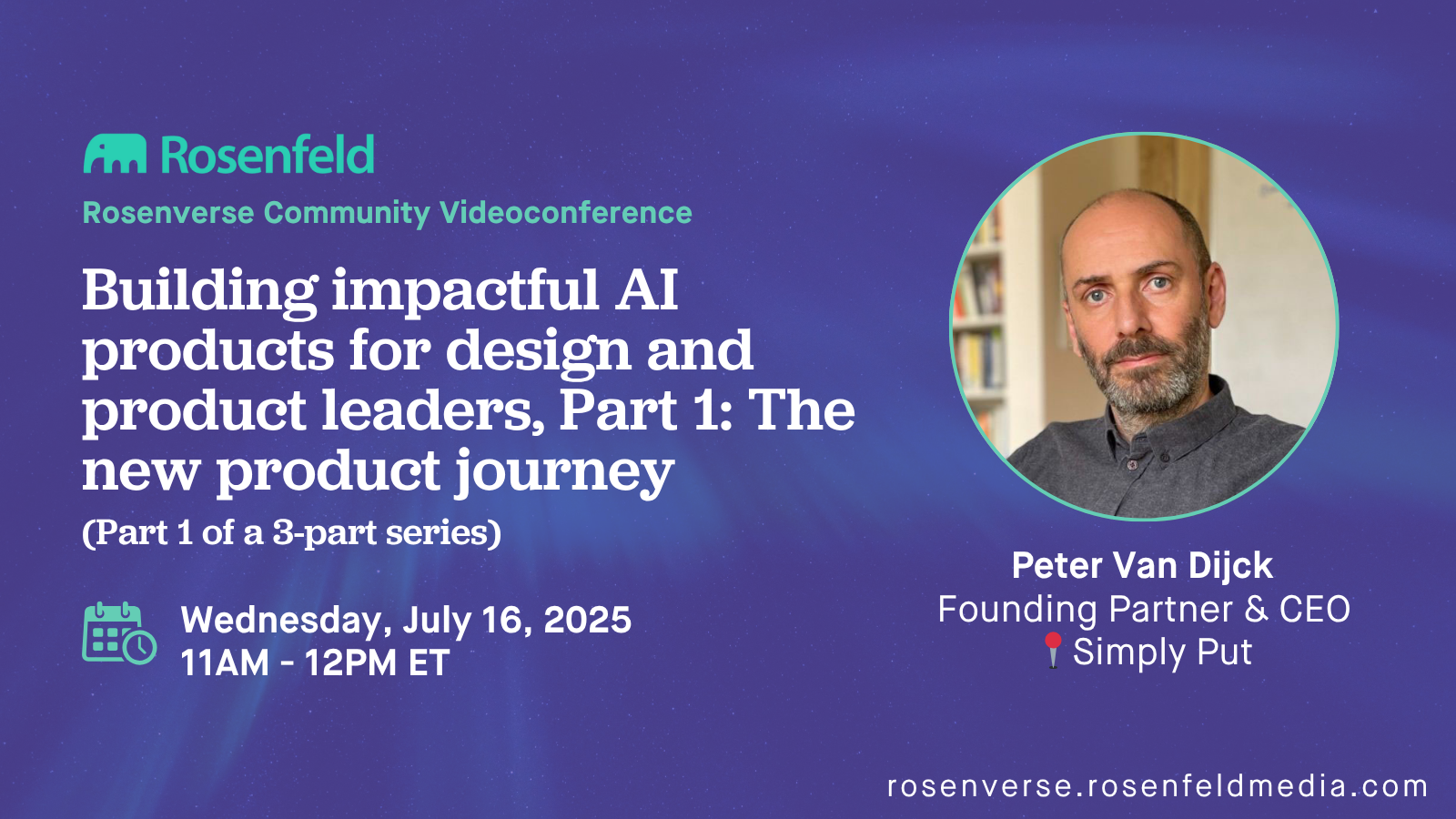
Building impactful AI products for design and product leaders, Part 1: The new product journey
This video is featured in the AI and UX playlist.

Summary
This talk is for product people, UX designers, researchers, and leadership preparing to work on AI products. How do we plan and build helpful and impactful AI products? What is different in this new world? Products that use AI as a core part of the experience are often very easy to prototype, but really hard to build and make actually useful and impactful. A lot of the knowledge on how to build these is locked up in foundation model companies and engineering teams in startups. Peter van Dijck, expert in both AI and IA, will provide an easy to understand framework for understanding how to think about this new world we all live in now, how to plan for effective, helpful and impactful AI products, how to think about model capabilities, AI architectures and evaluations. You will learn vocabulary and frameworks to understand what all the acronyms mean, and how to think about them.
Key Insights
-
•
AI product design is best understood through a model, context, and experience framework.
-
•
Models are stateless and require full context to be sent with each interaction.
-
•
Prototyping to explore model capabilities is critical before building full products.
-
•
Evals, automated and manual, are essential to measure model output quality and decide if it’s good enough.
-
•
Models gain enhanced abilities through post-training on specific capabilities like reasoning and conversational skills.
-
•
Synthetic data generation enables scalable training and evaluation by producing many good and bad examples.
-
•
Tool use and function calling empower AI agents to autonomously perform multi-step tasks.
-
•
Agents like Cloud Code gain product-market fit by making model reasoning and actions visible to build user trust.
-
•
UX principles remain vital in AI product development, especially when designing evals and assessing experience.
-
•
In high-risk domains, explicit risk identification and eval development are necessary, alongside clear ownership of go/no-go decisions.
Notable Quotes
"Today’s best AI products are designed by engineering first, but UX and product people have to join the party."
"Models are stateless; they take input and give output and forget everything immediately after."
"You want to trust the model, which means not overly instructing it but giving it the right context."
"Evals are the key to knowing when an AI’s output is good enough."
"Model companies post-train models on capabilities by showing them millions of good and bad examples."
"Tool use and function calling are what make agents possible, letting models call tools and reason through tasks."
"Synthetic data is exceedingly useful because you can generate it at scale for training and evals."
"The reason Cloud Code has such product market fit is because it shows what it’s doing, building trust."
"UX skills especially shine in defining realistic, user-centered evals and collaborating with experts."
"If a capability exists and is useful, it’s very likely the model will improve significantly on it over time."
Or choose a question:
















More Videos

"One thing I learned from working with product people is how to speak their language like all disciplines."
Noreen Whysel Katie SaindonShort Take #4: UX/Product Lessons from Your Industry Peers
December 6, 2022

"We set a two-year goal to advise leadership on top issues for annual planning, even though we hadn’t figured out all the steps."
Mac SmithMeasuring Up: Using Product Research for Organizational Impact
March 12, 2021

"Design is not dead; the things we know how to do still really matter."
Anne CanteraThe New Design Stack: The Skills Traditional Designers Need to Add To Their Toolboxes ASAP
July 29, 2026

"Every major brand has a dark side brought to you by design on purpose, 40 hours a week."
George AyeThat Quiet Little Voice: When Design and Ethics Collide
November 16, 2022

"The Apple 3GS and the accessibility that was developed by Apple was a massive shift."
Sam ProulxTo Boldly Go: The New Frontiers of Accessibility
March 11, 2022

"Accessibility at scale can put you into the VUCA world – volatile, uncertain, complex, ambiguous."
Sheri Byrne-HaberAccessibility at Scale
June 9, 2021

"Slowing down with research can help us move faster overall."
Kristen Guth, Ph.D.Out of the FOG: A Non-traditional Research Approach to Alignment
March 28, 2023

"Our team was the only thing you could describe as an actual team—because we deliberately built onboarding and culture."
Tanya SnookDesigning the team experience: Building culture through onboarding
November 4, 2021

"We’re really passionate about our craft but we’re not in control — that’s a shared hallucination we must give up."
Craig VillamorResilient Enterprise Design
June 8, 2017