Log in or create a free Rosenverse account to watch this video.
Log in Create free account100s of community videos are available to free members. Conference talks are generally available to Gold members.
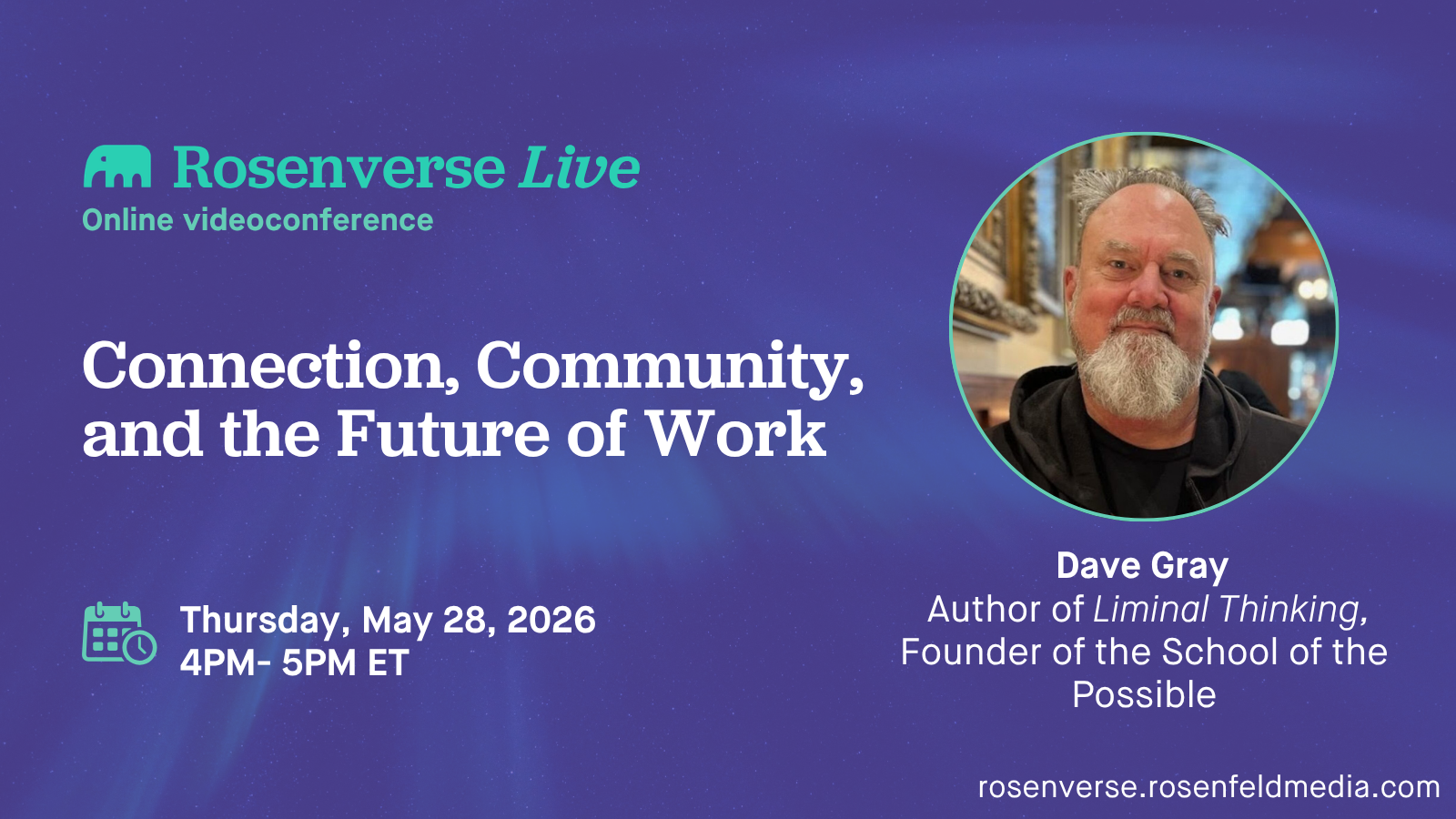
Connection, Community, and the Future of Work
This video is featured in the UX Watch Party playlist.
Summary
Key Insights
-
•
Major technological shifts historically compress and redirect human labor into radically new types of work.
-
•
The current decline of corporate jobs might accelerate a return to practice-based economies tied to personal relationships and community.
-
•
Practice work, such as barbers or local journalists, resists automation due to its relational nature and intrinsic value.
-
•
The pace of technological change is accelerating, outstripping the ability of social, economic, and political institutions to adapt smoothly.
-
•
Cultural orientations, such as individualism in the US versus collectivism in China, shape differing approaches to AI-driven disruptions in the workforce.
-
•
The modern corporation, starting with Dutch and British East India companies, decouples work and accountability from local communities and land.
-
•
Work identity strongly impacts human dignity; job loss is often experienced as a deep violation beyond financial consequences.
-
•
There is potential for individuals to create unique value and 'customers' directly rather than fitting into corporate job descriptions.
-
•
Economic inequality challenges the feasibility and equity of accountable local or practice economies in undercapitalized communities.
-
•
The historic notion and language of 'jobs' as employer-employee roles only emerged around 1850, linked to industrialization and corporate structures.
Notable Quotes
"If you zoom out far enough, a new technology comes along and it sucks up human labor and puts them into a completely new paradigm."
"I think maybe that’s the time has come for universal basic income, but never in history have I seen governments just pay everybody to be there."
"Most people would prefer to be foraging than work on a farm, but farmers kept taking all the land."
"The corporate work is actually starting to decline after peaking because it’s a form of extraction that may be collapsing."
"Social institutions need generations to adapt, but now changes happen within fragments of a lifetime, making transitions painful."
"The modern corporation decouples accountability from territory and functions as arbitrage machines with no one truly responsible."
"If the corporate form collapses, we need to think about how to provide value to our actual communities, virtual or local."
"Practice work means understanding your value to someone and being able to ask for money directly, which is validating."
"The word job did not mean employer-employee until after 1850; before that, jobs were chores or tasks people did."
"We are ultimately status-seeking monkeys, and our attachment to work is largely about our perceived role and rank."
Or choose a question:















More Videos

"Sponsor sessions do not overlap at all with the main programming. It is 100% fully optional."
Bria AlexanderOpening Remarks
October 3, 2023

"Non-attachment to our insights and to our identities opens space for growth and better collaboration."
Jemma Ahmed Subhasree Chatterjee Robert Fabricant Alexandra Jayeun Lee Ben RobinsCollaboration: learning from other fields beyond our own [Advancing Research Community Workshop Series]
August 7, 2024

"Design ops is the bridge between silos and agencies that otherwise tend to be somewhat stagnant."
Elena Naids Liza McRuerThe Power of Difficult Conversations: A Case Study on How We Introduced Design Ops in the Federal Government Space
October 2, 2023

"The only way to do research wrong is to not do it at all."
Benjamin Wiedmaier Annie MayfieldRedefining Toolkits: Unbundling to Create a Perfect Match
March 11, 2025

"Hallucinations are a kind of AI creativity—dreaming, invention, fiction—all forms of hallucination."
Matt WebbContext Window: Five Futures for AI
June 11, 2025

"Even though we’ve got a single dropdown field, it maps to a far richer set of instructions in the prompt."
Trisha Causley[Demo] Complexity in disguise: Crafting experiences for generative AI features
June 5, 2024

"People often fill gaps in communication with their own anxieties, so clear communication is key."
Bassel Deeb Will OsbornDo More With Less: Equip and Lead Design Orgs Through Adversity
October 2, 2023
"There’s no need to take notes; we’ve got session notes, sketch notes, and a resource list all provided."
Bria AlexanderOpening Remarks
September 29, 2021

"In enterprise, people often just want to not get fired — that’s a very important need."
Christian RohrerInsight Types That Influence Enterprise Decision Makers
May 13, 2015