Log in or create a free Rosenverse account to watch this video.
Log in Create free account100s of community videos are available to free members. Conference talks are generally available to Gold members.
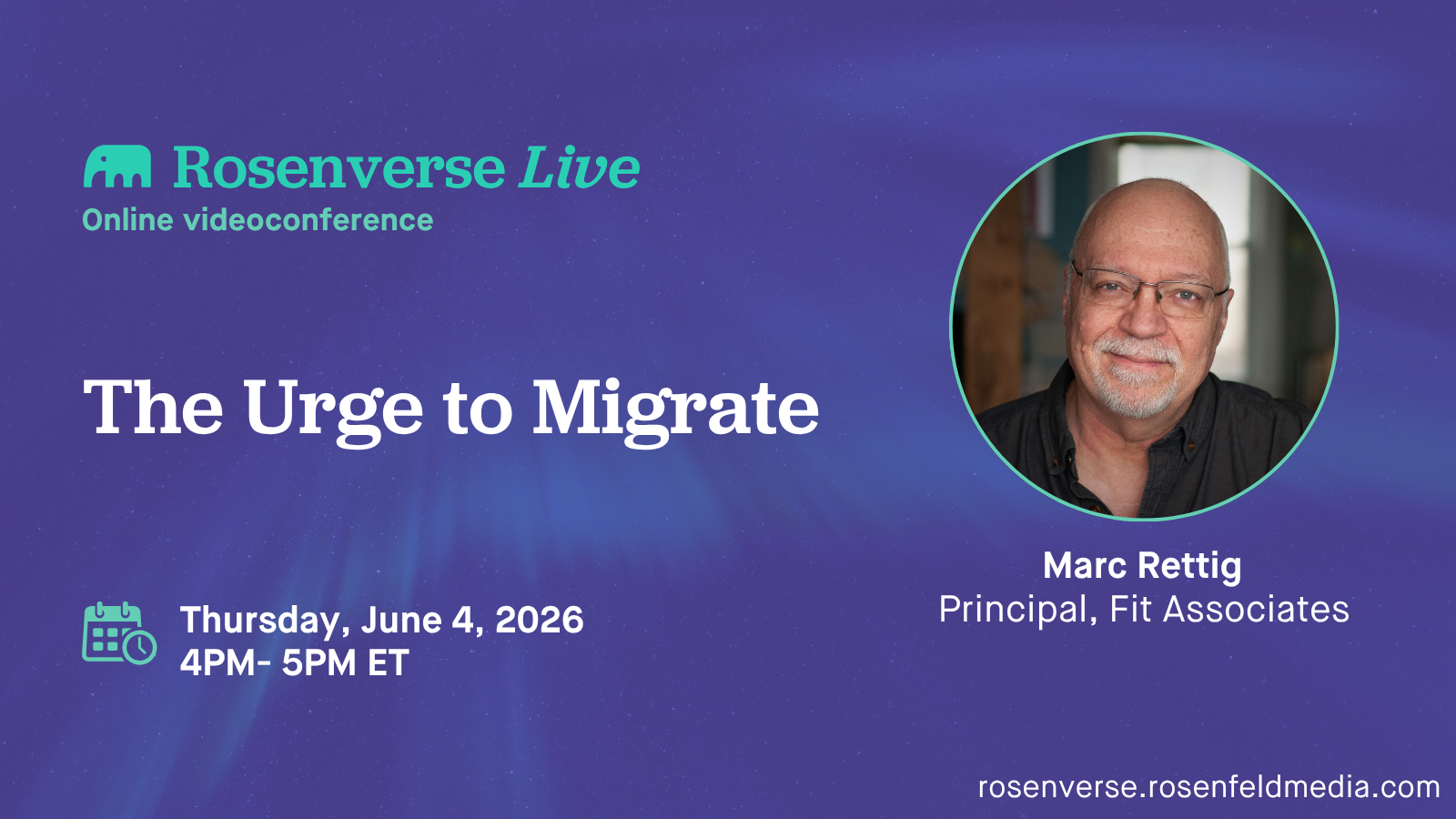
The Urge to Migrate

Summary
This session starts with a feeling. A kind of itch. Maybe the project is touching questions we weren't trained to answer. The outcomes feel smaller than the problems. Work as usual feels… uncomfortable. Or maybe it’s better than that: seeing the forces at play in the world, there’s a desire to contribute beyond the scale of an organizational agenda. Something is pulling. Toward what, exactly, you can't yet say. This session is for anyone who recognizes that feeling, even faintly. Marc Rettig spent decades in corporate design before following what his late collaborator Hanna du Plessis called ""the urge to migrate""—the push of a container that no longer fits, and the pull of something not yet visible. In his case, that migration carried him out of the familiar territory of design-led problem-solving, into a different kind of work: long-term co-creation with communities, and the challenge of shifting deeply ingrained social patterns. In a series of first-person vignettes, he'll trace that journey: the first spark, the crossings, the companions, and what he found on the other side. Not as a how-to, but as a personal lens useful to anyone standing at the edge of something they cannot yet name. Marc’s talk will be followed by time for open conversation.
Key Insights
-
•
Feeling 'homeless' can arise when professional expertise no longer aligns with personal purpose or societal needs.
-
•
Executives often focus on revenue outcomes, which can obscure deeper human stories and opportunities in design work.
-
•
Crossing the threshold to social design requires letting go of familiar roles and narratives about oneself.
-
•
Social complexity differs from traditional problems; it involves change-resistant patterns rooted in relationships and culture.
-
•
Poetic and metaphorical language helps make sense of complex social transitions and internal states.
-
•
Hosting rather than facilitating reflects a stance focused on presence, listening, and enabling collective emergence without imposing agendas.
-
•
Capacity building in social design works by nurturing conditions and relationships rather than delivering fixed solutions.
-
•
Different cultures experience social complexity and collective work differently; sensitivity to cultural context is essential.
-
•
Inner work, including holding strong emotions and self-presence, is essential for effective social design and hosting.
-
•
Communities of practice are emerging around social design, offering hope despite fragmentation and uncertainty.
Notable Quotes
"I feel homeless. More revenue for the client was not my home intention, not my purpose."
"What you can dream is too small for you to live because what you can see is constrained by where you're standing."
"The further you go into social complexity, the deeper the soil under your feet—the roots of intergenerational trauma and cultural stories."
"Hosting is being a light presence to help the group see and listen without judgment, moving attention from me to us."
"It's not only a difference in method; it's a difference in stance, mindset, intention, and how power works in creation."
"We’ve got to get louder. We outnumber the haters, but we’ve got to be louder."
"The urge to migrate comes from restlessness, a longing for change, not just because the habitat becomes colder."
"Sometimes when you're lost, the thing to do is stop and stop repeating the story you've told yourself for years."
"Social patterns are established, change-resistant patterns that emerge from the interactions between people."
"You are more beautiful in your simple wish to find a way than the gilded ruse of any destination you could reach."
Or choose a question:
















More Videos

"Having each other's backs is like literal video game hero style slaying constraints."
Jennifer KanyamibwaCreating the Blueprint: Growing and Building Design Teams
November 8, 2018

"Buddy systems create leadership opportunities and a support network without changing org charts."
Russ UngerOnboarding: The Ecosystem, not the Afterthought
November 7, 2017

"Leadership is unlocking potential and taking responsibility, far beyond the title or executive level."
John Mortimer Milan Guenther Lucy Ellis Patrick QuattlebaumPanel Discussion
December 3, 2024

"I was trained to isolate very specific data points and only assert what was backed by evidence."
Michele MarutResearch Repositories Reconsidered
February 14, 2019

"Why am I talking? Sometimes it’s better to ask a question and be silent."
Laura WeissThere is No Playbook: Leader as Coach During Challenging Times
April 26, 2024

"Nobody really knows what all this AI stuff is about yet, so we’re experimenting with it ourselves."
Louis Rosenfeld Peter Van DijckGenAI for UXers: A Rosenbot Demo and Discussion
September 11, 2025

"You never start AI product design from the technology itself; you start from the user outcomes and retro-engineer the needed context."
Peter Van DijckBuilding impactful AI products for design and product leaders, Part 3: Understand AI architectures: RAG, Agents, Oh My!
July 30, 2025

"Data, information, and knowledge are distinct, and we need systems that transform data into actionable context-rich knowledge."
Husani OakleyTheme Two Intro
June 6, 2023

"This work does not fit our product program."
Aditi Ruiz Christian Crumlish Farid SabitovA PM State of Mind: Empathy Mapping Your Product Manager, Pt. 1
December 6, 2022