Log in or create a free Rosenverse account to watch this video.
Log in Create free account100s of community videos are available to free members. Conference talks are generally available to Gold members.
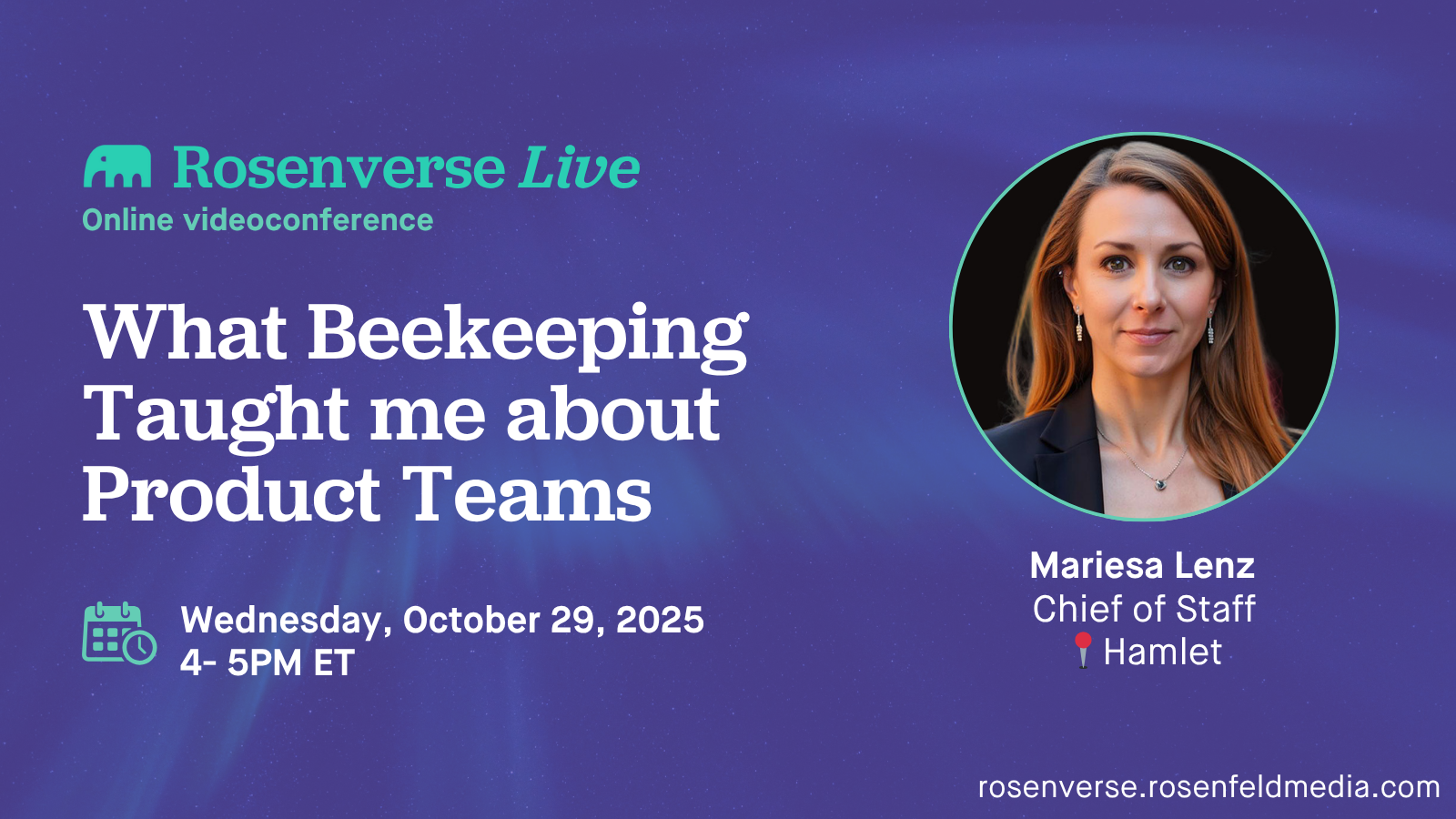
What Beekeeping Taught me about Product Teams

Summary
Key Insights
-
•
Bees do not have a central decision-maker; the queen reproduces but does not control the hive.
-
•
Resilience in teams is about preparation and sustainable effort, not speed or vanity metrics.
-
•
Building resilience requires creating feedback loops, rituals, and time for reflection to adapt rather than just hustle.
-
•
Product teams should trade some efficiency for better resilience to handle unpredictable changes.
-
•
High-functioning teams distribute knowledge and decision-making power rather than centralizing it.
-
•
Trust and clear communication among team members are fundamental to collaboration and autonomy.
-
•
Teams aligned around a shared purpose perform more cohesively and innovate better.
-
•
Autonomy and interdependence must be balanced; individual roles shift dynamically like worker bees’ changing tasks.
-
•
Effective communication in bees uses subtle signals like waggle dances, which product teams can parallel with roadmaps and open collaboration.
-
•
Psychological safety is crucial so team members can take initiative without fear of failure or punishment.
Notable Quotes
"The queen is not a decision-maker, she’s just there to reproduce."
"Bees measure success not by how fast they work but by how well they prepare."
"True success means designing teams for resilience so they’re ready for whatever season comes."
"Adaptability isn’t weakness, it’s strength."
"High functioning teams are built on trust and not control."
"No bee micromanages another; they have different roles and contribute independently but in sync."
"Every bee understands the same purpose — the survival of the hive for winter."
"Teams can thrive when iteration and responsiveness are normalized and psychological safety is present."
"The waggle dance communicates direction and distance to new food sources with remarkable precision."
"Leadership is not about having all the answers but facilitating conversations with experts to find solutions."
Or choose a question:
















More Videos

"If you want to work with Hilton, you have to bring accessibility to the table like security and privacy."
Nicole Bergstrom Anna Cook Kate Kalcevich Saara Kamppari-MillerAccessibilityOps: Moving beyond “nice to have”
September 19, 2024

"Sometimes you need somebody else to tell you something obvious, like consultants should not be expected to know everything upfront."
Smitha Papolu Nova Wehman-Brown Melissa Schmidt Adam MenterTheme 3 Discussion
January 8, 2024

"It becomes the designer’s responsibility to figure out what aspects of the instructions to the LLM should be configurable and what should be fixed."
Trisha Causley[Demo] Complexity in disguise: Crafting experiences for generative AI features
June 5, 2024

"Bringing in expert interviews and secondary data gives you an outsider’s perspective to challenge the status quo."
Megan BlockerGetting to the “So What?”: How Management Consulting Practices Can Transform Your Approach to Research
March 26, 2024

"If roles and responsibilities aren’t clear, scope starts to grow legs and we end up on rabbit holes that dilute the original project."
Séamus ByrneAligning Teams with Choreography
January 8, 2024

"Even though we're virtual, our code of conduct still applies and requires respect and kindness."
Bria AlexanderOpening Remarks
January 8, 2024

"We decided these would be the social norms now, and we just went for it."
Ilana LipsettAnticipating Risk, Regulating Tech: A Playbook for Ethical Technology Governance
December 10, 2021

"I always want to see the work, the design iterations, not just the finished product."
Marissa Cui Rachel He Michael Leggett Manos SaratsisClimate Design Product Showcase
March 13, 2024

"Design thinking became a theater, a spectacle that generated feeling of meaningful work while systematically evacuating its content."
Angelos ArnisOur Fragmented Identity
June 12, 2026