Log in or create a free Rosenverse account to watch this video.
Log in Create free account100s of community videos are available to free members. Conference talks are generally available to Gold members.
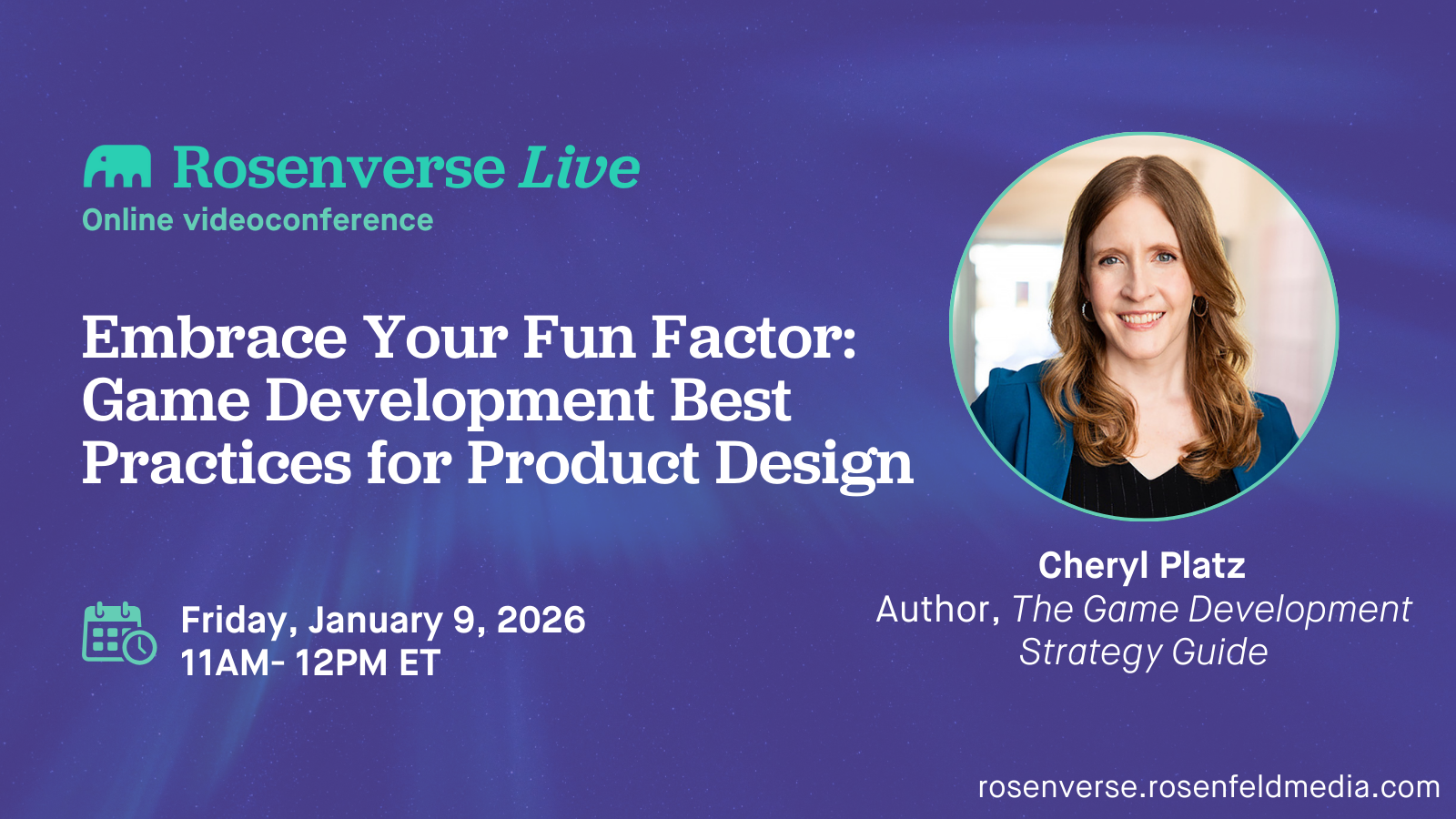
Embrace Your Fun Factor: Game Development Best Practices for Product Design
This video is featured in the UX Watch Party playlist.

Summary
According to a Circana report from October 2024, 71% of US consumers play video games. So why is it that we treat the art and science of game design and development as completely separate from product design? Many of your customers view video games as the ultimate way to spend their time, and the best practices developed there are forged in the fire of a hyper-competitive marketplace. \ In this session, author Cheryl Platz shares her insights as a missing link between the two worlds. She’s worked as design lead for Microsoft’s Azure platform, but she’s also served as UX Director for Riot Games and Scopely’s MARVEL Strike Force in addition to her continuing role as adjunct faculty of video games for Carnegie Mellon University’s Masters of Entertainment Industry Management program. You'll learn about some of the most universally applicable insights from her new Rosenfeld book The Game Development Strategy Guide: Crafting Modern Video Games That Thrive, including the Motivators of Play – a tool for understanding player and customer behavior backed by cognitive psychology and industry research that reveals how expectations have changed deeply in the past decade. You’ll also be introduced to useful concepts around monetization, emergent behavior, and designing for positive large-scale interactions. Isn’t it time to level up your product design skills with a new skill tree?
Key Insights
-
•
71% of people self-identify as gamers, making game design principles widely relevant.
-
•
Classic motivators of play include mastery, competition, immersion, meditation, and comfort.
-
•
Modern motivators like self-expression, companionship, and education have risen due to technological and social changes.
-
•
Competitiveness as a motivator has diminished, replaced increasingly by a desire for companionship and collaboration.
-
•
Misapplied gamification, such as meaningless badges or incentivizing harmful behaviors, can demotivate users.
-
•
Game loops help understand and optimize user engagement by linking sequential player actions with feedback.
-
•
Pro-social design focuses on fostering positive social interactions and community safety, a key challenge at scale.
-
•
Ethical monetization varies; pay-to-express models (cosmetics) are less harmful than pay-to-win (pay-for-power) schemes.
-
•
Duolingo exemplifies both strengths (mastery challenges) and pitfalls (manipulative nudges, declining immersion) in gamified products.
-
•
Understanding and designing for motivators can transform traditionally 'non-fun' domains like banking, healthcare, and enterprise software.
Notable Quotes
"If 71% of people self-identify as gamers, why aren’t you learning from the video game industry?"
"Is gamification just last decade’s fad or have the principles become so ubiquitous we stopped calling it that?"
"With great power comes great responsibility; we shouldn’t abandon using motivation techniques, or others will use them poorly."
"Competitiveness doesn’t motivate play as much as it used to; companionship and collaboration are more motivating now."
"Mastery is a core human motivator; people want to understand and feel competent in what they do."
"Pro-social gaming is about designing for positive social interactions that contribute to thriving communities."
"Not all monetization is equal; pay-to-express models are less threatening to social dynamics than pay-for-power schemes."
"Duolingo’s AI push damaged immersion by breaking narrative cohesion and lowering course quality."
"The Echo Look failed because it missed key motivators like self-expression and companionship by focusing too much on AI."
"Designing for human motivation makes experiences more likely to thrive long term."
Or choose a question:















More Videos

"Teams ask good questions; the problem was how they were answering them—often with opinions or coworkers, not valid evidence."
Julia CowingFrom Researcher to Builder: Vibe Coding Tomer Sharon's Method Finder
July 23, 2026

"Reading unfamiliar news content helps you see structure and language more clearly than reading what you already care about."
Shazia Ali Bruce Gillespie Joyce Lee Andy WarrCommunication: Innovative techniques for making your voice heard [Advancing Research Community Workshop Series]
August 21, 2024

"Keeping something cloud-based accessible is the most complicated because of hundreds of releases per day in continuous integration."
Sheri Byrne-HaberAccessibility at Scale
June 9, 2021

"We don't assume companies intentionally fail certain audiences; it’s often about awareness and lacking champions."
Suzan Bednarz Hilary SunderlandAccessibilityOps for All
January 8, 2024

"Cross-silo communication is huge because AI is only as good as the permeable membrane between data."
Erika FlowersAI-Readiness: Preparing NASA for a Data-Driven, Agile Future
June 10, 2025

"Human connection is a basic need that doesn’t get paused just because someone works remotely."
Jilanna WilsonDistributed Design Operations Management
October 23, 2019

"The head is where we are logical and rational and ask why do we need to include inclusion in Design Ops."
Saara Kamppari-MillerTheme Three Intro
September 9, 2022
"People don’t really care about design methods; they care about solving problems and achieving impact."
World Usability Day Panel Discussion
November 10, 2022

"I thought, maybe now is the time for change, maybe designers should code—maybe the better question in 2025 is should I code."
John DonmoyerShipping your code generation experiments to production
June 11, 2025