Log in or create a free Rosenverse account to watch this video.
Log in Create free account100s of community videos are available to free members. Conference talks are generally available to Gold members.
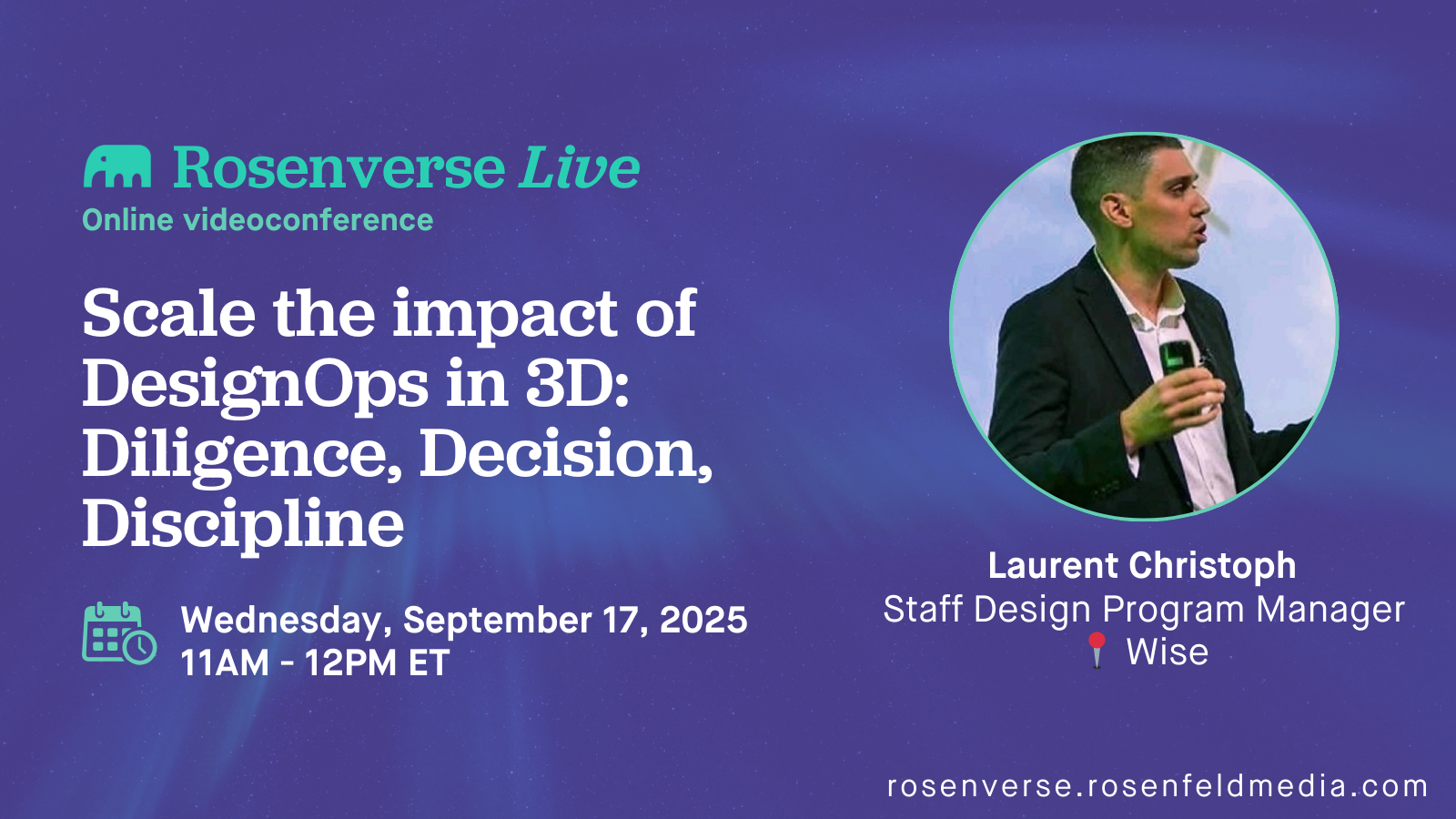
Scale the impact of DesignOps in 3D: Diligence, Decision, Discipline

Summary
Driving some of these initiatives can be very time-consuming yet they often fail to deliver meaningful impact. What differentiates failed initiatives from successful ones? Is it creativity? Vision? A top-down mandate? Efficiency?
It actually comes down to 3 factors: Diligence, Decision and Discipline.
Diligence is about identifying the true needs of the organisation. Decision is about having a strategic and repeatable decision making process that gets stakeholders on board. Discipline is about instilling accountability towards execution because without execution there's no impact.
Learn how to apply the 3D framework, a practical blueprint for driving meaningful change, scaling design capabilities and delivering true value to your organisation.
Key Insights
-
•
Diligence requires uncovering organizational culture beyond surface-level mission statements by searching for stories and performing systems mapping.
-
•
Effective design ops is akin to being a product manager for the design organization, needing systematic decision frameworks.
-
•
Design critiques fail or succeed largely based on the psychological safety and culture surrounding the practice, not merely cadence or tools.
-
•
Execution discipline demands defining lead measures, maintaining visible scorecards, and establishing regular accountability check-ins.
-
•
Starting initiatives without understanding organizational readiness often wastes effort and yields little impact.
-
•
Expanding options and critically assessing what must be true for a project's success avoids costly, premature decisions.
-
•
Design ops impact can be significantly increased by focusing on cross-functional collaboration across design, product, and engineering.
-
•
Public commitments and peer accountability create systems that support individual and team discipline effectively.
-
•
The 3D framework complements existing frameworks like the 5Ps by providing a mindset for prioritizing initiatives through diligence, decision, and discipline.
-
•
Designing organizations demands different tools and mindsets than designing products or services because of complex power dynamics and culture.
Notable Quotes
"Design ops is like being the PM of the design organization."
"Sometimes it’s not about what you want to do, it’s about when."
"Organizations are complex systems; you need to understand them deeply before acting."
"The stories you hear inside an organization are like its soul."
"What would have to be true is the most powerful question in strategy."
"Execution without discipline means no impact."
"Lead measures tell you if you are on track before you see the results."
"Psychological safety is the foundation of successful design critiques."
"If it’s really important to you, you’ll find a way to prioritize it."
"To have higher impact, see the entire cross-functional team as your team, not silos."
Or choose a question:















More Videos

"David Nicholson is the reason why you don’t have to write very fast."
Bria AlexanderOpening Remarks
October 3, 2023

"The system we rely on is ironically an approximation engine, like large language models that calculate approximations."
Jemma Ahmed Subhasree Chatterjee Robert Fabricant Alexandra Jayeun Lee Ben RobinsCollaboration: learning from other fields beyond our own [Advancing Research Community Workshop Series]
August 7, 2024

"Early on, getting stakeholders to attend syncs felt like pulling teeth, but later it became their favorite meeting."
Elena Naids Liza McRuerThe Power of Difficult Conversations: A Case Study on How We Introduced Design Ops in the Federal Government Space
October 2, 2023

"We built AI that suggests projects to participants that pre-match what you’re asking for instead of mass blasting everyone."
Benjamin Wiedmaier Annie MayfieldRedefining Toolkits: Unbundling to Create a Perfect Match
March 11, 2025

"Mini apps might not be useful for you, but they are for someone, and now those people can have them."
Matt WebbContext Window: Five Futures for AI
June 11, 2025

"The confident tone built into these tools may be one of the more problematic features of Gen AI."
Trisha Causley[Demo] Complexity in disguise: Crafting experiences for generative AI features
June 5, 2024

"Risk doesn’t usually happen out of the blue; there are driving forces you can watch for."
Bassel Deeb Will OsbornDo More With Less: Equip and Lead Design Orgs Through Adversity
October 2, 2023
"If you’re not in our Slack channel, you’re missing out on so many big parts of the party."
Bria AlexanderOpening Remarks
September 29, 2021

"What people say and what people do are not the same thing, not because they lie but often because they aren’t aware."
Christian RohrerInsight Types That Influence Enterprise Decision Makers
May 13, 2015