
Log in or create a free Rosenverse account to watch this video.
Log in Create free account100s of community videos are available to free members. Conference talks are generally available to Gold members.
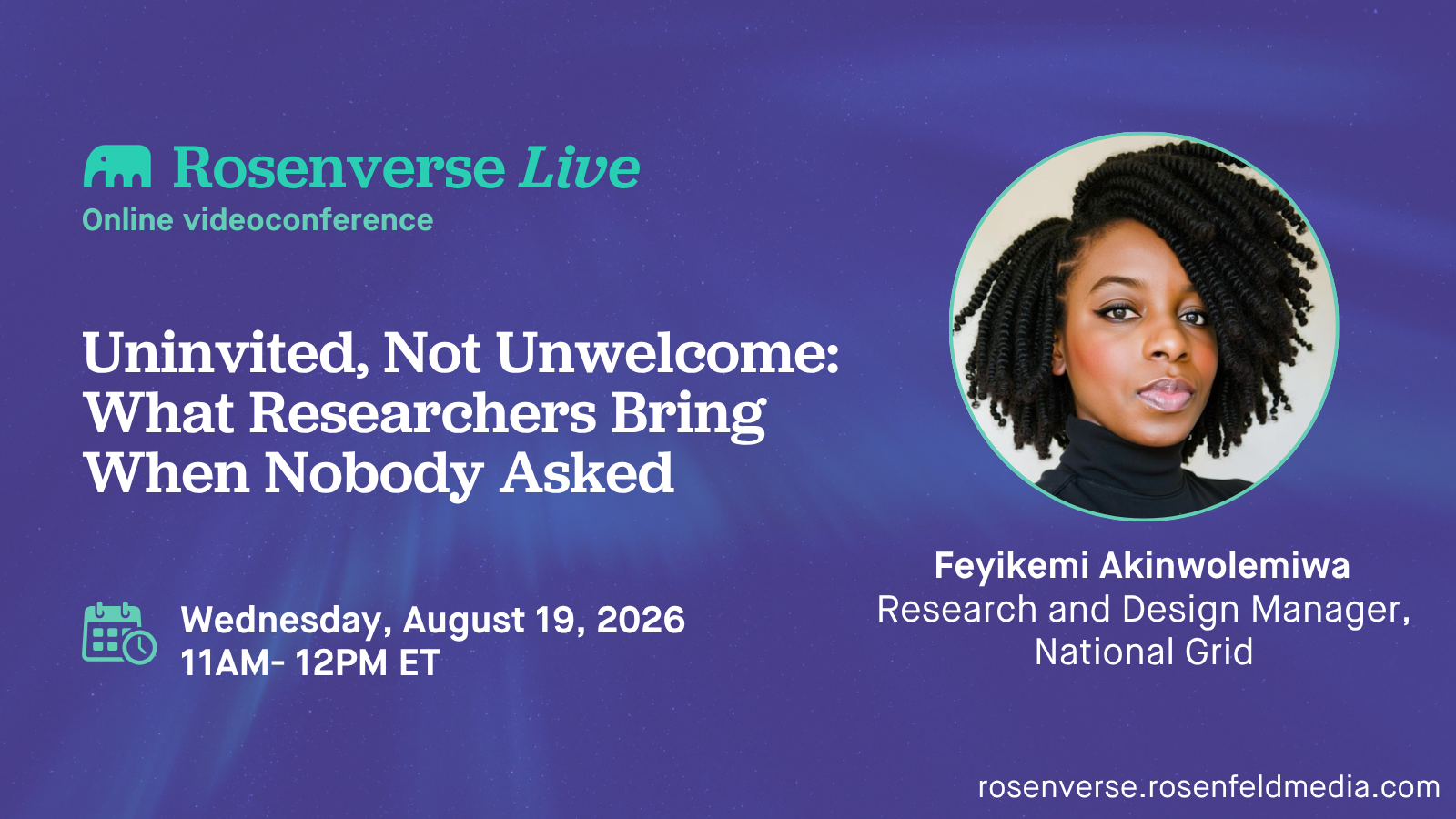
Uninvited, Not Unwelcome: What Researchers Bring When Nobody Asked
This video is featured in the UX Watch Party playlist.

Summary
In this interactive session, we'll turn those skills outward. Together, we'll explore how the judgment researchers use every day,making sense of ambiguity, facilitating difficult conversations, aligning stakeholders, and helping teams make better decisions can create value in places we don't always think to look.
Through real stories and a practical breakout exercise, you'll identify the capabilities you rely on every day but rarely describe, map where they already apply across areas like product strategy, programme delivery, responsible AI, and organisational change, and leave with one deliberate experiment to put into practice within the next 30 days.
The question isn't whether researchers have transferable skills. It's whether we're choosing to use them where they matter most.
Stop asking, "Is this UX research?" Start asking, "What problem needs solving?" Join us to discover what your own amalgamation could become.
Key Insights
-
•
71% of organizations now have non-researchers conducting research, signaling a democratization of research roles.
-
•
The traditional research role is redistributing rather than disappearing; designers and product managers often take on research tasks.
-
•
Researchers are 'chameleons' who have developed skills in communication, stakeholder empathy, and synthesis beyond just research methods.
-
•
Leading with curiosity opens doors to new collaborations and reframes the value of research in organizations.
-
•
Excessive rigor or strict definitions of research can block important conversations and limit researcher influence.
-
•
Researchers can solve complex organizational problems such as roadmap alignment and prioritization by leveraging soft and strategic skills.
-
•
New career paths for researchers include roles in change management, HR, responsible AI, and program management, often fueled by core research skills.
-
•
Responsible AI and AI safety evaluation are emerging areas where researcher skill sets are increasingly valuable.
-
•
Actively demonstrating capability through practical interventions like workshops or hackathons helps build allies and expand researcher impact.
-
•
Researchers should write down and consciously acknowledge their broad skills to better claim ownership and evolve their roles.
Notable Quotes
"Our title says researchers, but it never said only."
"We’re researchers, but there’s a lot more to us."
"If we become too self-preservation about our craft, then we could actually be blocking doors."
"Leading with curiosity, tell me more, why is that? helps us see how research can be repositioned."
"There’s no way everyone else can see what we’re capable of doing if we don’t step out from our defined areas."
"She’s not a research and design manager anymore, but we don’t know what she’s doing. We just know she’s solving key problems."
"Everything else flows everywhere. It’s always going to be about humans at the end of the day, no matter the technology."
"We already have what our teams need, we just pick up that problem and see it as an opportunity to reframe what we bring."
"You have to build those value stories about the contribution of research in terms of business impact."
"I’m a researcher and... And that’s even more exciting because I know I can always learn if I don’t have that skill set."
Or choose a question:














More Videos

"Non-designers can build wireframes really quickly using easy drag-and-drop components from a design system."
Billy CarlsonTips to Utilize Wireframes to Tell an Effective Product Story
June 6, 2023

"Be a diplomat. Help people do their jobs better and share what you learn generously."
Kristin SkinnerOpening Keynote: Org Design for Design Orgs
November 6, 2017

"Design is a very powerful role and at Airbnb people are ready to engage in it as a collective practice."
Rebecca GimenezWork in Progress: Service Design at Airbnb
December 3, 2024

"Melissa Burnett is a creator of order out of chaos, leader of leaders."
Uday Gajendar Louis RosenfeldDay 2 Welcome
June 5, 2024

"We ask our AI assistants to explicitly avoid leading and double-barreled questions to ensure unbiased research."
Mike OrenImproving Democratized Research with CustomGPTs and Gems
February 25, 2026

"AI can accelerate prioritization tasks, but the final judgment must come from humans who understand context."
Mark Interrante Harry MaxAI for Prioritization (3rd of 3 seminars)
July 11, 2024

"We ran ambient workshops so folks could contribute on their own time and remove the friction of synchronous meetings."
Liam ThurstonWhy Your Design Team Is Quitting, And How To Fix It
June 10, 2022

"We want AI to augment human skills like an electric bike, not replace them like a robotic vacuum cleaner."
Sheryl Cababa Ethan Marcotte Milena PribicDay 2 Panel
June 5, 2024

"If you’re like us, you’d love to have 100% of the UX talent every project needs, but your team isn’t large enough."
Patrick CommarfordDesign Staffing for Impact
January 8, 2024
Latest Books All books













Dig deeper with the Rosenbot
What strategies help address client resistance to changing inaccessible brand colors?
How can individuals develop personal constraints after leaving full-time employment to maintain productivity?
What roles can information architects and service designers play in the emerging field of AI context engineering?