Log in or create a free Rosenverse account to watch this video.
Log in Create free account100s of community videos are available to free members. Conference talks are generally available to Gold members.
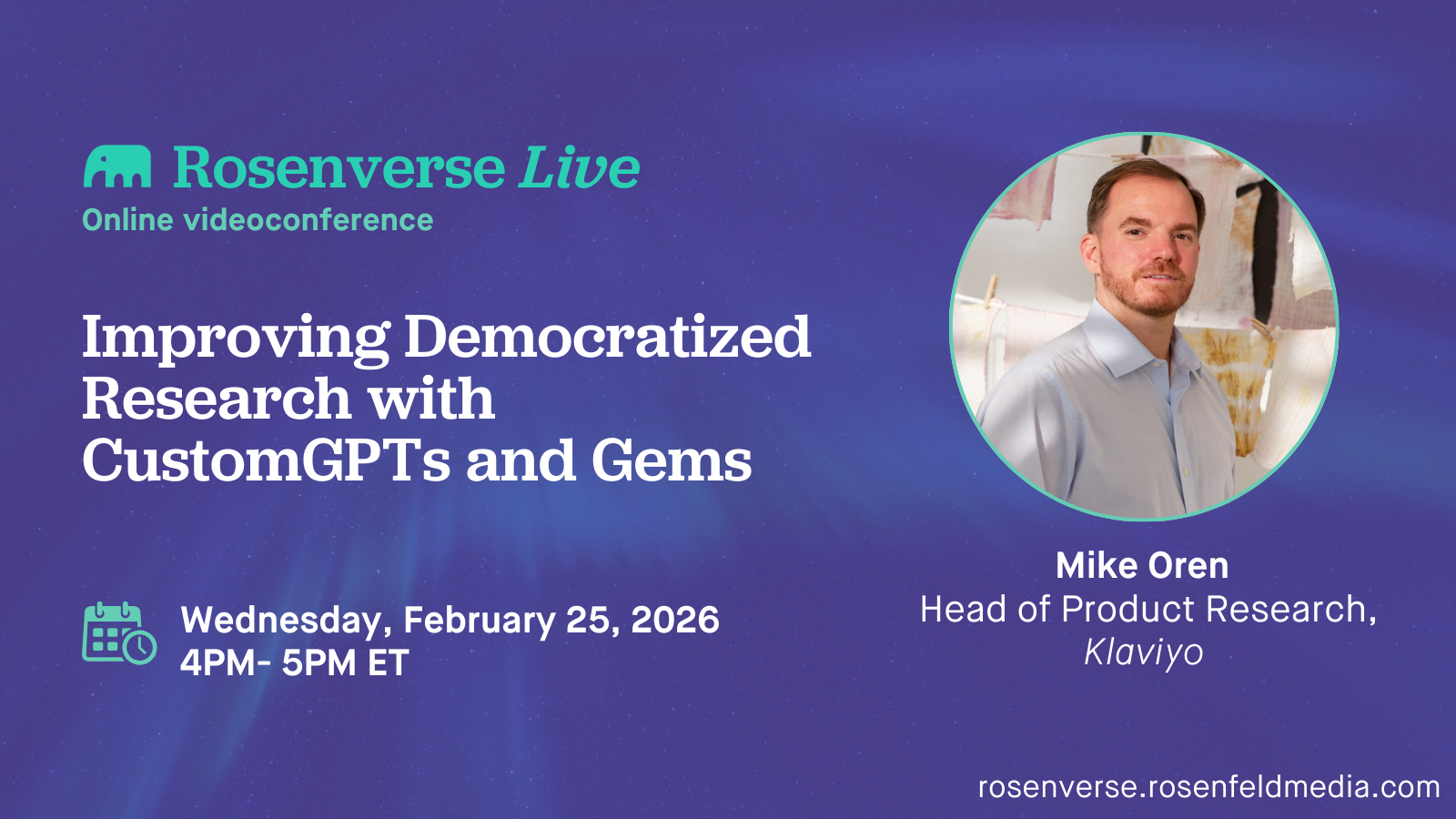
Improving Democratized Research with CustomGPTs and Gems
This video is featured in the AI Trends in User Research playlist and 1 more.

Summary
One of the biggest concerns researchers have when having any designer or product manager conduct their own research is that they'll ask biased or bad questions. In theory bad research done by a product team should be accountable to them but since there's a team named "research," that can inevitably fallback on us. We've all offered training to teams at some point but you can lead a horse to water but not force them to drink. Enter AI - your partners will want to use it because it helps them get something they don't usually do (write discussion guides) faster and by writing custom Gems or GPTs, the research team can keep consistency, ensure the AI pushes back in the right way for quality, etc. In this session, I'll cover how to build these and the instruction sets I provide to the tools.
Key Insights
-
•
Custom AI GPTs can provide guardrails to help non-researchers conduct higher-quality user research.
-
•
Splitting AI tools into multiple specialized GPTs prevents context overload and hallucinations.
-
•
Researchers save over 80% of their time by using AI to support routine research planning and execution.
-
•
Automating recruitment and incentive tracking through Google Sheets and Zapier reduces manual effort.
-
•
AI can improve research consistency by enforcing unbiased question guidelines and avoiding leading or double-barreled questions.
-
•
Limitations remain in AI’s ability to synthesize large transcript sets and provide fully accurate quotes.
-
•
Democratizing research allows product managers and designers to engage more closely with customers while researchers focus on strategic insights.
-
•
Avoiding shadow AI tools is critical for organizational security and compliance.
-
•
Video analysis and unmoderated usability testing can now be partially automated using custom GPT Gems.
-
•
The future of UX research may shift toward researchers providing ‘forest-level’ insights while PMs/designers handle ‘tree-level’ tactical research.
Notable Quotes
"We call ourselves a B2C CRM: helping businesses connect to their consumers and keep the relationship going."
"Before AI, research teams spent over a quarter of their time consulting about research questions, often repeating themselves."
"One of my biggest pet peeves is biased questions; I hate the term validation, I prefer evaluation."
"If we’re not helping with the decision, why are they paying us what they’re paying us? That’s the essence of research."
"We want to make sure researchers spend one hour in office hours, not eight to twelve hours a week helping others."
"Designers and product managers often want more control, and custom AI gives them that in research tasks."
"The tools are meeting people where they’re already going: ChatGPT or Gemini, rather than forcing new platforms."
"Shadow AI usage is a huge security risk in public companies and should be managed by IT and leadership."
"We ask our AI assistants to explicitly avoid leading and double-barreled questions to ensure unbiased research."
"The future is researchers painting the larger picture while PMs and designers focus on deep, tactical user insights."
Or choose a question:
















More Videos

"When infrastructure breaks down, it is human infrastructure — communities and organizers — that saves the day."
Tricia WangSpatial Collapse: Designing for Emergent Culture
January 8, 2024

"Don’t dress for the job you have, dress for the job you want—this applies to people and companies alike."
Mark TempletonCreating a Legacy: the ultimate experience
June 9, 2017

"90% of my job is saying the same thing over and over and over again."
Mark BoultonOps without Designers
November 7, 2018

"We introduced 'go-to' people, like account managers, responsible for particular business areas to maintain relationships."
Catherine BlizzardUsing Integrated Insight to Drive Growth
March 10, 2022

"Your company is a service provider; your HR, IT, design, and security teams are all service providers."
Jeff SussnaWhat DesignOps Can Learn From DevOps
November 6, 2017

"There is no end state in design ops; it’s a constant state of evolution."
Dianne QueReal Talk: Proving Value through a Scrappy Playbook
October 23, 2019

"No more than five key insights — any more and teams start going off in different directions."
Jon White Erin MayUnsticking Research for Better Information Flow
March 11, 2026

"When we say if only I could get that executive to think differently, we’re actually giving them power over us."
Matt LeMayYou Don’t “Get” Anyone to Do Anything
December 6, 2022

"The difference between director and principal often lies in whether you’re inspired more by leading people or focused on outputs and craft."
Catt Small Micah Bennett Brian Carr Jessica HarlleeWhat's Next for ICs: Exploring Staff and Principal Designer Roles
February 22, 2024