Log in or create a free Rosenverse account to watch this video.
Log in Create free account100s of community videos are available to free members. Conference talks are generally available to Gold members.
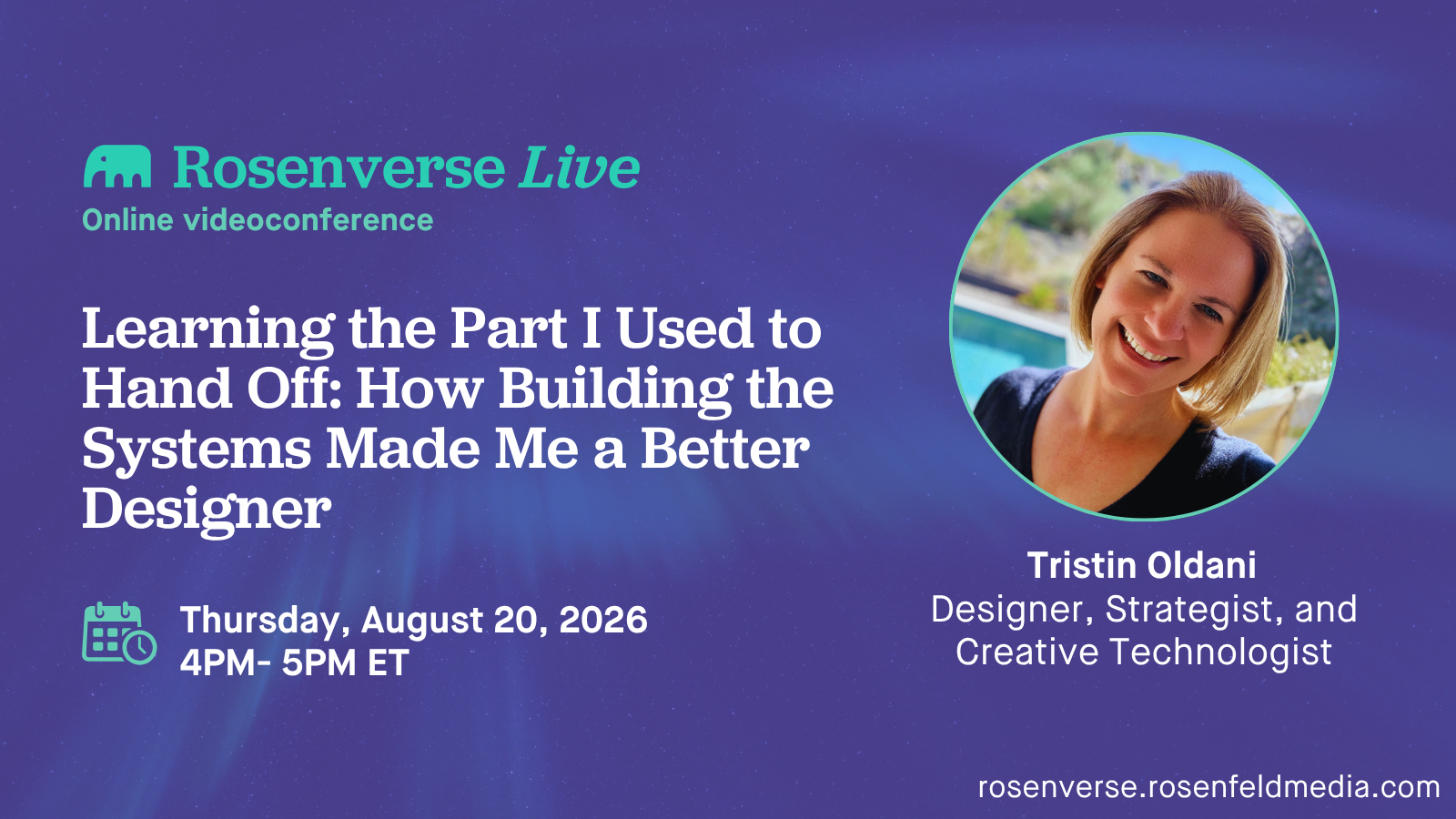
Learning the Part I Used to Hand Off: How Building the Systems Made Me a Better Designer
This video is featured in the UX Watch Party playlist.

Summary
For fifteen years, Tristin drew the map: designing and prototyping the front end of complex systems at Intel, while engineers and data specialists built the part she used to hand off. Then she went solo, and that part became hers too. In "Learning the Part I Used to Hand Off," she walks through one real project in depth: a home energy system built from scratch on Raspberry Pis, pulling together four systems that each lived in their own separate app, none of which could tell her if her house was doing the right thing right now. Real screens, real failures, and the moment she had to override Tesla's own AI when it started making decisions about her house without asking. Learning that part didn't just mean she could build. It made her a better designer.
Key Insights
-
•
Multiple solar system components typically require separate apps that do not communicate, creating fragmented user experiences.
-
•
Utility rate plans with demand charges complicate energy management by penalizing peak power draws, making automation critical.
-
•
Many users lack full access or must pay for their own usage data due to vendor restrictions, frustrating ownership and control.
-
•
AI tools serve better as critics and tutors to improve design thinking rather than as direct builders of UI.
-
•
Deep engagement with backend systems and data integration unlocks new design possibilities and more effective user experiences.
-
•
Home Assistant on Raspberry Pi offers an open-source, local solution for unifying disparate smart energy data without cloud dependency.
-
•
Visualizing energy data spatially on home blueprints reveals infrastructure issues like poorly mapped electrical circuits.
-
•
Vendor over-the-air updates can override user preferences and reduce control, exposing risks in black-box smart home systems.
-
•
Implementing VPN tunneling like Tailscale enables secure, private remote access to home energy management systems.
-
•
The fragmented solar industry suffers from lack of holistic service design and industry collaboration, limiting consumer adoption.
Notable Quotes
"None of these apps know that we do laundry in the middle of the day. They just report data and leave the occupants to fend for themselves."
"Every day becomes a mental chess game. When do I run the dryer? Should I pre-cool the house before 2:00 PM?"
"I realized I had too much chart junk and cognitive load, and users are left to decode instead of understand."
"AI is a far better tutor than it is a designer. It really just needs a captain for that situation."
"The hard part was actually just getting my house to talk to itself."
"No reconfiguring, no manual tweaks, no app hopping. One place, one view, and a system that finally works for the people living in it."
"I didn't want a cloud. I wanted privacy. I wanted to keep everything here on-site."
"Tesla's black box over-the-air updates are scary because they reduce control and happen without notification."
"Building the backend made me so much better at the front end, understanding functionality on a deeper level."
"If our iPhones were this complicated, people wouldn't have them. We need to make these systems easy and integrated."
Or choose a question:
















More Videos

"The speakers will share hard-won lessons to help you navigate low corporate design maturity and rapid growth."
Kit UngerTheme 2: Introduction
June 10, 2021

"Some stakeholders still prefer their beliefs to data, even in academia."
Mackenzie Cockram Sara Branco Cunha Ian FranklinIntegrating Qualitative and Quantitative Research from Discovery to Live
December 16, 2022

"The success of SLDS is not about the technology itself but about people and relationships."
Nalini P. KotamrajuAn Organizational Story: Salesforce Lightning Design System
June 9, 2016

"We call it research goo: regulation, risk, inefficiencies that complicate research in banks."
Christian RohrerResearch Operations at Scale
November 7, 2017

"Design system decision records prevent knowledge being stuck in one person’s head."
Dan DonaldDesign Systems as a Vehicle for Systemic Change
June 1, 2023

"Being fluent in multiple data languages and understanding behavioral and attitudinal data will be essential."
Lija Hogan Milan Mijatovic Sam Proulx Louis RosenfeldThree Years Out: Perspectives on the Near-Term Future of User Research
March 15, 2024

"I’m always shocked when my design is just the perfect solution from the get go."
Anna AvrekhUser Research, Design, and Product - A Love Story
March 11, 2021

"There aren’t enough lean UX experts to collaborate with every team, so we create a lean UX Center of Excellence for each value stream."
Jack MoffettSAFe or Sorry?
May 29, 2019

"There is a synergy between design and social work values that gives trauma-informed design its meaning and purpose."
Rachael Dietkus, LCSWTrauma-Responsive Design: Reimagining the Future of Design Now
December 10, 2021