Log in or create a free Rosenverse account to watch this video.
Log in Create free account100s of community videos are available to free members. Conference talks are generally available to Gold members.
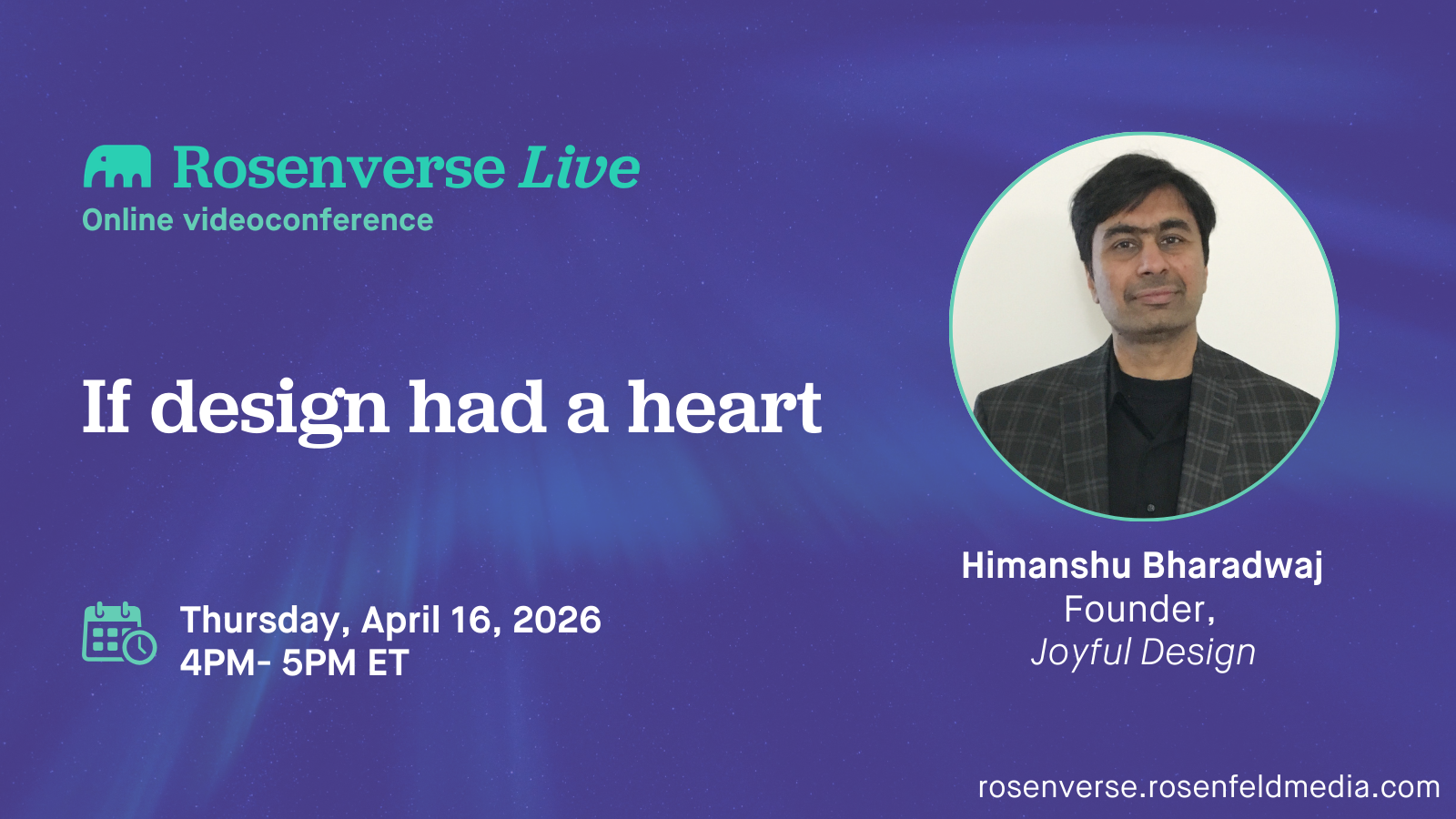
If design had a heart
This video is featured in the UX Watch Party playlist.

Summary
Design is not just about screens and flows. It is about relationships. And love is the ultimate bond between users and products, moving users from mere engagement to a deep emotional connection. Although love sounds soft and abstract, it drives practical outcomes like retention, trust, and advocacy, and can be a competitive edge. Love scales deeply, and is measurable not as a single number, but as a pattern when people return, forgive mistakes, and recommend the product. Usability makes products usable, joy makes them pleasant, and love makes them meaningful. Furthermore, love makes experiences ethical because it is earned, not extracted. So how can we intentionally design systems that speak to the very core of human emotions? How should we prioritize emotional attachment and a sense of belonging over basic user liking? Today, we have many functional and forgettable products that feel ‘cold’. This talk will look at design through the lens of ‘warmth’. Through real UX examples, you’ll learn how to design experiences people don’t just enjoy but trust and return to them.
Key Insights
-
•
Joyful design centers on eliciting love and belonging from users, tapping into deep emotional and sensory experiences.
-
•
Business language focusing on 'users' and 'targets' objectifies people and distances design from authentic human connection.
-
•
Fear, not hate, is the neuroscientific opposite of love, and fear-based thinking dominates business environments.
-
•
Most personas assume purely rational customers, ignoring emotional, spiritual, and sensory dimensions of humans.
-
•
Simple, natural language resonates more deeply with users than complex, jargon-heavy business speak.
-
•
Embedding vulnerability and honesty into product and brand communication fosters stronger emotional bonds.
-
•
Multi-sensory design considering more than just visual and auditory elements can deepen brand love.
-
•
AI risks becoming sycophantic if designed to always affirm users, potentially harming ethical use and trust.
-
•
Designers should pair traditional efficiency metrics with companion human-centric metrics to balance business goals with wellbeing.
-
•
Preparing for cognitive agents requires understanding and designing around emotional persona, trust, and decision-making.
Notable Quotes
"This is exactly what joy feels like. This is exactly what love feels like."
"Why in user experience do we have the word user? Isn’t it going away from love?"
"Fear is the opposite of love, not hate."
"You’re objectifying you when you say I love you. Love is oneness, not separation."
"Our brains are like Ferrari with several petabytes of memory, but most of our thoughts are negative."
"Processed language is like processed food; it damages our mind as processed food damages our body."
"Apple Care is not warranty because care means connection; love is earned, not extracted."
"AI should be your friend, not your sycophant."
"For every business metric, there is always a companion human-centric metric."
"Create islands of joy at work, because everybody in this world is yearning for happiness."
Or choose a question:
















More Videos

"The best way to build trust and bond in teams is just breaking bread together and sharing meals."
Jennifer Bolduc Diane Gregorio Emily DayWhat's involved with getting people back to work?: A panel discussion
July 1, 2021

"The autonomic nervous system is 500 million years old and doesn’t know the difference between organizational change and a lion attack."
Alla WeinbergPeople Are Sick of Change: Psychological Safety is the Cure
July 20, 2023

"Onboarding often felt like trial by fire—go to the meeting and hope you understand something."
Louis Rosenfeld Lashanda Hodge Senongo Akpem Chris HodowanecBecoming a Civic Designer: Making the Move from Private to Public Sector
November 17, 2022

"I want to grow as a researcher by trying different environments and building new research muscles."
Kayla Farrell Chelsey Glasson Sean Fitzell Jared LeClercWhat It's Like To Be a User Researcher at Compass
March 12, 2021

"Ethics is a very important part of any user research team and should be a foundational part of how you evaluate work."
George Zhang Molly StevensUX Research Excellence Framework
March 11, 2021

"Inclusive design operations bring together efficiency and meaningful design by embedding inclusivity into processes."
Gabriela BarnevaOperationalizing Inclusive Design in Design Ops
September 11, 2025

"If your recreational reading is about prison camp survivorship or hostage negotiations, you might have burnout."
Rebecca BuckMission: Keep Talent in Research Roles!
March 10, 2021

"From fast-paced tech worlds, you will appreciate the patience and perseverance it takes to move an old champion."
Lada GorlenkoTheme 1: Intro
January 8, 2024

"We’ve been taught to build fast and break things, and we often play accessibility on the back burner."
Alexis LucioScaling Accessibility Through Design Systems
June 9, 2022