Log in or create a free Rosenverse account to watch this video.
Log in Create free account100s of community videos are available to free members. Conference talks are generally available to Gold members.
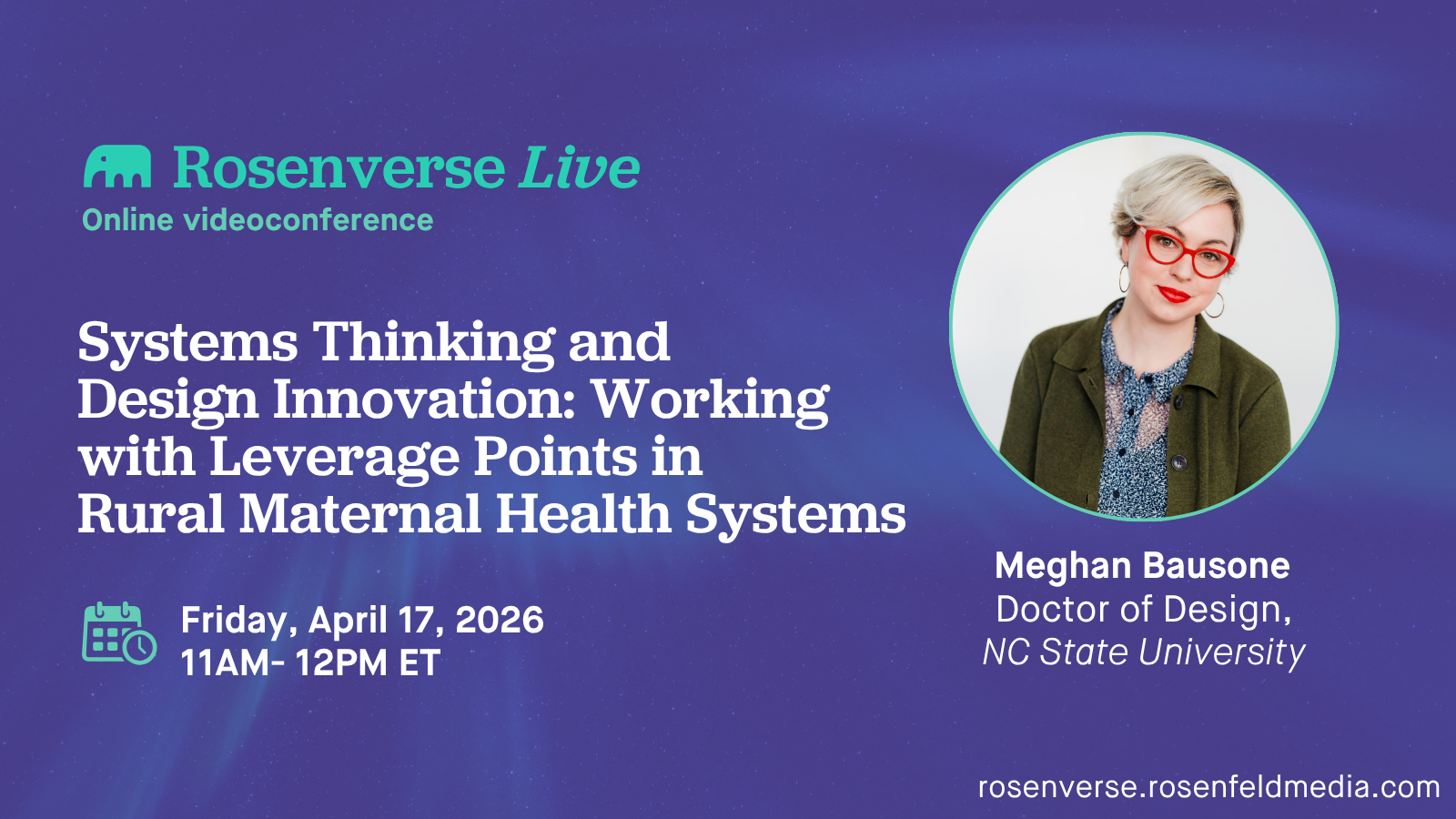
Systems Thinking and Design Innovation: Working with Leverage Points in Rural Maternal Health Systems
This video is featured in the Systems Thinking playlist and 1 more.

Summary
Are some problems too wicked, complex, and systemic for designers to solve? The United States is experiencing a maternal health crisis—with the highest maternal mortality rate among high-income nations globally and an expanding number of counties being deemed "maternity care deserts" or areas without obstetrical services. These failures are disproportionately impacting Black and Indigenous communities, especially in rural areas. In this presentation, Meghan will share research that applies systems thinking to first-hand accounts from maternal health stakeholders to identify leverage points for design innovation. Meghan will break down leverage points using Donella Meadows' framework and discuss the power of her ultimate leverage point — paradigm shifts.
Key Insights
-
•
The US has the highest maternal mortality among high-income nations, especially impacting Black and Indigenous communities.
-
•
Maternity care deserts disproportionately affect rural areas, with nearly half of US counties lacking obstetric care.
-
•
A systemic paradigm shift is needed from technocratic to more holistic maternal health models.
-
•
Financial barriers like low reimbursement and costly malpractice insurance threaten birth centers’ viability.
-
•
Rapid labor unit closures create urgent access crises for pregnant people in rural regions.
-
•
Managerialism and profit-driven goals conflict with maternal safety and compassionate care.
-
•
Information flow, including transparency of hospital closures and costs, is a crucial leverage point for systemic improvement.
-
•
Community resilience and self-organization are key structural factors for rebuilding maternal health systems.
-
•
Pragmatic pluralism exists in maternal health paradigms; multiple belief systems coexist with tension but no clear dominant shift.
-
•
Design opportunities include supporting grassroots initiatives, improving data communication, and redefining system boundaries beyond hospitals.
Notable Quotes
"The US has the highest maternal mortality rate among high-income nations in the world."
"Birth centers would be replicable if reimbursement structures were adequate, but they can't survive without payment."
"What does a hysterectomy cost? $2,000, $13,000, or $40,000? It depends who you ask and who pays."
"Managerialism justifies one size fits all efficiency techniques that increase burnout and diminish professional authority."
"Paradigm shifts depend on how a problem is described and who controls the narratives and beliefs."
"Where big corporations don't want to bother, little seeds can sprout in maternal health."
"Systems that can self-organize are the strongest form of resilience."
"Maternal health is embedded within a healthcare industry prioritizing cost control, risk management, and standardization, not maternal safety."
"Information flow distortion compounds dysfunction in the system over time."
"The dominant technocratic paradigm under managerialism may be incompatible with rural maternal health needs."
Or choose a question:
















More Videos

"The future was already here. It’s just not evenly distributed."
Daniel J. RosenbergDesigning with and for Artificial Intelligence
August 11, 2022

"The only rule is to maintain your smile and just to feel the being that have fun."
Ana Maria Montero Barrantes Aditi Dhar Michelle Kaplan Nate Osborne Matt LaurenceThe Authentic UX Talent Show
January 8, 2024

"Data prompted interviews use the participant's own data to enhance understanding of their specific experience."
Amelia ColeData-Prompted Interviews
December 17, 2021

"Information experience needs wayfinding so people can find and use data easily."
Sarah CoyleDesign and Analytics with Sarah Coyle
July 30, 2020

"People are starting to catch on with the fact that design matters and that it’s maturely important to solving the problems we face."
Greg PetroffSoftware as Material—A Redux
June 6, 2023

"You can change the conference time zone to your local time zone in the upper right corner so there’s no confusion about start times."
Louis Rosenfeld Bria AlexanderDay 1 Welcome
September 23, 2024

"Customer journeys used to be specialist knowledge, but now they’re a normalized, even commodified, organizational artifact."
Lavrans Løvlie Ben ReasonAsk me anything – Authors of Service Design: From Insight to Implementation
November 19, 2025

"An accessible product is not only the right thing to do, it’s also good for business."
Erin WeigelReal-world lessons to improve your conversion rates
June 26, 2024

"It’s not that developers want to do design, they need to do it because they need to keep working on their projects."
Nora Tejeda Giovanna AlonsoScaling Design Capabilities at BBVA Through a Self-service Design Model
June 10, 2021