Log in or create a free Rosenverse account to watch this video.
Log in Create free account100s of community videos are available to free members. Conference talks are generally available to Gold members.
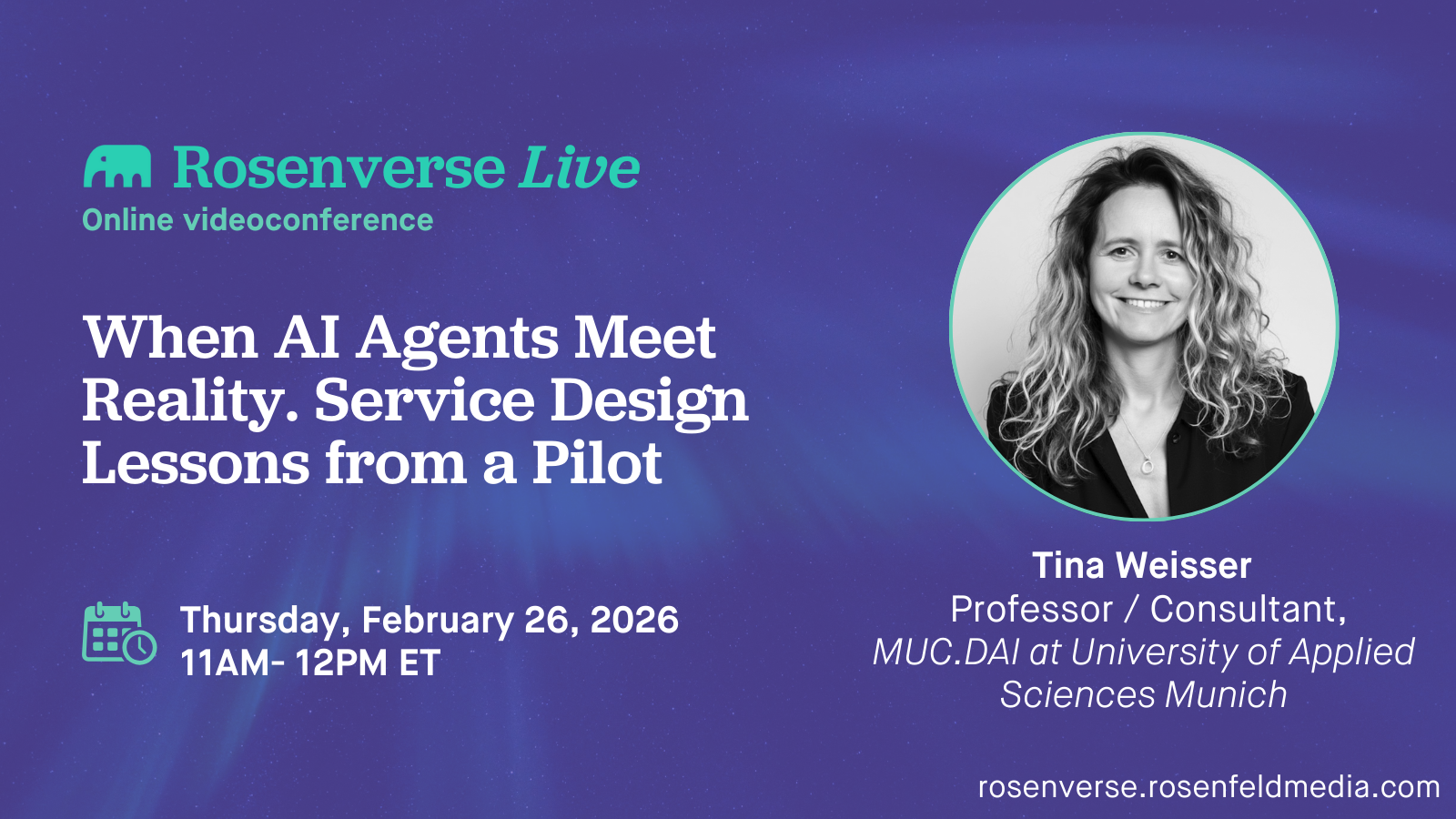
When AI Agents Meet Reality. Service Design Lessons from a Pilot
This video is featured in the AI Trends in User Research playlist.

Summary
The session shows how Service Design helped make these dynamics visible and manageable. Not as a creativity method, but as a way to design clear responsibility, decision paths, and collaboration between humans and agents. Presentation and discussion.
Key Insights
-
•
Agentic AI represents a shift from AI as a tool to AI as autonomous collaborators that run background workflows.
-
•
Many organizations have AI agents built, but a large gap remains in making them truly helpful and valuable.
-
•
Service design methods like process blueprints and human-in-the-loop approaches are key to designing effective AI-human workflows.
-
•
Building AI agents quickly is easy, but identifying where they add value requires deep problem understanding and organizational context.
-
•
Chaos in undocumented or inconsistent workflows complicates designing useful AI workflows.
-
•
Trust and responsibility must remain human-led with clear definitions of when and how humans intervene in AI processes.
-
•
Organizational power dynamics around information sharing critically impact the effectiveness of AI agent deployment.
-
•
Iterative quality feedback loops where AI agents improve based on continuous human input are vital for success.
-
•
Co-creative, multidisciplinary engagement including non-technical stakeholders increases adoption and reduces resistance to AI.
-
•
AI literacy at all organizational levels is necessary; leaders must engage with AI to properly support teams using it.
Notable Quotes
"Before for me, AI was just a tool, but now these agents are running in the background and are mostly invisible, changing everything."
"Lots of people have agents running, but they don't feel they’re really useful yet."
"It’s not about pure automation. It's like playing tennis—back and forth between human and agent."
"We must design who is in the loop and who is in the lead. The responsibility can’t be handed over to AI."
"If you spend more time building an agent than doing the task, it’s not worth it."
"The chaos of undocumented processes makes it hard to build useful AI workflows; mapping and blueprinting help."
"Information is power in organizations, so deploying AI agents means reconsidering who gets access to what data."
"It’s dangerous to believe everything AI says or to believe nothing. We must find a balance."
"You can't delegate AI decisions to IT alone; every team needs to figure out how AI agents support their work."
"If we don't do hard thinking and critical collaboration when building agents, we’ll end up with armies of unused agents."
Or choose a question:















More Videos

"Budget and time are the enemies of inclusivity in research."
Chloe Amos-EdkinsA Cultural Approach: Research in the Context of Glocalisation
March 27, 2023

"The design of our systems should make room for messy, complicated human realities, not just positive illusions."
Deanna ZandtThe Unspoken Complexity of “Self-Care” with Deanna Zandt
July 21, 2022

"The Rosen Bot can turn a simple prompt into a five-week training program for your team."
Louis Rosenfeld Peter Van DijckGenAI for UXers: A Rosenbot Demo and Discussion
September 11, 2025

"Our framework is our playbook, our single source of truth for every launch."
Tamara KartoziiaThink global, adapt local: how service design accelerated B2B market entry by 6 months
November 20, 2025

"We need to create evolving system loops that incorporate feedback and allow our units of one to learn and adapt."
Dave Malouf Adrienne Allnutt Jon Fukuda Dominique WardThe Future of DesignOps
January 8, 2024

"The boss’s son is no longer the default backup boss; there are now written rules accessible to all."
Sam LadnerHow Research Can Drive Strategic Foresight
March 9, 2022

"Facilitation is probably the most undervalued skill on modern product teams."
Matt LeMayYou Don’t “Get” Anyone to Do Anything
December 6, 2022

"Meetings tell us what kind of conversations we are having and what kind of conversations we are not having."
Alla WeinbergHow to Build and Scale Team Safety
January 8, 2024

"The community is an ongoing prototype; members have a strong, frequent voice in shaping what good looks like."
Marc Fonteijn Ru ButlerIncrease your confidence, influence, and impact (through a Professional Community)
December 3, 2024