Log in or create a free Rosenverse account to watch this video.
Log in Create free account100s of community videos are available to free members. Conference talks are generally available to Gold members.
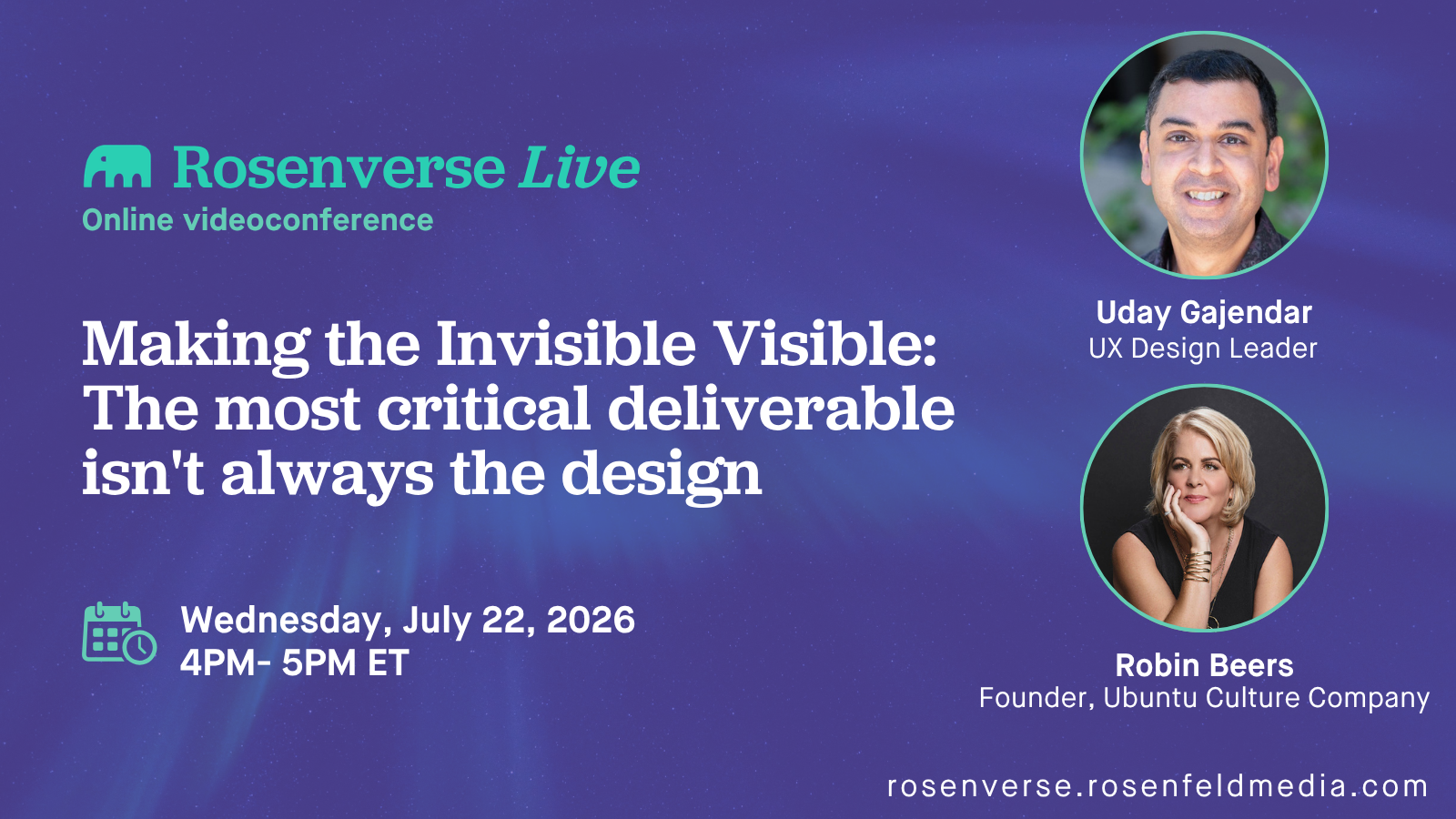
Making the Invisible Visible: The most critical deliverable isn't always the design
This video is featured in the UX Watch Party playlist.

Summary
Designers often create journey maps, service blueprints, prototypes, and models. But their greatest value may not be what they define about digital products—it may be what they reveal about organizations! This session explores how visual artifacts expose hidden assumptions, organizational blind spots, and unmet human needs, helping teams align on what's really important. In this moment of speedy AI-generated outputs, Robin Beers and Uday Gajendar argue that one of the designer's most enduring roles is creating the shared understanding that makes meaningful change possible.
Key Insights
-
•
Visibility creates accountability, which can drive organizational change.
-
•
Organizational blind spots often stem from unexamined assumptions and lack of reflective practices.
-
•
Double-loop learning interrogates underlying assumptions, unlike single-loop learning, which only fixes symptoms.
-
•
Visual anchor objects (e.g., journey maps, experience models) help externalize conflicts and depersonalize disagreements.
-
•
Anchor objects invite collaboration by being just detailed enough to argue with the artifact, not the people.
-
•
Psychological safety is critical to surface invisible issues and protect the messenger.
-
•
The ‘invisible’ in AI—like biases and opaque processes—requires deliberate sense-making and ethical scrutiny.
-
•
Naming vulnerabilities openly can foster trust and make difficult conversations more productive.
-
•
Coalitions formed through workshops and collaboration are essential to support courageous transparency.
-
•
Ethical responsibility in design and AI involves recognizing cascading second- and third-order effects and acting with care.
Notable Quotes
"Visibility creates accountability, and accountability can, hopefully, sometimes create change."
"Once you've seen it, you can't unsee it."
"The difference between single-loop and double-loop learning is the difference between looking through your lens and looking at your lens."
"Anchor objects open up the conversation while focusing it at the same time."
"The argument is not between the people, it’s an argument with the thing."
"Not everything that is faced can be changed, but nothing can be changed until it is faced."
"Courage is the new charisma."
"Psychological safety is still a massive problem in organizations."
"We want radical transparency while adopting radically opaque technology."
"Making the invisible visible is not just good design; it’s sense-making as care."
Or choose a question:
















More Videos

"Separating genders in research can perpetuate stereotypes rather than challenge them."
Mansi GuptaAdvancing the Inclusion of Womxn in Research Practices
September 15, 2022

"Disability is normal, not shameful or rare, and everyone can benefit from accessibility innovations."
Sam ProulxAccessibility: An Opportunity to Innovate
June 8, 2022

"Sustainability isn't binary but multi-attribute, and it varies over time and geography."
Mike Brzozowski Laura Palotie Steve Isley Nancy TsangUX in everyday products: Empowering climate conscious choices
July 17, 2024

"Design is navigating through unprecedented times."
Angelos ArnisNavigating the Rapid Shifts in Tech's Turbulent Terrain
October 2, 2023

"After years of fighting to be included in strategic boardroom decision making, many UX professionals are now finding themselves seated at the grown-up table."
JD BuckleyCommunicating the ROI of UX within a large enterprise and out on the streets
June 14, 2018

"The climate crisis is a symptom of us being disconnected from so many things around us."
Aiyana Bodi James Christie Marc O'Brien Louis RosenfeldThree Key Climate Initiatives and How You Can Help
September 11, 2024

"Democratization helps free up researchers by shifting ad hoc research to others."
Lija HoganDoing more with more: Lessons from the Front Lines of Democratization
March 9, 2022

"The longer you take to recognize research ops and scale your team, the harder it becomes to amplify the value of your research investment — Carrie, Booking.com."
Kate TowseyThe State of ResearchOps: More Than Just Theory
June 20, 2019

"When UX researchers and product managers collaborate, the product speaks to users’ hearts."
Prayag Narula Hannah HudsonEmpowering Designers to do Good Research
March 11, 2022