Log in or create a free Rosenverse account to watch this video.
Log in Create free account100s of community videos are available to free members. Conference talks are generally available to Gold members.
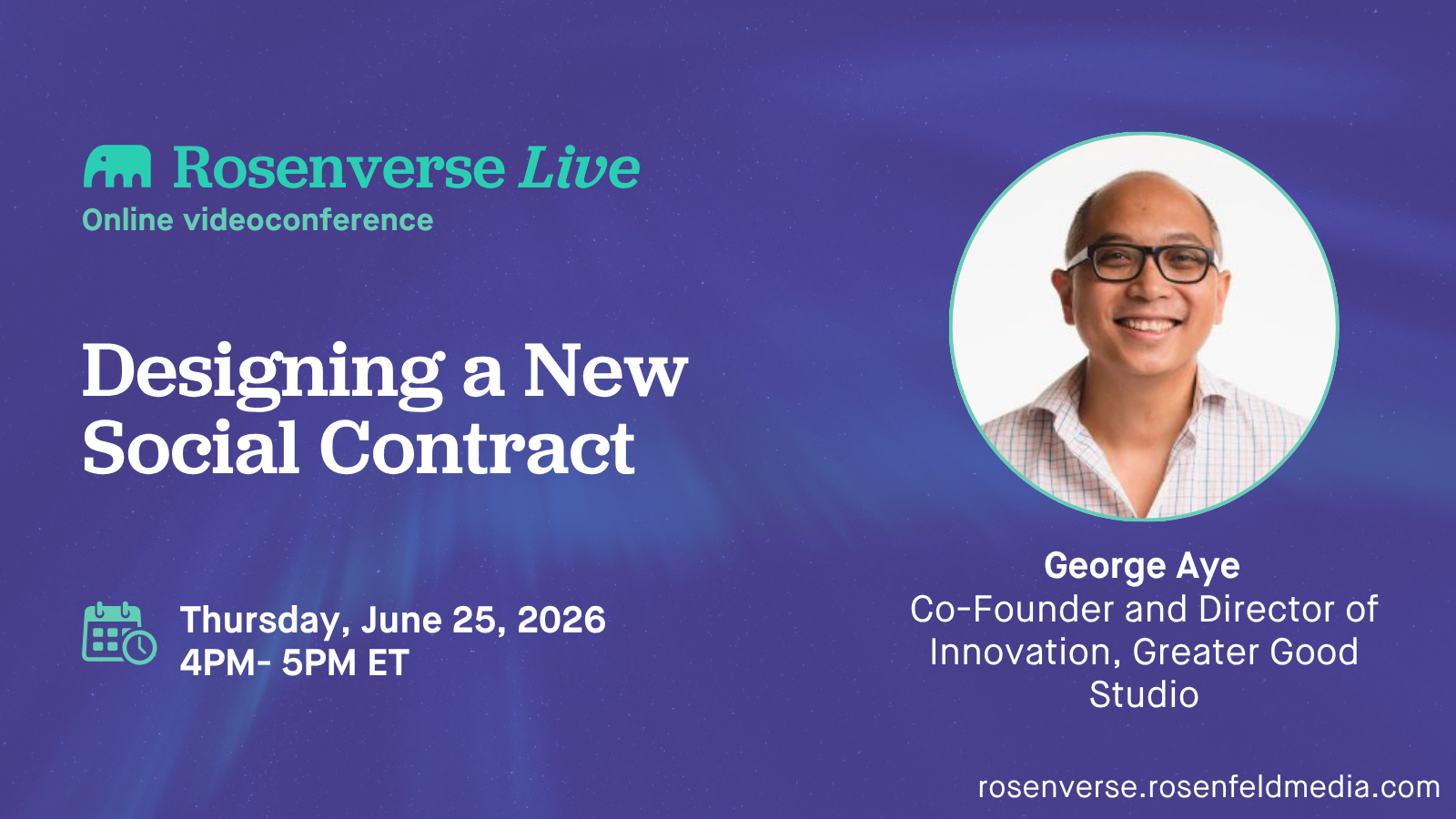
Designing a New Social Contract

Summary
Designers, advocates, and social sector leaders are working inside a social contract they didn't design, and one that is rapidly being rewritten by a well-organized, authoritarian right. ""Designing a New Social Contract"" argues that if we don't become intentional authors of a different future, we will be governed by someone else's blueprint for generations. Drawing on co-leading Greater Good Studio for 15 years, this talk surfaces how race and class quietly structure our current contract, how efforts by the authors of Project 2025 are codifying a new one, and why most people don't realize they've already been assigned a role in this system at birth. Rather than centering policy experts or design heroes, the talk presents aging and long-term care as a gateway issue and the hardest design constraint that, when solved, reverse-engineers the supports needed at every earlier stage of life.
Key Insights
-
•
Social contracts historically prioritize the needs of the dominant group, often marginalizing or harming others.
-
•
Neely Fuller Jr. identified two distinct social contracts in America: one protecting white Americans and one harming Black Americans.
-
•
Isabel Wilkerson's caste system concept helps frame social contracts as infrastructure deciding who receives protection or harm.
-
•
A new 'Epstein class' exists above traditional social contracts, effectively opting out by privately securing their needs.
-
•
People of color often receive conditional social contracts, contingent on compliance and usefulness.
-
•
Asian Americans are positioned in racial triangulation, used to perpetuate anti-Blackness while being treated as outsiders.
-
•
Universal long-term care is a critical but under-recognized social contract failure, jeopardizing dignity and intergenerational wealth.
-
•
Designing social contracts by starting from the desired end state (dignified aging) helps reverse engineer supportive upstream policies.
-
•
Changing the authors of social contracts to include marginalized communities fundamentally transforms their design and outcomes.
-
•
Systemic issues and capitalist frameworks often stifle community-oriented, policy-driven technological solutions in favor of individualized products.
Notable Quotes
"A social contract is what we expect of each other when we're in need."
"Without a social contract, life is nasty, brutish, and short, as Hobbes said."
"The authors of a social contract tend to put their needs first."
"In their new social contract, if your family isn't a white heterosexual married couple, you might be punished when in need."
"If you don’t understand how white supremacy works, everything else will only confuse you, said Neely Fuller Jr."
"Asian Americans are used as a wedge, a tool, to perpetuate anti-Blackness, as Claire Jean Kim explains."
"Most people assume Medicare covers long-term care, but it doesn't."
"Universal long-term care lets you age with dignity without losing everything you've built."
"Designing social contracts from the end backward allows us to rethink housing, wages, savings, and care."
"Those closest to the problem should be the co-authors of designing the social contract."
Or choose a question:
















More Videos

"When you get lonely, battle that loneliness by identifying allies and people you can trust in your organization and the design ops community."
Jackie AjouxLeveling-Up: A Single-Player’s Guide to the DesignOps Team-of-One
January 8, 2024

"The true enabler of a successful innovation is not the new technology or clever business model, but the human beings involved."
Laura WeissTurn Down the Heat: 3 Ways to Handle Conflict in the Moment
November 20, 2024

"COVID was kind of the mean person to push us into the pool—we had to sink or swim with remote research."
Marjorie Stainback Molly Fargotstein Stephanie MarshWhat Research Ops Professionals Have Learned from COVID-19
July 16, 2020

"Leadership modeling of vulnerability and human challenges is the first step towards trauma-informed organizational culture."
Matt Bernius Sarah Fathallah Hera Hussain Jessica Zéroual-KaraTrauma-informed Research: A Panel Discussion
October 7, 2021

"Mentoring new hires actually reignites the mentor’s own passion for their work."
Allison SandersOperating with Purpose
January 8, 2024

"It’s not that our subscribers aren’t smart, they just don’t always feel smart."
Louis RosenfeldYou’ve got Gold! A Rosenverse demo with Lou Rosenfeld
June 9, 2026

"Be compassionate with yourself and others. Not everyone likes high fives, and that's okay."
Reginé GilbertAsking the Right Questions: Life, Hope and Moving Forward During the Pandemic
June 10, 2022

"Asking for help and engaging is actually a sign of growing confidence among teams."
Elizabeth Sklar Jessica ShengCo-creating research enablement with your tech org: a case study
March 10, 2026

"Transformation isn’t just about prototypes; it’s about designing governance."
Bethany BrownRewiring operations with service design and AI
November 20, 2025