Log in or create a free Rosenverse account to watch this video.
Log in Create free account100s of community videos are available to free members. Conference talks are generally available to Gold members.
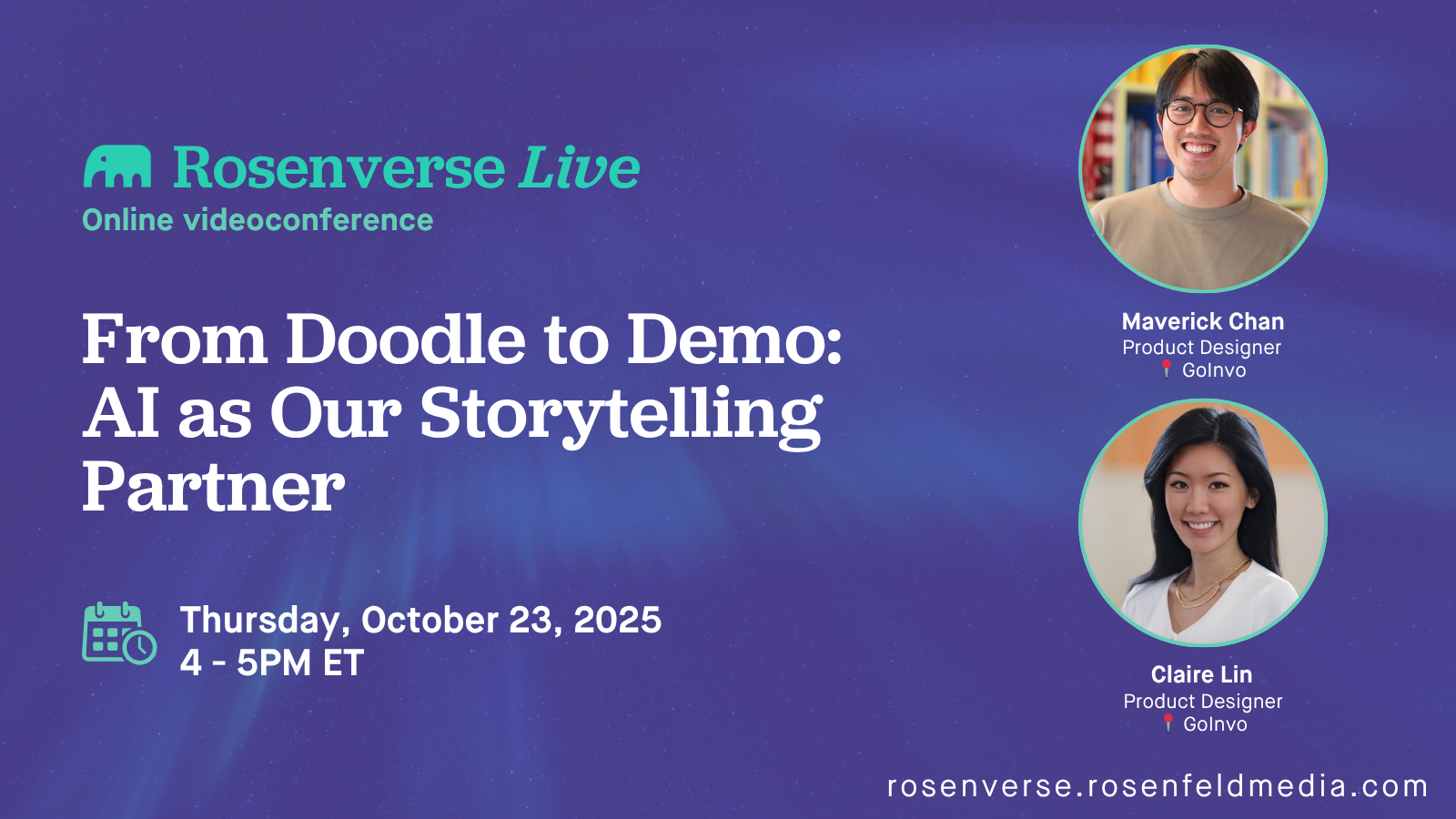
From Doodle to Demo: AI as Our Storytelling Partner


Summary
How can we communicate research and design insights to leadership in a way that drives action? This session shows how creatives can communicate real-world observations into compelling, story-driven solutions. We’ll share how to visualize problem sets and present designs that engage stakeholders and demonstrate clear value. Through project examples and live demos, attendees will learn how to generate better ideas, explore new ways of pitching work, and use visual storytelling to make problems and solutions instantly understandable.
Key Insights
-
•
Generative AI tools can reduce manual workload in animation and design by about one-third when integrated thoughtfully.
-
•
3D modeling backgrounds early in a project allows for reusable assets and flexible scene composition.
-
•
Training AI tools like Midjourney on a studio’s own visual style ensures consistency and unique output.
-
•
Creating AI-driven conversational characters enhances accessibility and empathy in storytelling, especially in healthcare.
-
•
Use of AI voice generators (like 11 Labs) helps produce realistic dialogues from patient interviews quickly.
-
•
AI coding assistants like Cursor enable rapid transformation of static designs into interactive prototypes.
-
•
Clients initially surprised by AI-driven presentations quickly embrace them when involved transparently in the process.
-
•
Generative AI expands design exploration and enables faster iteration but requires designer curation to maintain quality.
-
•
AI democratization can increase client involvement early, accelerating design decision-making and co-design.
-
•
Despite speed gains, designers must showcase the iterative process to manage client expectations and maintain strategic focus.
Notable Quotes
"I haven’t gone more than one day without seeing a new gen AI tool that promises to do it all with a single prompt."
"If we invest early time building a detailed 3D model, we can endlessly capture backgrounds and test compositions."
"What if we trained Midjourney on our own style? That felt more ethical and right for our project."
"Static posters started to feel limiting for complex healthcare stories that needed to move and react."
"Feeding interview data into ChatGPT helped us develop realistic character profiles and dialogues."
"Using tools like 11 Labs, we instantly generated voices with emotion and appropriate cadence for characters."
"Cursor is super transparent about what files it creates and how it builds the logic step by step."
"This process isn’t about replacing designers, it’s about augmenting and amplifying what we can do."
"Clients got used to AI-driven storytelling pretty quickly when involved in weekly progress updates."
"We have to show clients the hundreds of sketches and iterations behind the AI-generated outputs."
Or choose a question:














More Videos

"Borrowing from existing digital products helps show stakeholders proven design approaches rather than starting from zero."
Billy CarlsonIdeation tips for Product Managers
December 6, 2022

"The Web Sustainability Guidelines are massive but could become the first recognized standard for sustainable digital design."
Aiyana Bodi James Christie Marc O'Brien Louis RosenfeldThree Key Climate Initiatives and How You Can Help
September 11, 2024

"It’s really important that we have impact goals. It’s not worth doing design if we’re not having impact on our residents."
Ariel KennanBuilding a Design Culture
June 9, 2017

"Developers are protective of their code, so AI coding tools naturally landed with them first."
Allan LowsonRehashing the Double Diamond: Collaborating across functions with AI-assisted prototyping
June 9, 2026

"We had to push back on the idea that we could just use existing models without understanding our team’s needs."
Francesca Barrientos, PhDYou Need Your Own Definition of Design Maturity
June 8, 2022

"Simplicity rarely loses to complexity in the public square—it’s about meeting people where they are."
Steve ChaparroBringing Into Alignment Brand, Culture and Space
August 13, 2020

"Louisa Scholar saves us a lot of work by curating the Civic Design library and digital benefits hub."
Bria AlexanderOpening Remarks
November 18, 2022

"Investments in training may not yield immediate profit but can be justified by linking skills to efficiency gains and future savings."
Gonzalo GoyanesDesign ROI: Cover a Little, Get a Lot
September 8, 2022

"The catalog exploration paradox shows how current conversational AI restricts browsing and comparison, creating uncertainty."
Kritika YadavOptimizing AI Conversations: A Case Study on Personalized Shopping Assistance Frameworks
June 10, 2025