Log in or create a free Rosenverse account to watch this video.
Log in Create free account100s of community videos are available to free members. Conference talks are generally available to Gold members.
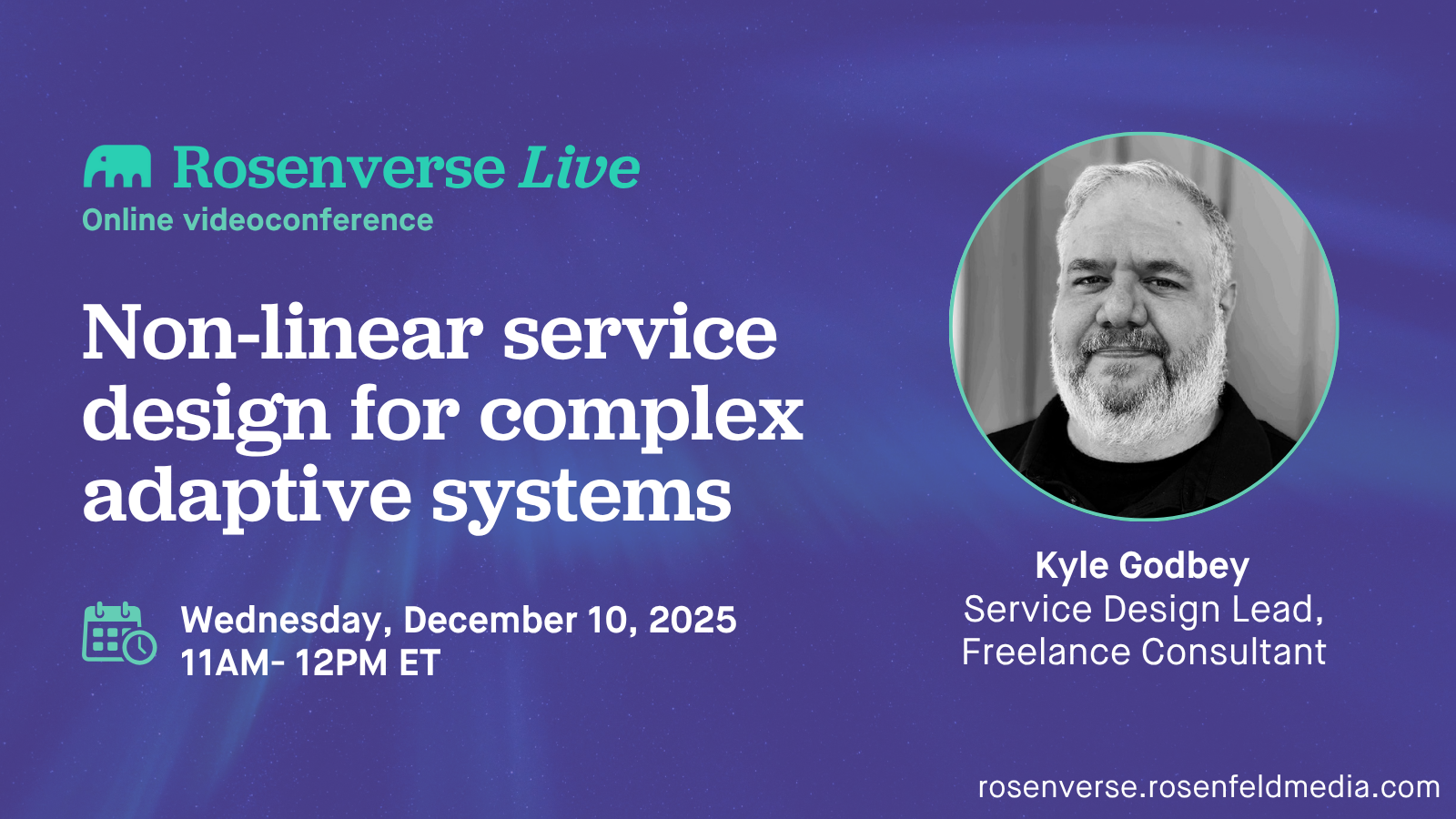
Non-linear service design for complex adaptive systems
This video is featured in the Systemic Design playlist and 1 more.

Summary
What is service design without chronology? And when do our tools force us to misrepresent and misdirect? In this session, Kyle Godbey uses the Cynefin framework to show how the methods we rely on work beautifully for known, constrained, and measurable spaces—like airport security—but can fail us in more fluid, unpredictable, self-organizing spaces—like an airport atrium. If humans are complex, then human-centered design needs to better reflect that complexity. Kyle will share a set of new tools designed to complement traditional service design methods—tools that help teams work in and make sense of complex, ambiguous contexts, and find opportunities for innovation right where uncertainty lives.
Key Insights
-
•
Human systems are inherently complex adaptive systems where messiness and unpredictability are features, not bugs.
-
•
Traditional service design tools that rely on linear, ordered sequences struggle to represent complex, unconstrained human interactions.
-
•
The Cynefin framework helps differentiate domains of order (clear, complicated) from disorder (complex, chaotic), guiding appropriate design methods.
-
•
Emergence means whole-system properties cannot be reduced to the properties of individual parts, making prediction impossible but creativity possible.
-
•
Participatory sense-making involves creating spaces where people collectively discover and reframe their roles and agency, enabling systemic change.
-
•
Service designers are shifting from deliverers of solutions to facilitators, spacemakers, and guides in complexity navigation.
-
•
No single tool or process fits all complexity challenges; success requires mixing, adapting, and iterating tools contextually.
-
•
Storytelling methods like warm data and participatory narrative inquiry reveal multiple perspectives and affordances not captured by traditional metrics.
-
•
Understanding energy and constraints in systems helps identify where to intervene, amplify, or monitor relationships effectively.
-
•
Cultural context matters; complexity approaches are more readily embraced in places like Australia and Europe versus the US, requiring tailored communication.
Notable Quotes
"Complex adaptive system is the domain of humans. Humans are messy and we’re complex."
"When we’re released from constraints and enter into the airport atrium, we become free range humans self-organizing unpredictably."
"The right answer is, it depends. And for the sake of our tools we’re forced to make edits not knowing what nuance we lose."
"Chaos is brief. Humans are bad at existing without constraints. We impose or imagine them because we like constraints like gravity."
"Emergence is properties of a whole system not expressed in properties of parts. Water is liquid but hydrogen and oxygen atoms are not."
"It’s not about solving or fixing complexity. We’re making sense of it so we can operate in it."
"Service design fundamentals carry over nicely: pragmatism, evidence, building assets, and iterative relationships."
"No one size fits all solution in complexity. We have to work in context and be resourceful and repurpose tools."
"The role of the service designer shifts from design savior to facilitator, spacemaker, and guide."
"Navigating complexity is like sailing in open ocean. A GPS won’t help if you don’t know how to read wind and water."
Or choose a question:
















More Videos

"Christian from Denmark helped us recognize but also clarify what we mean by civic design."
Charlotte LeeTheme 1 Intro
December 8, 2021

"Navigating uncertainty is part of our work; uncertainty actually becomes a catalyst we didn’t think we needed."
Dr. Jamika BurgeEmbracing change: Navigating shifting landscapes with compassion and agency
March 11, 2025

"AI itself has a very large carbon footprint, so we have to balance adoption with our environmental goals."
Louis Rosenfeld Billy Carlson Jon Fukuda Maria TaylorHow AI will Change DesignOps Tooling
October 3, 2023

"Technology helps efficiency but cannot replace human connection—eye contact and handshake remain essential."
Iram ShahClosing Keynote: The View from the Top
June 4, 2019

"If you put yourself between the C-suite and the product teams, you become a bottleneck with no time for actual leadership."
Christian Crumlish Wendy Johansson Rich Mironov Aditi Ruiz Adam ThomasAfternoon Insights Panel
December 6, 2022

"A designer working on a new component needs to understand not just that component but the templates using it and overall approach."
Jon Fukuda Ellie KryslDesign Planning and Management Support
October 3, 2023

"Design is always going to be subjective, so you have to figure out what quality looks like in your organization."
Peter MerholzCustomer-Centered Design Organizations
June 8, 2017

"Intersectionality is a lens to understand how dominant culture creates obstacles outside of conventional advocacy."
Spencer L. A. StultzWhy Social Justice Frameworks are Necessary for Successful DEI/JEDI Initiatives
October 4, 2023

"Being scrappy means being determined to get shit done without letting perfect get in the way of better."
Dianne QueReal Talk: Proving Value through a Scrappy Playbook
October 23, 2019