Log in or create a free Rosenverse account to watch this video.
Log in Create free account100s of community videos are available to free members. Conference talks are generally available to Gold members.
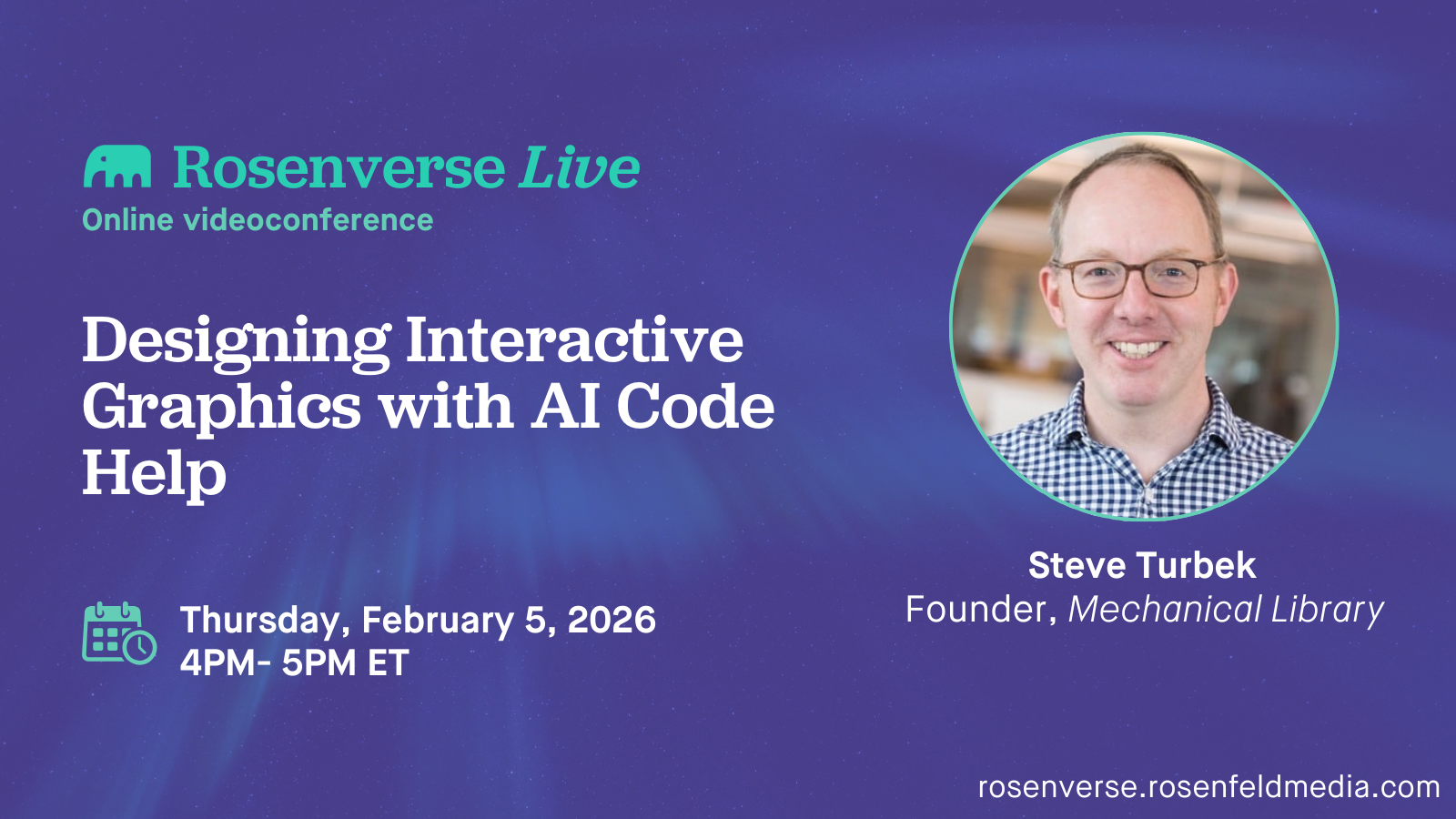
Designing Interactive Graphics with AI Code Help
This video is featured in the UX Watch Party playlist.

Summary
In this session, you’ll learn how to combine classic design software with a free AI workflow tool to add animation, interactivity, and live data to SVGs—aka Scalable Vector Graphics (crisp, code-based images that stay sharp at any size, perfect for the web, logos, and illustrations). No programming background required, just curiosity and a sense of play.
Key Insights
-
•
SVG is a powerful, text-based open standard that can encode interactive, animated graphics and is widely supported across browsers.
-
•
Design and programming historically overlapped more closely, as seen with Flash, but have since diverged, limiting designers' ability to directly build working products.
-
•
AI tools excel at language manipulation, making SVG ideal for AI-assisted design iteration through precise textual prompts.
-
•
Design is fundamentally about communication of intent rather than generating generic or statistically average outputs.
-
•
Designers should embrace coding mindset to fully specify product behaviors, which covers much of the programming logic in the process.
-
•
Layer and object naming in SVG files is critical to communicate clearly with AI and enable precise interactive modifications.
-
•
SVG files encapsulate data, styling, and interactivity in a single file, allowing designers to upload ready-to-use components that respond to live data.
-
•
AI's iterative, conversational feedback is valuable for debugging and refining designs based on explicit and evolving instructions.
-
•
The use of SVG sandboxes avoids CSS bleed, allowing safer and more modular dashboard or UI component assembly.
-
•
Open standards like SVG empower creativity and reduce dependence on proprietary platforms, enabling more direct designer innovation.
Notable Quotes
"The big distinction between design and programming is kind of being erased, and that’s an interesting opportunity for designers."
"AI design tools are great for sketching or inspiration, but designers are never asked to create statistically average designs."
"Design is the communication of intent—understanding exactly what you want and specifying it clearly is the hardest part."
"A mockup is worth a thousand prompts—visual context reduces ambiguity more than text alone."
"Naming your layers is really, really important; it helps the AI understand exactly what to manipulate."
"SVG is like bizarro HTML—you can style, animate, and make it interactive all within one language-based file."
"When developers saw the interactive color wheel I made in SVG, they were surprised but realized it reduced their workload."
"The success of this approach depends on being a good communicator and iterating constantly with the AI."
"It’s strange that despite all our technology, we’re still struggling to bring design and code closer together."
"Open standards rock. Proprietary monopolies keep you from making stuff and limit creativity."
Or choose a question:















More Videos

"No one wants to use a calendar; they want to be organized. Protect users from having to engage with complexity."
Dem Gerolemou Alexis Oh Neef RehmanClimate technology fundamentals
May 15, 2024

"I see design ops as deeply linked to how internal operations influence what our customers experience."
Bud Caddell Kristin Skinner Alana WashingtonDesignOps Community Sensing Session
May 13, 2021

"The Business Roundtable radically redefined the purpose of a corporation — it’s to promote an economy that serves all Americans, not just shareholders."
Robin BeersResearch as a Catalyst for Organizational Transformation
March 12, 2021

"The success of this approach depends on being a good communicator and iterating constantly with the AI."
Steve TurbekDesigning Interactive Graphics with AI Code Help
February 5, 2026

"Empathy is not sensitivity or an emotion—it is a skill that you have."
Indi YoungPaying Better Attention to the Problem with Indi Young
December 12, 2019

"Working in enterprise can feel like chaos with unclear directions and siloed information."
Nick CochranGrowing in Enterprise Design through Making Connections
June 3, 2019

"Using the inverted pyramid doesn’t mean dumbing down your findings, it means explaining complex issues clearly."
Bruce GillespieLearning from journalism: Balancing impactful communication with compassionate storytelling
March 13, 2025

"Empathy and trust develop through working together, not in isolation."
Christopher Taylor Edwards Valerie RoskeDesign as a Team Practice, A Practical Guide to Cross-functional Collaboration
September 30, 2021

"How do they grow and organize their teams to keep up? How do they scale their processes? How do they maximize efficiency and quality?"
Jemma AhmedTheme 2 Intro
January 8, 2024