Log in or create a free Rosenverse account to watch this video.
Log in Create free account100s of community videos are available to free members. Conference talks are generally available to Gold members.
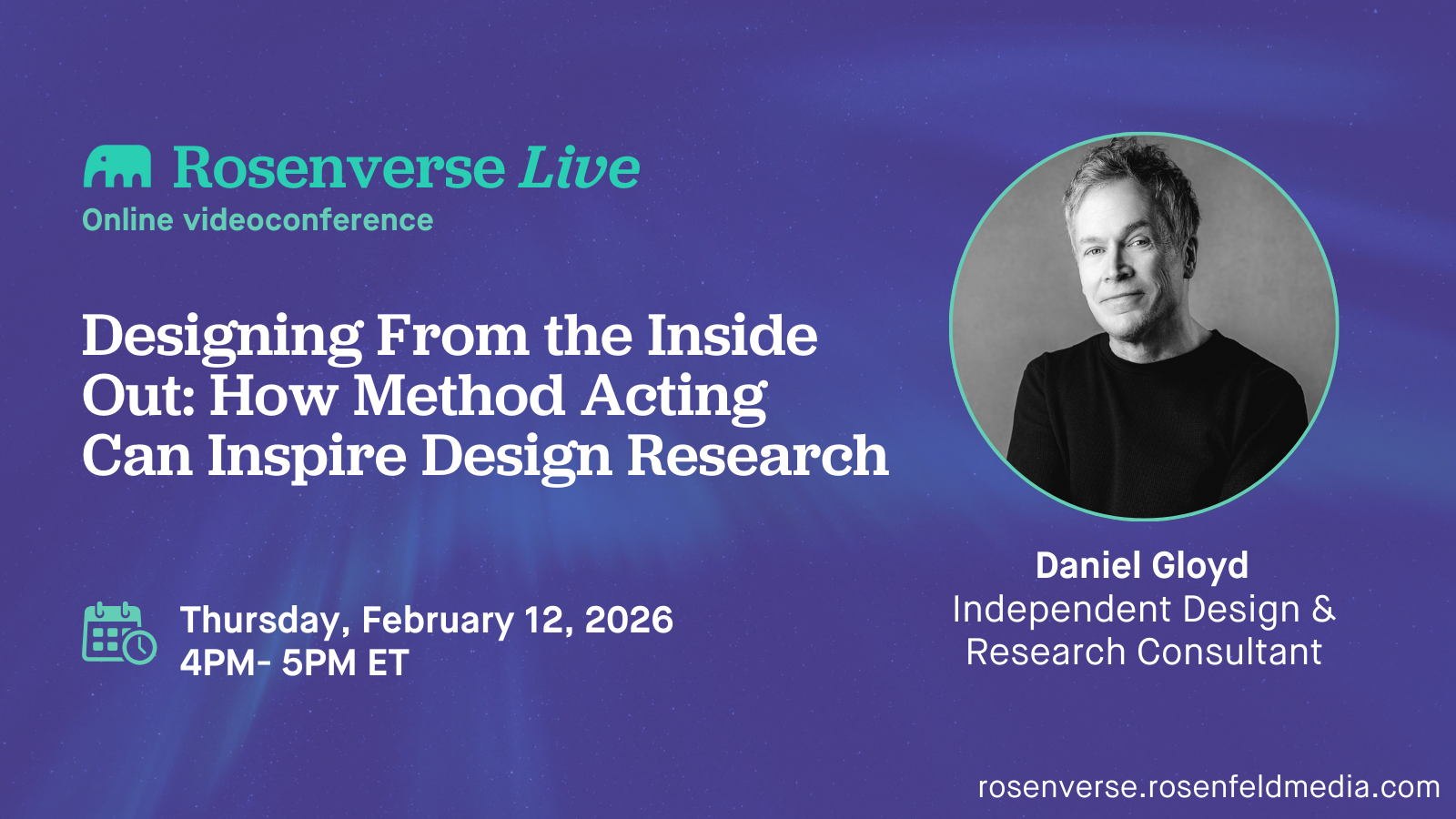
Designing From the Inside Out: How Method Acting Can Inspire Design Research
This video is featured in the UX Watch Party playlist.

Summary
Key Insights
-
•
Design research today often sacrifices emotional depth for efficiency and scalability, leading to a clinical and distant understanding of users.
-
•
Daniel Day-Lewis’s extreme immersion as an actor models a possible radical empathy approach that design researchers might learn from.
-
•
Stanislavski’s method urges researchers to fully inhabit the user’s reality, including their social, economic, and environmental constraints.
-
•
Patricia Moore’s experiential research on aging, involving prosthetics and mobility constraints, exemplifies living the user experience to inform design.
-
•
Lee Strasberg’s emotional memory technique encourages designers to relate personal emotional experiences to those of users to deepen empathy.
-
•
Stella Adler warns against over-reliance on personal trauma, instead advocating for understanding users within broader contextual and cultural frameworks.
-
•
Real presence and active listening in the moment, as taught by Sanford Meisner, are often lost in structured, hypothesis-driven interviews.
-
•
Hugh Dubberly critiques design as problem solving, instead emphasizing design as an ongoing conversation that values mystery and discovery.
-
•
Modern design research risk reducing empathy to cognitive exercises rather than lived emotional understanding.
-
•
Method acting principles challenge design researchers to embrace vulnerability, time, and immersion to achieve truly human-centered design.
Notable Quotes
"We all say empathy is foundational for good design, yet contemporary research often remains oddly distant from real human experience."
"Daniel Day-Lewis went so far as to suffer three broken ribs immersing in his role for My Left Foot."
"Jamie Foxx spent 14 hours with his eyes closed to inhabit Ray Charles’ world."
"Patricia Moore’s aging research revealed how product design often excludes elderly users by living their constraints."
"Strasberg believed you can’t honestly portray fear or grief without accessing analogous feelings from your own experience."
"No role exists in isolation, said Fred Rogers, emphasizing interconnectedness beyond the individual."
"Meisner taught actors to respond truthfully in the moment, prioritizing presence over preconceived ideas."
"Design research often acts like scientists with clipboards rather than humans in conversation."
"Hugh Dubberly argues we should stop describing design as problem solving and instead see it as engaged conversation."
"You can’t know a human honestly from the outside alone; you have to let their reality work on you."
Or choose a question:















More Videos

"Asking stupid questions can lead experts to reframe their thinking and improve the work."
Dem Gerolemou Alexis Oh Neef RehmanClimate technology fundamentals
May 15, 2024

"Having a 'dope' leader who champions design ops changes everything."
Bud Caddell Kristin Skinner Alana WashingtonDesignOps Community Sensing Session
May 13, 2021

"Research is inherently a silo-busting activity because customers experience the whole, not just parts divided by departments."
Robin BeersResearch as a Catalyst for Organizational Transformation
March 12, 2021

"The big distinction between design and programming is kind of being erased, and that’s an interesting opportunity for designers."
Steve TurbekDesigning Interactive Graphics with AI Code Help
February 5, 2026

"You have to build all the puzzle pieces with clear summaries before the patterns come together in mental models."
Indi YoungPaying Better Attention to the Problem with Indi Young
December 12, 2019

"John Kolko said design is a way of organizing complexity or finding clarity in chaos."
Nick CochranGrowing in Enterprise Design through Making Connections
June 3, 2019

"Communicating in an academic or marketing way builds suspense instead of building trust."
Bruce GillespieLearning from journalism: Balancing impactful communication with compassionate storytelling
March 13, 2025

"Pairing isn't about taking away jobs; it's about amplifying everyone's expertise and breaking down hierarchy."
Christopher Taylor Edwards Valerie RoskeDesign as a Team Practice, A Practical Guide to Cross-functional Collaboration
September 30, 2021

"VB Rosenstein scaled Zendesk’s global UX research practice while adding rigor and credibility to their work."
Jemma AhmedTheme 2 Intro
January 8, 2024