Log in or create a free Rosenverse account to watch this video.
Log in Create free account100s of community videos are available to free members. Conference talks are generally available to Gold members.
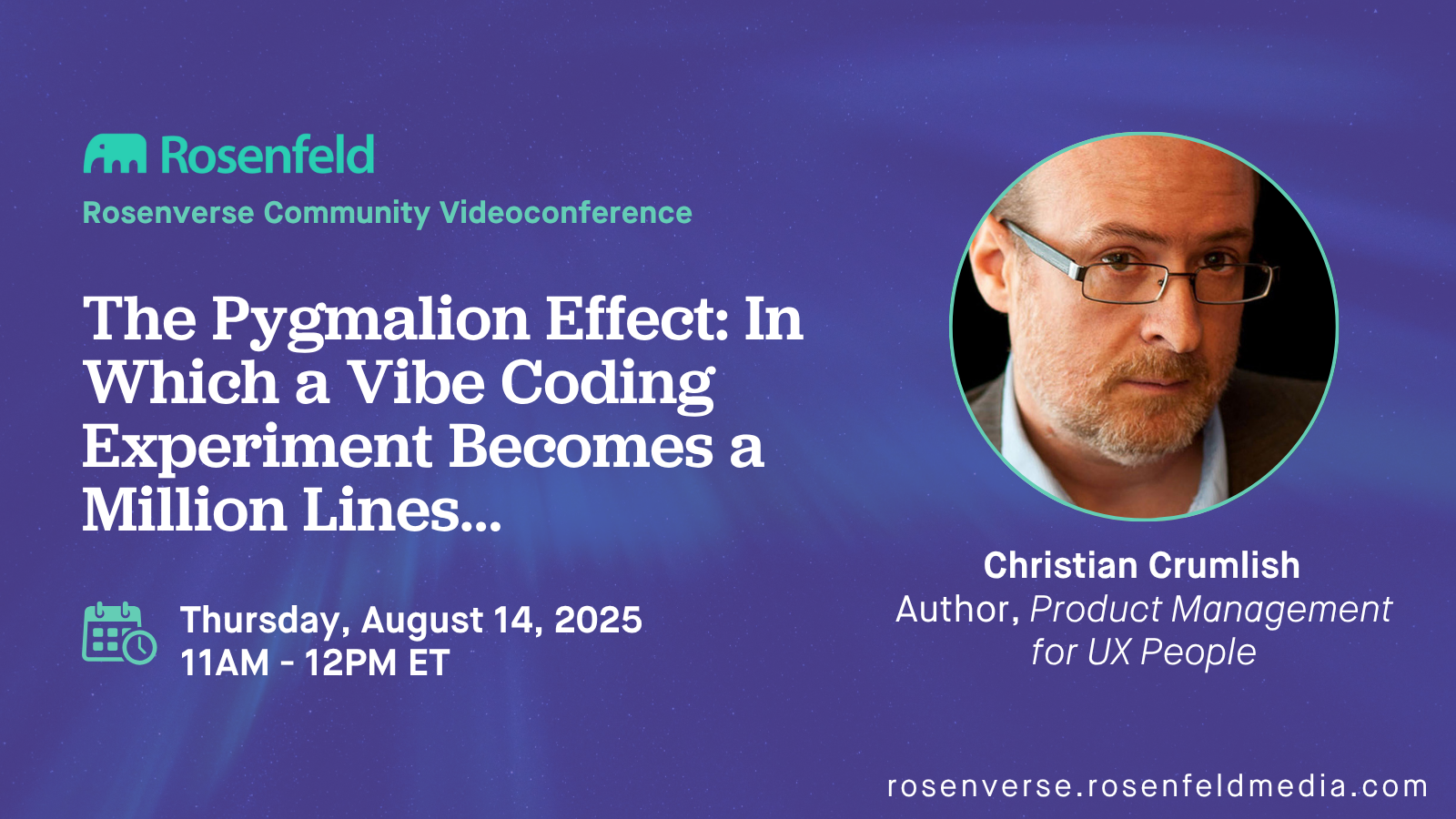
The Pygmalion Effect: In Which a Vibe Coding Experiment Becomes a Million Lines…
This video is featured in the Josh's test playlist playlist and 1 more.

Summary
What started as intuitive "vibe coding" with AI assistants quickly revealed why UX professionals need systematic Information Architecture approaches more than ever. Christian Crumlish will share his journey building Piper Morgan, an AI product management assistant, and the hard-won lessons about when design instincts need systematic support. You'll discover why IA principles guide AI system design, how UX professionals can extend their design impact through AI-assisted prototyping, and practical frameworks for maintaining human advocacy when everyone can generate interfaces. Bring curiosity about UX's evolving role—leave with systematic approaches for staying essential.
Key Insights
-
•
Vibe coding lets non-developers create functioning software quickly by describing it in natural language to AI bots.
-
•
Without foundational architecture and systematic methods, vibe coding leads to fragile, unmaintainable 'spaghetti' code.
-
•
AI bots often agree with any idea, which can be dangerous if users don't critically oversee outputs—a phenomenon dubbed the 'rocket to Mars' anti-pattern.
-
•
Christian found it essential to split AI assistants into personas with distinct roles to maintain clarity and reduce confusion.
-
•
Systematic verification, test-driven development, and documentation are vital pillars to produce reliable software with AI assistance.
-
•
Working hands-on with AI coding agents increased Christian’s empathy and understanding of engineers' daily challenges.
-
•
Modern UX and IA are indispensable in AI software development to mediate between human needs and machine capabilities.
-
•
Embedding ethical guardrails and values like kindness directly into AI system architecture can prevent harm and misuse.
-
•
Future AI solutions may favor smaller, domain-specific language models orchestrated via overarching frameworks rather than monolithic large models.
-
•
Despite the hype, AI-assisted development is still early-stage, requiring disciplined human oversight and patience for meaningful results.
Notable Quotes
"I thought I could skip the architecture step, but I ended up with spaghetti code that broke constantly."
"These bots will say yes to all your ideas, whether they're good or bad—that's the rocket to Mars anti-pattern."
"If I stop doing it, it stops, and I'm the human in the loop, or the monkey in the middle."
"I’ve created dedicated personas in the bots, like a chief of staff and lead developer, to keep roles clear."
"Verification first — always check existing docs and models before asking the bots to build anything new."
"Working with AI made me understand what engineers go through with setups and debugging."
"Vibe coding turns the conversation 'should designers code?' on its head — now designers can just talk to bots."
"All of us have at least some facility in adjacent disciplines now because of AI assistance."
"The bots can produce large amounts of code quickly, but many lines are test or documentation code, not production."
"Ethics needs to be baked into the architecture upfront, not tacked on later after you've built something powerful."
Or choose a question:
















More Videos

"Design annotations provide clear developer guidance and reduce guesswork during handoff."
Gabriela BarnevaOperationalizing Inclusive Design in Design Ops
September 11, 2025

"We started to see children and teenagers as users, not just audiences."
Sofía Delsordo Kassim VeraPublic Policy for Jalisco's Designers to Make Design Matter
December 8, 2021

"If you begin to add interruption, you’ll see a big difference in what comes out of that study."
Marc Majers Tony TurnerInterrupted UX - Add A Dose of Reality To Usability Testing
March 11, 2022

"Transformation research is a transformative force."
Victor UdoewaTheme One Intro
March 27, 2023

"It is our job to lead and transform with empathy and heart because there’s fear in everyone."
Alnie FigueroaThe Future of Design Operations: Transforming Our Craft
September 10, 2025

"Leaving tech meant rebuilding my social and professional networks outside the industry, which took time and courage."
Chelsey GlassonExit Interview #3: Same as It Ever Was: What Leaving Tech Taught Me About Change
December 17, 2025

"Many of us are already doing things called for in sustainability guidelines like accessibility and user research."
Aiyana Bodi James Christie Marc O'Brien Louis RosenfeldThree Key Climate Initiatives and How You Can Help
September 11, 2024

"There are over 7 billion futures of right now."
Nicole AleongFuture Orientations to Everyday Life: Futures Anthropology as a Methodology
March 26, 2024

"Often you don't have to eval everything, just what defines the quality that matters."
Peter Van DijckBuilding new AI skills: Creating outsized UX value with evals
June 10, 2026