Log in or create a free Rosenverse account to watch this video.
Log in Create free account100s of community videos are available to free members. Conference talks are generally available to Gold members.
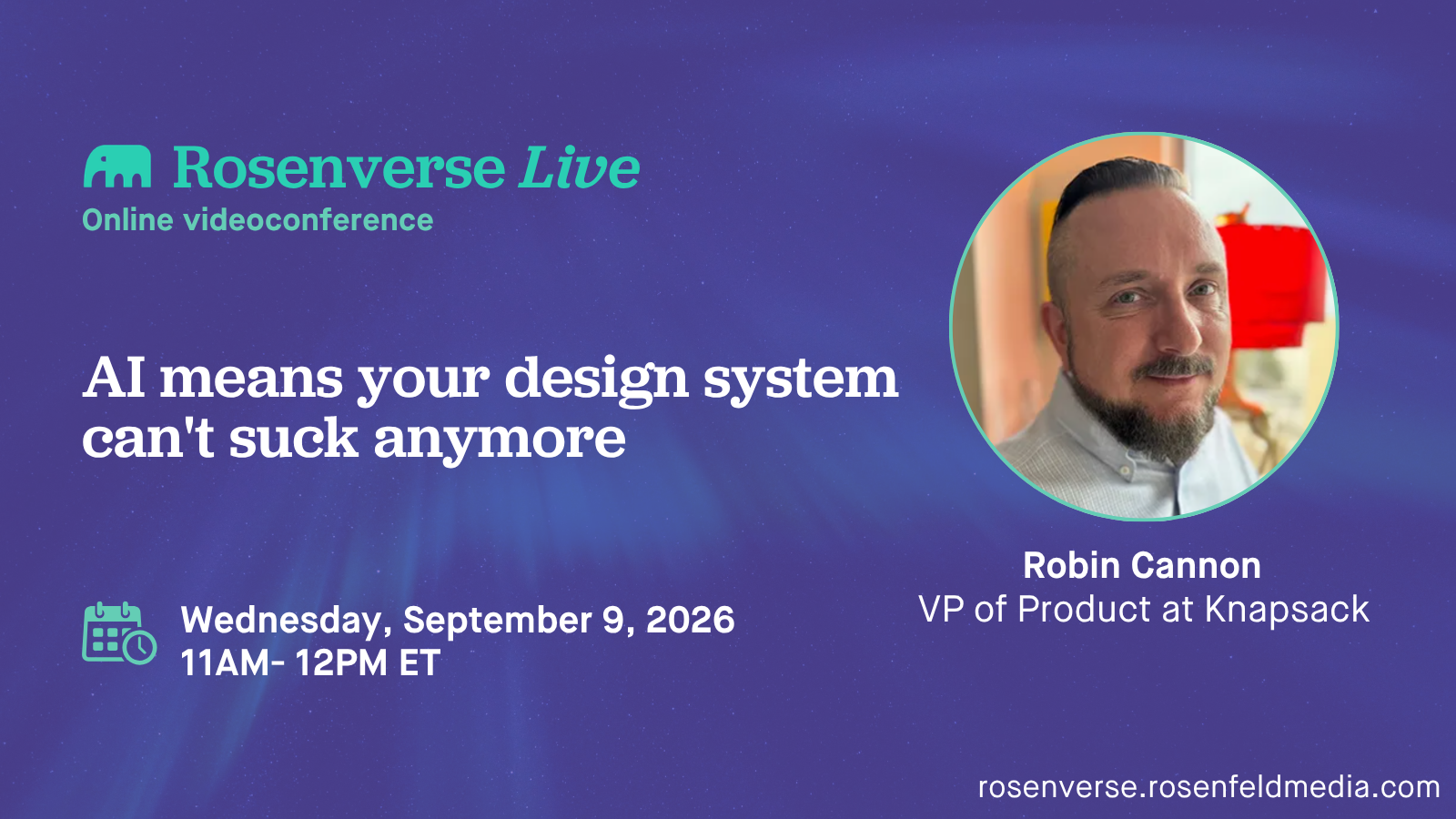
AI means your design system can't suck anymore
This video is featured in the UX Watch Party playlist.

Summary
You've probably been there. You need a component, but the choices available don't quite fit. And the documentation doesn't answer your question about how to work with it.
So you find someone to ask. A senior designer who's been around long enough to know. A Slack thread from 2024. An engineer who remembers why the pattern exists the way it does.
It somehow works out.
But that's not the design system functioning properly. That's you and your colleagues compensating for it.
And AI doesn't compensate. It'll take what's visible, follow a likely pattern. It makes something plausible. But plausible isn't the same as correct. Every gap that you and your team papered over with a conversation is now a hole for AI to fall straight through.
It means more than documenting what you already have more rigorously. The scope of what a design system needs to capture is expanding. It's always been more than components and patterns. It's the broader product context to give those artifacts meaning.
You and your colleagues have carried that all informally. AI needs it to be explicit.
This session is about what it means to build something AI can use without you and other helpful humans standing behind it.
Key Insights
-
•
AI highlights existing gaps in design systems rather than creating new ones.
-
•
Many design system decisions and nuances live only in informal channels or in people's memories.
-
•
Plausible but incorrect designs from AI can go unnoticed longer than broken code.
-
•
Good design system documentation includes reasoning and context, not just rules and artifacts.
-
•
AI consumers lack human nuance, speed does not equal progress in AI-generated UX.
-
•
The new challenge is making design systems comprehensive enough for AI to understand usage and intent.
-
•
Documenting when and why design decisions change helps both humans and AI navigate conflicts.
-
•
Design systems should specify 'usage' guidance, guiding what should be used, not just what is available.
-
•
AI tends to compound both good and bad design rapidly, increasing the cost of missing documentation.
-
•
AI-ready design systems mean improving human-understandable documentation that AI can also consume, not AI-native machine-first systems.
Notable Quotes
"AI tends to compound things that are good and compound things that are bad, much, much faster than people will."
"If a message in Slack from years ago is doing part of the job of the design system, then it’s part of the design system AI will often miss."
"A good design system documents why, not just what, providing reasoning so the next time you understand the purpose."
"Plausible but wrong design renders and works at a glance, so it can be much harder to detect than broken code."
"The biggest difference is availability is just I can use this, usage guidance is I exist to do this and this."
"Once you start changing components because you didn’t like them, and those changes live only in people’s heads, then the system starts to break down."
"AI removes gates for designers and engineers, but designers gain more because AI helps them ship and iterate faster."
"Design systems haven't changed fundamentally; it’s just that AI removes the capacity to gloss over gaps with human judgment."
"A design system is about how to be legible, how an organization wants to build the things it has decided to build."
"We want to document not just accessibility rules but how this applies to everyone, giving broader context and reasoning."
Or choose a question:













More Videos

"Designers must understand their domain deeply or risk being glorified production artists."
Uday Gajendar Lada Gorlenko Dave Malouf Louis Rosenfeld Dan Willis10 Years of Enterprise UX: Reflecting on the community and the practice
June 18, 2025

"Banks have 144 years of tech baggage making digital-first mindsets hard, and culture change is just as important as technology."
Julie Gitlin Esther RaiceDesign as an Agent of Digital Transformation at JPMC
June 9, 2021

"Confidence doesn’t dull criticality; self-doubt is a statement about your own worth, which we want to reduce."
Megan KiersteadYou Are a Badass at UX: Overcoming Imposter Syndrome
March 10, 2021

"A typical enterprise customer has like five analysts who need a login, not millions of users."
Dan WillisEnterprise Storytelling Sessions
May 13, 2015

"Empathy walls emerged at DTA because teams needed a visceral way to bring stories back from the field."
Leisa ReicheltOpening Keynote: Operating in Context
November 7, 2018

"No design system will ever be fully accessible because new features and permutations are always being introduced."
Alexis LucioScaling Accessibility Through Design Systems
June 9, 2022

"We set a goal to fill 25% of our early career roles with underrepresented demographics and landed 37%."
Jen Crim Jess Quittner Saritha Kattekola Alex Karr Gurbani PahwaCulture, DIBS & Recruiting
June 11, 2021
"Strategy always before tactics. You cannot succeed without a clear strategic framework."
How to Identify and Increase your "Experience Quotient"
June 15, 2018

"Stop just throwing AI at the end of the process; integrate it strategically across the whole product and content lifecycle."
Noz UrbinaRapid AI-powered UX (RAUX): A framework for empowering human designers
May 1, 2025