All the Ops: Successful cross-functional collaboration





Summary
Key Insights
-
•
Aligning operational priorities with business goals requires common frameworks and integration across product development cycles.
-
•
Close partnerships between design ops and product ops can lead to measurable improvements in resource allocation and business impact.
-
•
Content ops often suffers from being an afterthought, resulting in last-minute breakdowns unless operationalized early with clear responsibilities.
-
•
Tooling is a consistent friction point, especially for creating shared insights repositories across operations functions.
-
•
Different operational teams have distinct incentives and goals, creating alignment challenges that need to be managed through shared OKRs and incentives.
-
•
Omni ops suggests creating horizontal standards for tooling, processes, and metrics while maintaining 20% flexibility for domain-specific needs.
-
•
Building cross-functional trust through showing impact and collaborative advocacy is more effective than siloed or didactic approaches.
-
•
Operations teams should focus on demonstrating the value of their work visibly to raise awareness and adoption within the organization.
-
•
Operational boundaries often break down around unclear ownership, asynchronous handoffs, and lack of early cross-discipline involvement.
-
•
The future of design and product operations lies in integrating AI and automation while preserving craft and adaptable processes.
Notable Quotes
"Research teams often don’t know how to plug their insights beyond the immediate study to influence ongoing product decisions."
"The closer we worked with product ops, the better we enabled our own design and business goals."
"If you don’t operationalize content early, you end up with last minute crunches breaking the design."
"Often tooling is a vacuum particularly around insights repositories—everyone wants it or no one wants it."
"Different ops functions have different incentives; aligning those incentives could make leaps and bounds in collaboration."
"Omni ops might be 80% standardized processes and 20% function-specific to keep necessary flexibility."
"We should advocate together, not just for ourselves; if you want to go far, go together."
"Showing where you’re using research more visibly creates a virtuous cycle of adoption and impact."
"The COO isn’t paying attention to ops silos—COOs focus on longer term strategic enablement beyond today’s operational teams."
"There’s no future without craft—craft is the foundation for all the operational work that follows."
Or choose a question:
















More Videos

"Ratios always start on the premise of spreading people too thin, which is not a great way to get success."
Leisa ReicheltOpening Keynote: Operating in Context
November 7, 2018

"We kept feeling the same consistent pain around some truths for our design system."
Charles Lee Jennie YipBuilding a New Home for the Atlassian Design System
October 22, 2020

"Alignment isn’t a one-time event. You build it, and then you maintain it."
Claire DhooscheCoordinating chaos: Preventing workflow fragmentation when everyone accelerates with AI
June 9, 2026

"We’re not curing brain cancer here; sometimes perfect just has to be good enough."
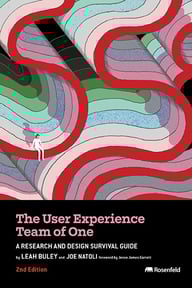
Leah Buley Joe NatoliAsk Me Anything with Leah Buley and Joe Natoli, co-authors of The User Experience Team of One (2nd edition)
October 8, 2024

"We had to reduce optional virtual social meetings after burnout hit, which showed the importance of balance."
Maggie DieringerCutting through the Noise
September 24, 2020

"Notes are a way to enhance our thinking, serving different purposes from memory aids to generative creative work."
Jorge ArangoThe Best of Both Worlds: How to Integrate Paper and Digital Notes (1st of 3 seminars)
April 5, 2024

"Intersectionality is a lens to understand how dominant culture creates obstacles outside of conventional advocacy."
Spencer L. A. StultzWhy Social Justice Frameworks are Necessary for Successful DEI/JEDI Initiatives
October 4, 2023

"Low fidelity design lets you try things quickly and learn so much before you get too detailed."
Billy CarlsonPrinciples of Team Wireframing
October 2, 2023

"Content design is nascent and often misunderstood, but embedding content designers improves product clarity and usability."
Craig Brookes Andreas Huebner Morgan Quinn"Just Make it Look Good" and Other Ways We're Misunderstood
June 11, 2021