Log in or create a free Rosenverse account to watch this video.
Log in Create free account100s of community videos are available to free members. Conference talks are generally available to Gold members.
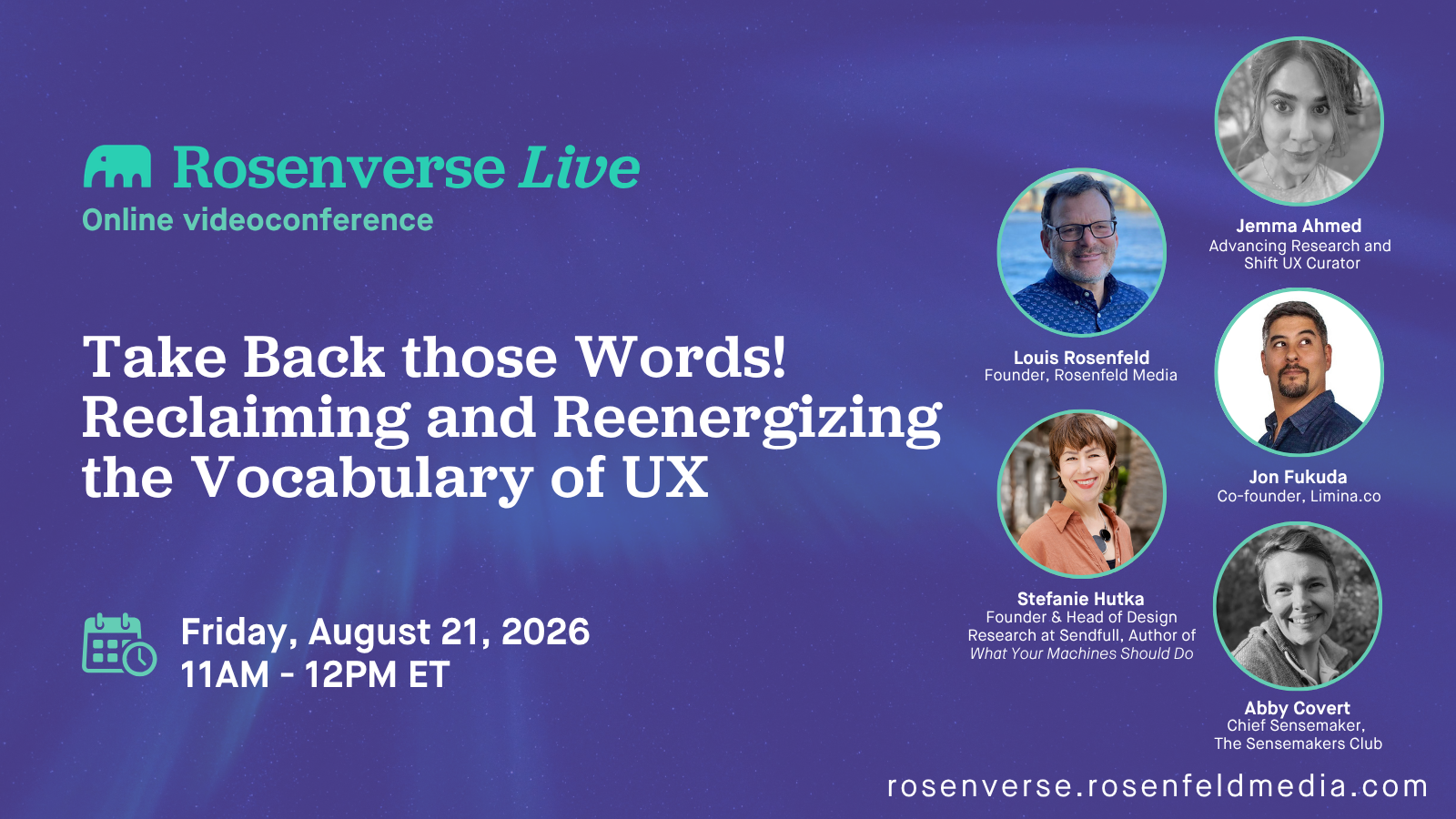
Take Back those Words! Reclaiming and Reenergizing the Vocabulary of UX
This video is featured in the UX Watch Party playlist.

Jemma Ahmed
Advancing Research and Shift UX Curator

Jon Fukuda
Co-founder, Limina.co

Abby Covert
Abby Covert, Chief Sensemaker, The Sensemakers Club

Stefanie Hutka
Founder & Head of Design Research at Sendfull, Author of What Your Machines Should Do

Louis Rosenfeld
Founder, Publisher, & CEO, Rosenfeld Media
Summary
In UX, we often take for granted the words we use to describe our roles, tools, methods, and our work in general. And therein lies a trap: while we initially define our vocabulary, eventually our vocabulary defines--and hamstrings--us. Terms like “agile,” “delight,” “user,” “innovation,” "research" and more recently, “AI,” have become so abstract, ambiguous, and misinterpreted that they’re actually harmful to productive conversations. So let’s take aim at the words that constrain us, and take back our vocabulary! Join the Shift UX curation team (Stef Hutka, Jon Fukuda, Jem Ahmed, Abby Covert, and Lou Rosenfeld); we’ll be searching for UX terms to deconstruct and maybe even ban! Be sure to bring your own semantic suspects to this spicy soiree.
Key Insights
-
•
Common UX terms like 'portal,' 'persona,' and 'journey maps' have become overloaded and often hinder clear understanding rather than help.
-
•
Banning problematic words in discussions uncovers underlying needs, goals, and assumptions that such jargon obscures.
-
•
The term 'AI' especially carries significant baggage and hype, masking both its historical context as automation and its real technological limitations.
-
•
Human-in-the-loop remains crucial in working with automation technologies to maintain critical thinking and avoid abdication of responsibility.
-
•
Reframing 'AI' as a chapter in a longer automation story helps situate it and reduces sensationalism.
-
•
Language shapes how harms and unintended consequences of technology are perceived or minimized, for example with terms like 'machine learning' and 'AI'.
-
•
There is a growing split and tension between UX and product design roles, with some companies rebranding UX into product design, sometimes causing lost knowledge and redundant reinvention.
-
•
The user research field faces both opportunities and challenges in the evolving industry, including skill gaps related to integration with UI and data analytics.
-
•
Emerging interview practices like 'vibe coding' reveal shifts in how entry-level design and product roles are assessed, blending coding with intuition or quick tool use.
-
•
Regularly revisiting and questioning language in UX practice is valuable to re-align meaning and foster clearer, more productive collaboration and outcomes.
Notable Quotes
"What the hell is a portal? That sounds like a solution without knowing the problem."
"If anyone uses the word portal, you have to throw a dollar on the table."
"Empathy is one of those catchall terms that ends up making it very hard to create action because you don’t know what anyone actually needs."
"Journey maps often mask organization and operations problems rather than real customer needs."
"I like to reframe AI as a point in time of automation, part of a much longer history we’ve been on."
"There’s some really valuable ways to integrate this technology, but also dangerous ones that require human judgment as a discipline."
"People believe that AI is a gift from the universe, when it’s really just a bunch of zeros and ones."
"Vibe coding is coding when you cannot code — it’s coding on vibes."
"Product design has edged in as a culminating term, similar to how UX design specialized years ago."
"Let’s talk about a term without using it to re-level set what it really means and what it might be masking."
Or choose a question:















More Videos

"Having a recruitment coordinator who knows all the agencies and best practices is a game changer — a recruitment guru."
Saskia LiebenbergStart Small for Big Impact
May 15, 2019

"Having a repo isn’t the same as having a strategy for socializing and evangelizing the research."
Brigette Metzler Dana ChrisfieldResearch Repositories: A global project by the ResearchOps Community
August 27, 2020

"Resiliency is not really a professional thing. It's actually a lot more personal."
Jennifer KanyamibwaCreating the Blueprint: Growing and Building Design Teams
November 8, 2018

"If participants want us to delete a video, we’re going to delete their video, even if legally we don’t have to."
Theresa MarwahHow Atlassian is Operationalizing Respect in Research
February 27, 2020

"Product managers are trying to keep up with deadlines but often launch hard-to-use features hoping to make them better later."
Aditi Ruiz Christian Crumlish Farid SabitovPulse Check: Empathy Mapping Your Product Manager, Pt. 2
December 6, 2022

"Making career architectures explicit empowers employees to drive their own growth independent of managerial changes."
Peter MerholzThe Mysterious Case of the Missing UX Career Path
August 25, 2022

"Design has to incorporate intellectual humanism—remembering we’re designing for people, with people."
Uday GajendarThe Rise of Meta-Design: A Starter Playbook
May 19, 2022

"Steve Jobs said design is the fundamental soul of a man-made creation, expressing itself beyond just surface veneer."
Hugh DubberlyProblems with Problems: Reconsidering the Frame of Designing as Problem-Solving
June 19, 2019

"We get these 75-page PRDs created by enthusiastic people, not PMs, and they’re unreadable. We call that fake holder input."
Paul FordNew work, new words: A glossary for AI
June 9, 2026